
If you've ever explored options trading or how derivatives are priced, you may have come across a term that sounds more complicated than it actually is: put-call parity. Despite the technical-sounding name, put-call parity is simply a mathematical relationship that connects the prices of put options, call options, and the underlying stock. Understanding it can help you spot mispriced options, build better trading strategies, and develop a deeper sense of how options markets actually work.
In this blog, we'll break down what put-call parity is, walk through the put-call parity formula, and explain why it matters.
What Is Put-Call Parity?
Put-call parity is a principle in options pricing that defines a fixed relationship between the price of a European call option and a European put option, when both options have the same underlying asset, the same strike price, and the same expiration date.
In simple terms, put-call parity states that holding a call option and a risk-free bond (worth the present value of the strike price) should give you the same payoff as holding a put option and the underlying stock. If this relationship doesn't hold true in the market, an arbitrage opportunity exists, meaning traders could theoretically make a risk-free profit until prices adjust back into balance.
This concept was first formally described by economist Hans Stoll in 1969, and it remains one of the foundational principles taught in derivatives and share market investment courses today.
The Put-Call Parity Formula
The standard put-call parity formula is written as: C + PV(K) = P + S
Where:
- C = Price of the call option
- P = Price of the put option
- S = Current price of the underlying stock
- PV(K) = Present value of the strike price (K), discounted at the risk-free rate until expiration
This formula can also be rearranged to highlight the relationship more directly: C − P = S − PV(K)
This version shows that the difference between the call and put price should equal the difference between the stock's current price and the discounted strike price.
A Simple Example
Suppose a stock is trading at ₹1,000. A call option and a put option on this stock, both with a strike price of ₹1,000 and a 3-month expiry date, are available.
If we assume a standard risk-free interest rate, the present value of that ₹1,000 strike price at expiry might work out to roughly ₹985 today. According to the put-call parity formula: C − P = 1,000 − 985 = 15
This means the call option (C) should be priced exactly ₹15 higher than the put option (P). For instance, if the put premium is ₹30, the call premium should be ₹45. If the actual market prices deviate significantly from this ₹15 gap, it signals that the options are temporarily mispriced.
Why Does Put-Call Parity Matter?
Understanding put-call parity isn't just an academic exercise; it has several practical applications for anyone interested in stock market or share market investment:
- Identifying arbitrage opportunities: When the formula doesn't hold, it can signal a mispricing that sophisticated traders may try to exploit through arbitrage strategies.
- Synthetic positions: Traders use put-call parity to create "synthetic" positions. For instance, a synthetic long stock position can be built using a long call and a short put with the same strike and expiry.
- Sanity-checking option prices: It offers a quick way to check whether option prices quoted in the market are reasonably aligned with each other.
Building a foundation for options pricing models: Concepts like the Black-Scholes model are built on assumptions that align closely with put-call parity logic.
Assumptions Behind Put-Call Parity
It's important to note that the classic put-call parity formula relies on a few assumptions:
- The options are European-style (exercised only at expiration), since American-style options (which can be exercised anytime) can deviate from strict parity due to early exercise possibilities.
- No dividends are paid on the underlying stock during the option's life (the formula can be adjusted if dividends are involved).
- There are no transaction costs, taxes, or restrictions on borrowing/lending at the risk-free rate.
- Markets are efficient, with no arbitrage opportunities persisting for long.
In real-world share market conditions, these assumptions don't always hold perfectly, which is why prices may show small, temporary deviations from textbook parity.
Put-Call Parity vs. Real Market Behavior
While the formula provides a theoretical benchmark, real markets often see short-lived discrepancies due to liquidity constraints, dividend payments, interest rate changes, or differences between European and American-style options. These gaps are usually small and tend to close quickly as traders act on arbitrage opportunities. For everyday investors, the key takeaway is not to chase tiny pricing gaps, but to understand the underlying logic so you can make more informed decisions when evaluating options strategies.
How This Fits Into Your Broader Investment Journey?
If you're relatively new to investment in the share market, options and their pricing models might feel intimidating at first. That's completely normal. Concepts like put-call parity are best understood as building blocks, once you grasp how puts, calls, and stocks are mathematically connected, other option strategies (like covered calls, protective puts, or straddles) become much easier to understand.
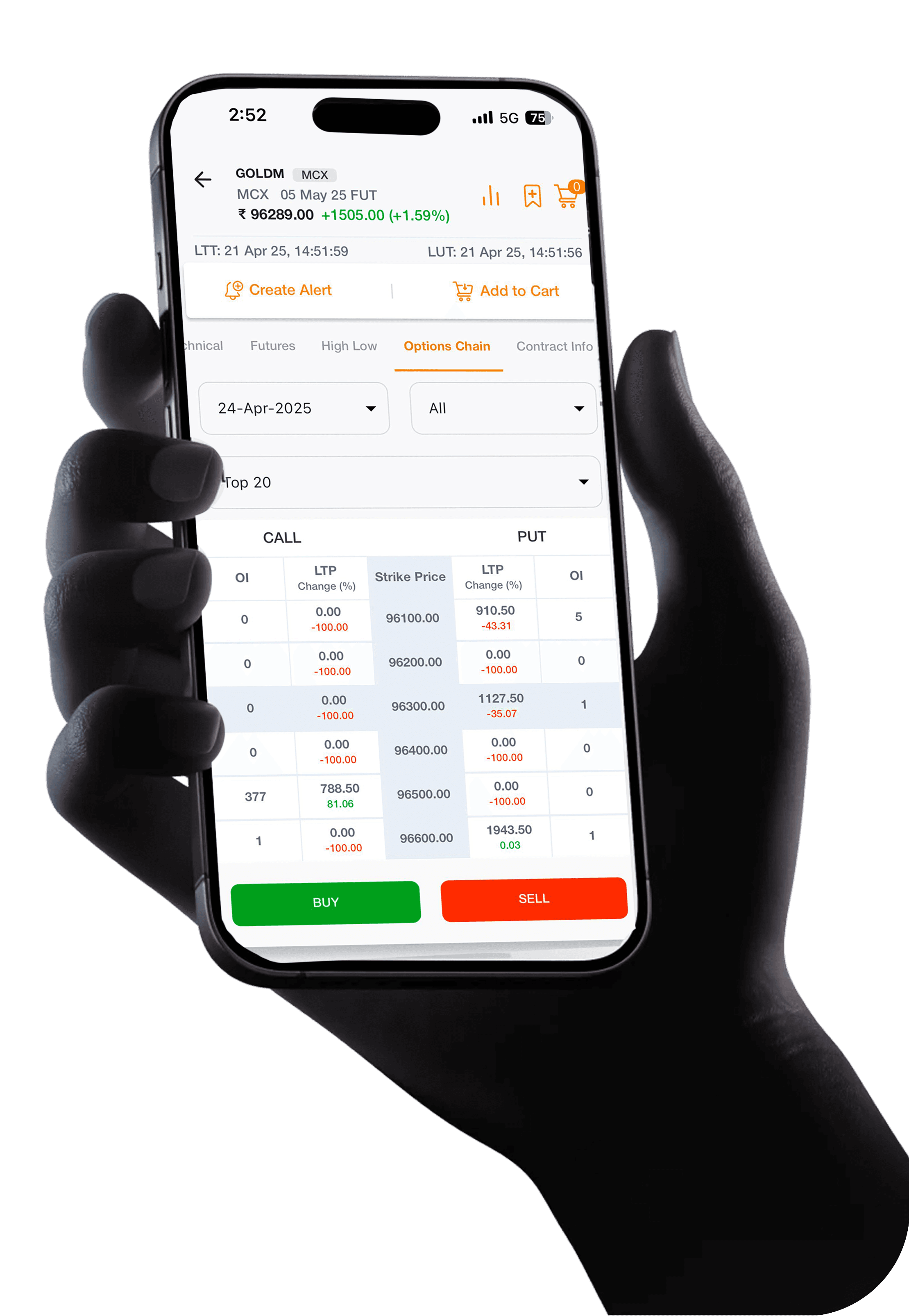
Many investors today use a share market app to track live option chains, compare put and call premiums, and monitor how prices move relative to each other. While these apps are useful for visibility and analysis, it's worth remembering that options trading carries significant risk and is not suitable for everyone. It's advisable to thoroughly understand the mechanics, assess your own risk appetite, and, where needed, consult a registered financial or investment advisor before trading in derivatives.
Conclusion
Put-call parity is a foundational concept that ties together the pricing of call options, put options, and the underlying stock through a simple, elegant formula. While the math might look intimidating at first glance, the core idea is straightforward: if the relationship between these instruments gets out of balance, the market tends to correct it. For anyone serious about understanding stock market mechanics or building a long-term strategy around share market investment, taking the time to understand put-call parity can offer real clarity into how options are valued and traded.
As with any derivatives concept, it's important to keep learning, use reliable tools and platforms to track real-time data, and approach options trading with a well-researched strategy rather than speculation.