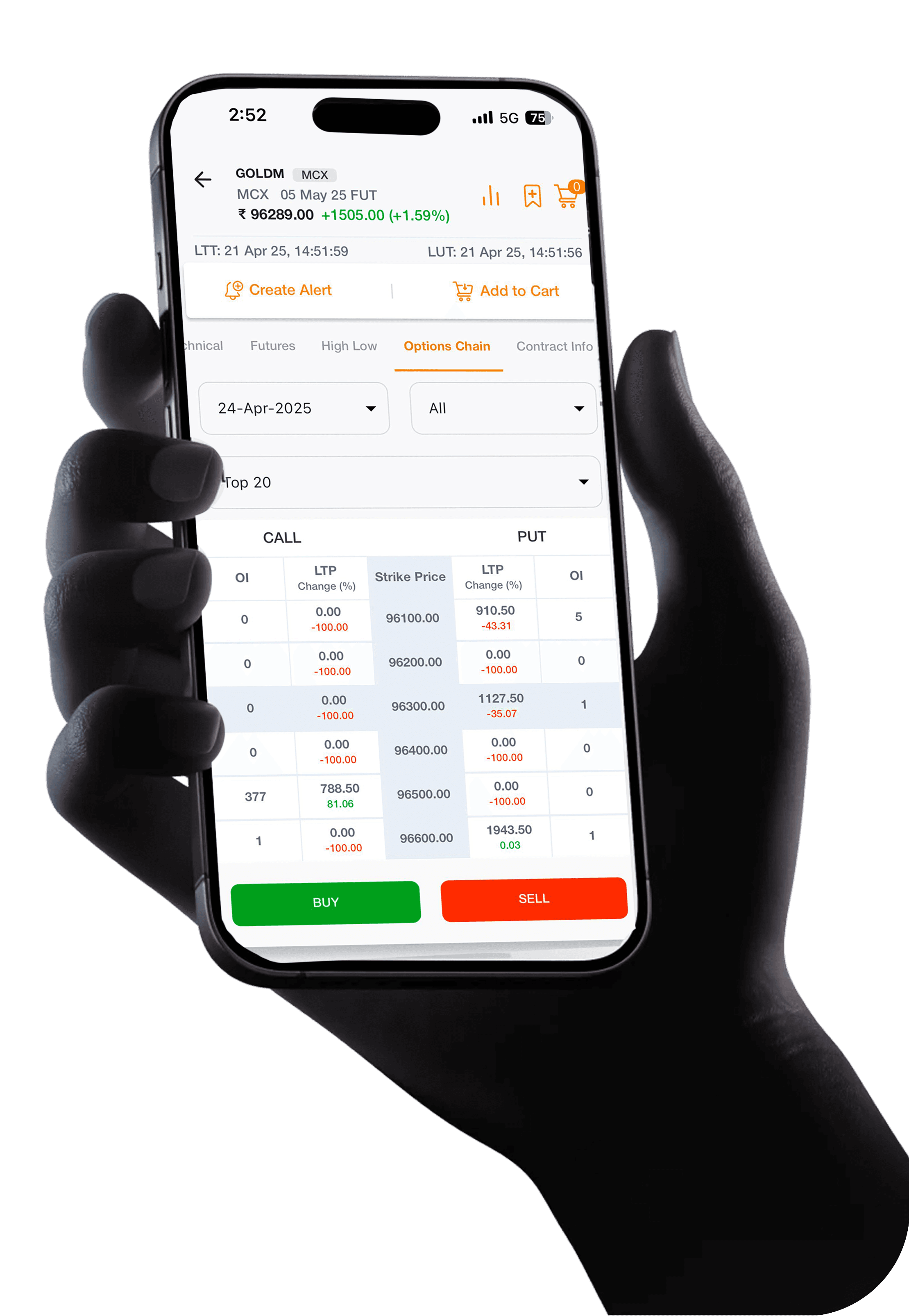

If you have ever looked at a futures or options contract on your trading terminal, you may have noticed two different figures attached to the same position, one significantly larger than the other. This is not an error. It reflects two distinct financial concepts: notional value and market value.
For anyone involved in stock market investment, particularly those trading in derivatives, understanding this distinction is not optional - it is essential. Confusing the two can lead to a misjudged sense of risk, incorrect position sizing, or an inaccurate picture of exposure.
This blog breaks down what notional value and market value mean, how each is calculated, where they diverge, and why the difference matters for anyone building a disciplined approach to investment in the share market.
What Is Notional Value?
Notional value is the reference value of the underlying asset represented by a financial contract. In exchange-traded derivatives, it is generally calculated by multiplying the current underlying price by the contract quantity or lot size. It measures the scale of exposure represented by the position; it does not necessarily equal the amount paid to enter the trade or the maximum amount that can be lost.
The concept is especially important in derivatives such as futures and options. A futures trader generally deposits margin, while a long option buyer pays a premium. These amounts may be substantially lower than the value of the underlying exposure represented by the contract. An option writer, however, generally has to provide margin and faces a different risk profile from an option buyer.
In simple terms, notional value tells you the scale of exposure a contract carries, not the cost of holding it.
How Is Notional Value Calculated?
The general formula for notional value is:
Notional Value = Contract Size (Lot Size) × Price of the Underlying Asset
For a futures or options contract, the contract quantity is generally represented by the lot size. The applicable lot size and contract specifications may change over time and should be checked on the relevant exchange website.
For options, this formula represents the notional value of the underlying exposure. It is not the same as the total option premium paid.
Example of Notional Value
Suppose a stock is trading at ₹1,000 and the futures contract has a quantity of 500 shares.
Notional Value = ₹1,000 × 500 = ₹5,00,000
If the applicable margin were ₹90,000, the trader would deposit ₹90,000 as margin to initiate or maintain the position. This figure is only an illustration. Actual margin varies according to the underlying, volatility, expiry, portfolio offsets, exchange requirements, and broker policies.
The ₹5,00,000 represents the underlying exposure, while ₹90,000 represents the illustrative margin requirement. The trader does not automatically gain or lose ₹5,00,000. The profit or loss depends on the price change multiplied by the contract quantity.
What Is Market Price and Market Value?
Market price is the current quoted price at which a security or derivative may be bought or sold. Market value is the current worth of an entire asset holding or trading position, usually calculated by multiplying the current market price by the quantity held.
For shares, market value is generally calculated as:
Market Value = Current Share Price x Number of Shares
For an option, the position’s market value is generally:
Option Position Value = Current Option Premium x Contract Quantity
For futures, the current futures price is quoted per unit, while the position’s gains or losses are calculated based on the change in the futures price multiplied by the contract quantity.
How Is Market Value Determined?
Market value is determined continuously through the process of price discovery on stock exchanges. Buy and sell orders are matched on the exchange, and the resulting trade price becomes the market price at that moment. The market value of an investor’s holding or position is then calculated using that price and the quantity held.
Several factors influence this price, including:
- Company earnings and financial performance
- Broader economic indicators and interest rates
- Sector-specific developments and news flow
- Overall market liquidity and investor demand
For an unchanged derivative position, notional value generally changes with the underlying price. It can also change if the number of contracts, contract quantity, or contract specifications change. Market value may respond to additional factors, particularly in options.
Notional Value vs Market Value: Key Differences
| Basis | Notional Value | Market Value |
| Meaning | Reference value of the underlying exposure represented by a contract | Current worth of an asset or position |
| Basic calculation | Underlying price × contract quantity | Current price of the asset or contract × quantity |
| Cash Outlay | May be supported by margin or premium, depending on the instrument | Represents the current worth of the holding or position; it is not necessarily the amount initially paid |
| Where It Applies | Particularly important in derivatives and leveraged positions | Relevant for shares, bonds, mutual funds and derivative positions |
| Options | Underlying price × lot size | Option premium × lot size |
| Purpose | Measures exposure and scale of a position | Measures the current worth of the holding or position |
| Key drivers | Underlying price, quantity, and contract specifications | Current price, supply and demand, and instrument-specific factors |
| Relationship | May be much higher than the premium or margin | May be lower, higher, or different depending on the asset and position |
Notional Value vs Market Value in Derivatives
This distinction is most relevant in the derivatives segment, where leverage plays a central role. When a trader enters a derivatives position, the amount paid or deposited may be substantially lower than the notional value of the underlying exposure. A futures trader generally deposits margin, while a long option buyer pays a premium. An option writer generally deposits margin and may face significant obligations.
This creates leverage because the trader’s exposure can be larger than the capital deposited or premium paid. For futures, P&L is generally calculated using the change in the futures price multiplied by the contract quantity. For options, P&L depends on the change in the option premium, the premium paid or received, the contract quantity and, where applicable, the option’s intrinsic value at expiry. As a result, the gain or loss may be large relative to the margin or premium committed.
Suppose a stock futures contract represents 500 shares and the futures price rises from ₹1,000 to ₹1,050:
Profit = (₹1,050 - ₹1,000) x 500 = ₹25,000
The trader’s gross profit is ₹25,000, not ₹5,00,000. If the trader had deposited ₹90,000 as illustrative margin, this ₹25,000 gain would represent a substantial return relative to the margin deposited. The actual net result would depend on applicable brokerage, taxes, exchange charges, and other costs.
What Is the Difference Between Notional Value and Contract Value?
The terms “notional value” and “contract value” may be used differently across products and platforms, so they should not automatically be treated as synonyms.
In a futures contract, “contract value” may refer to the futures price multiplied by the contract quantity, which is broadly similar to the notional value.
In an option, however, the option premium multiplied by the contract quantity represents the option position value, while the underlying price multiplied by the contract quantity represents the underlying notional value.
In OTC instruments such as swaps, notional value may be used as a reference amount for calculating payments without the principal amount changing hands.
Notional Value vs Market Value vs Market Price
These three terms should be kept separate:
- Market price: The current quoted price of one unit of a security or derivative.
- Market value: The current worth of the entire holding or position.
- Notional value: The value of the underlying exposure represented by a derivative contract.
For example, if a stock is priced at ₹1,000 and a derivative contract represents 500 shares:
Market price of the stock: ₹1,000 per share.
Underlying notional value: ₹1,000 × 500 = ₹5,00,000.
If an option premium is ₹40, the option position value is ₹40 × 500 = ₹20,000.
The market price is therefore an input used to calculate market value or notional value, but the three terms do not mean the same thing.\
Why Does Notional Value Matter?
Notional value matters because it shows the scale of underlying exposure represented by a position. It can help investors assess leverage, estimate the effect of price movements, and compare derivative positions across a portfolio. However, notional value alone does not determine the maximum loss or overall risk.
Two traders might commit the same margin amount, but if their lot sizes or underlying prices differ, their actual exposure, and therefore their potential profit or loss, can vary significantly. Notional value is also used by:
- Risk managers and exchanges to set margin requirements
- Institutional investors to assess portfolio-level derivative exposure
- Regulators to monitor systemic risk in the derivatives market
Risk also depends on the derivative type, whether the position is long or short, the volatility and liquidity of the underlying, the time to expiry, the use of hedges, and the availability of adequate funds to meet margin or settlement obligations.
Why Does Market Value Matter?
Market value provides an estimate of what an asset holding or trading position is currently worth based on prevailing market prices. For listed securities, the actual execution price may differ from the displayed price because of bid-ask spreads, liquidity, order size, and market movement. It is the figure investors use to:
- Track portfolio performance
- Make buy, sell, or hold decisions
- Assess the current value of holdings for financial planning, taxation, or reporting purposes
For someone engaged in direct investment in the share market, market value is generally the more relevant and frequently referenced figure, since most equity investments do not involve the leverage that makes notional value so significant in derivatives.
How Do Notional Value and Market Value Change?
For an unchanged derivative position, notional value generally changes when the underlying price changes:
Notional Value = Underlying Price x Contract Quantity
It can also change when the number of contracts, quantity, or contract specifications change.
Market value can change because of movements in the asset or derivative price. For options, market value may also be affected by time decay, implied volatility, interest rates, dividends, and demand-supply conditions.
In futures, profit or loss is generally based on the change in the futures price multiplied by the contract quantity, with applicable mark-to-market settlement.
When Should You Look at Notional Value and When Should You Look at Market Value?
Look at notional value when:
- Assessing the underlying exposure of a futures or options position.
- Measuring leverage and position size.
- Estimating how a price movement may affect the position.
- Reviewing portfolio-level derivative exposure.
- Checking whether available funds are adequate for potential margin or settlement requirements.
Look at market value when:
- Reviewing the current worth of shares or other holdings.
- Tracking portfolio value and performance.
- Estimating the current value of an option position.
- Reviewing financial statements, taxation records, or net worth.
For direct equity investors, market value is usually the primary figure. For derivatives traders, both market value and notional value may be necessary because they answer different questions.
Neither figure alone is a complete measure of risk. Investors should also review margin requirements, potential losses, liquidity, expiry, volatility, and the terms of the specific contract.
Conclusion
Notional value and market value answer different questions. Notional value indicates the scale of underlying exposure represented by a derivative, while market value indicates the current worth of an asset or position. Understanding the difference can help investors interpret trading statements, assess leverage, calculate potential P&L, and avoid confusing margin or premium with total exposure.