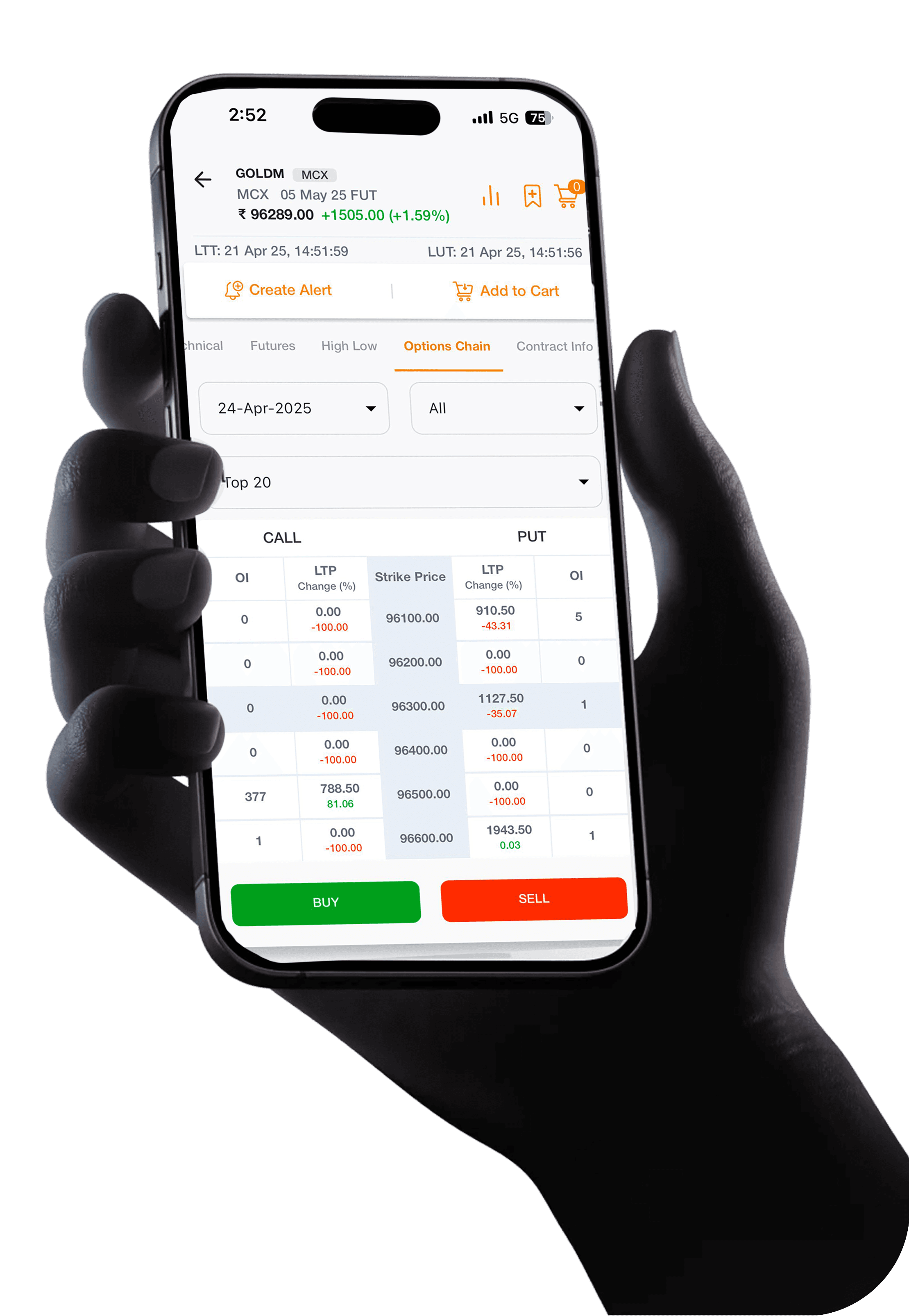

If you trade in futures or options, you may come across figures on your trading platform, position statement, or contract note that appear much larger than the amount you paid or deposited to enter the trade.
One of those figures may represent the notional value of your position. Understanding what notional value represents - and what it does not - is an important but often overlooked aspect of derivatives trading.
Many investors confuse notional value with the amount they have invested, or assume it reflects the maximum they stand to lose. Neither is accurate.
This blog explains what notional value means, how it is calculated, how it applies to futures and options, and why it matters for anyone building a disciplined approach to stock market investment.
What Is Notional Value?
Notional value is the reference value of the underlying asset represented by a derivative contract. It is a way of expressing the total exposure a position carries, rather than the amount of cash paid or deposited to hold that position.
In exchange-traded derivatives such as futures and options, notional value is generally calculated by multiplying the relevant underlying or contract price by the contract quantity, often referred to as the lot size. It tells you the scale of the position you are controlling, not the cost of controlling it.
This distinction matters because derivatives allow an investor to gain exposure to an asset without paying its full value upfront. A futures trader typically deposits margin, and an option buyer pays a premium, both of which are usually a fraction of the notional value.
This is what can create leverage, because the exposure represented by the contract may be greater than the capital deposited or premium paid. Notional value shows the scale of the underlying exposure, but leverage is better assessed by comparing that exposure with the margin, premium, or capital committed.
What Does Notional Value Tell You?
Notional value answers one specific question: how large is the underlying exposure of this position? By itself, notional value does not tell you:
- How much cash you paid or deposited.
- The maximum amount you can lose.
- The current market value of the derivative position.
- The actual leverage ratio of the trade.
Think of it as a measure of scale rather than a measure of cost or risk. Two positions with the same notional value can carry very different risk profiles depending on the underlying asset's volatility, the strategy used, and whether the position is long or short.
How Is Notional Value Calculated?
The standard formula is:
Notional Value = Contract Size (Lot Size) × Price of the Underlying Asset
For an option position, this formula generally gives the notional value of the underlying exposure. It is not the same as the option premium paid or the total market value of the option position. The applicable lot size for any contract is set by the exchange and can change from time to time, so it is worth confirming the current specifications on the exchange website before trading.
Notional Value in Futures
In a futures contract, notional value is generally calculated using the current futures price and the contract quantity:
Futures Notional Value = Current Futures Price × Contract Quantity
For some analyses, the current spot price may instead be used to estimate the underlying exposure. The appropriate convention depends on the reporting purpose, platform, and contract terms.
For example, if a stock futures contract has a lot size of 500 shares and the futures price is ₹1,000, the notional value works out to ₹5,00,000. This is the scale of exposure the contract represents, not the amount the trader deposits to hold the position.
The trader is typically required to provide and maintain margin. The applicable requirement is risk-based and may vary with the underlying asset, volatility, expiry, exchange or clearing-corporation rules, portfolio offsets and broker policies. It may not be a fixed percentage of notional value.
Gross profit or loss on a futures position is generally calculated as the change in the futures price multiplied by the contract quantity, with the direction of the position taken into account. A price increase generally benefits a long position but hurts a short position. The resulting amount is settled through the applicable mark-to-market process, subject to the relevant settlement rules and charges. It is not calculated by simply applying a percentage to the full notional value.
Notional Value in Options
For options, the calculation separates two related but distinct figures:
Underlying notional value = Underlying Price × Contract Quantity
Option position value = Current Option Premium × Contract Quantity
For instance, if a stock is priced at ₹1,000 with a lot size of 500, the underlying notional value is ₹5,00,000. If the option premium for that contract is ₹40, the option position value is ₹20,000 (₹40 × 500).
For a standalone long option position, the buyer’s maximum loss is generally limited to the premium paid, excluding applicable charges, provided no other leg or transaction changes the overall strategy.\
An option writer typically has to provide margin and may face a substantially larger loss, depending on the option and strategy. The risk of a combined strategy, such as a spread or hedge, must be assessed for the entire position rather than for one leg in isolation.
This is why the notional value of the underlying and the actual amount at stake in an options trade can differ significantly.
Notional Value vs Market Value
Notional value and market value are related concepts but are not the same thing. Notional value reflects the underlying exposure represented by a derivative contract, while market value reflects the current worth of an asset or position based on prevailing prices.
For a detailed comparison of notional value, market value, and market price, read our guide on Notional Value vs Market Value.
Notional Value vs Investment Amount vs Margin
These three terms are often used loosely, but they mean different things:
Term | What It Represents |
Notional value | The scale of underlying exposure represented by the contract |
Investment amount | The amount paid or committed to acquire or hold a position; it may include the purchase price, margin, premium, collateral, or other required funds depending on the instrument |
Margin | Funds or collateral required to enter, maintain, or support a leveraged derivatives position, generally a fraction of the notional value |
For illustration, a trader entering a futures position with a notional value of ₹5,00,000 might be required to deposit ₹90,000 as margin. Actual margin requirements vary by contract and may change over time.
The ₹90,000 is the illustrative margin deposited at that point, while ₹5,00,000 is the illustrative notional value based on the assumed futures price and contract quantity. The trader may need to provide additional funds if losses, margin requirements, or settlement obligations increase.
Confusing the two can lead to a misjudged sense of how much capital is actually at work, or how much risk a position genuinely carries.
Why Is Notional Value Important?
Notional value matters because it allows investors, risk managers, and regulators to gauge the true scale of exposure in a derivatives position, independent of how much capital was used to enter it. It is used for:
- Assessing leverage - Comparing the exposure created against the capital committed.
- Estimating price sensitivity - Understanding how a given move in the underlying could affect the position, subject to the instrument’s contract terms and payoff structure.
- Portfolio-level risk assessment - Institutional investors and risk managers use aggregated notional value to understand a portfolio's overall derivative exposure.
- Margin setting - Exchanges and clearing corporations determine margin requirements using risk-based methodologies that may consider exposure, volatility, liquidity, price movements, portfolio offsets, and other factors.
- Systemic risk monitoring - Regulators track notional value across the market to assess concentration and systemic exposure.
That said, notional value on its own is not a complete measure of risk. Two positions with identical notional value can carry very different risk depending on volatility, liquidity, time to expiry, hedging, and whether the position is long or short.
How Does Notional Value Change?
For an existing, unchanged derivative position, notional value generally moves with the relevant underlying or contract price:
Notional Value = Relevant Underlying or Contract Price × Contract Quantity
It can also change if the number of contracts held changes, or if the exchange revises contract specifications such as lot size. Because notional value is directly tied to the underlying price, it can fluctuate meaningfully over the life of a contract even if no new trades are made.
Is Notional Value the Same for Every Financial Product?
No. While the underlying concept, a reference value used to represent exposure, stays consistent, its application differs by instrument:
- Futures: Notional value is generally calculated as the futures price multiplied by the contract quantity. Depending on the exchange or platform, this may be referred to as contract value.
- Options: Notional value refers to the underlying exposure (underlying price × lot size), which is distinct from the option position value (premium × lot size).
- OTC instruments such as many interest-rate swaps: The notional amount is generally used as a reference for calculating periodic payments, and the principal amount is generally not exchanged in a plain-vanilla interest-rate swap, although the cash-flow structure depends on the specific contract.
- Direct equity holdings: For shares purchased outright, market value is usually the more relevant figure. The term “notional value” is not generally used to describe the value of an unleveraged shareholding in the same way it is used for derivatives.
Because terminology can vary across products and platforms, it is worth checking the specific definition used by your exchange or broker rather than assuming it applies uniformly.
A Simple Notional Value Calculation
Suppose a stock is trading at ₹1,000 and you hold a futures contract with a lot size of 500 shares.
Notional Value = ₹1,000 × 500 = ₹5,00,000
If you entered the futures position at ₹1,000 and the futures price later rises to ₹1,050, the gross price-movement profit is:
Gross Profit = (₹1,050 − ₹1,000) × 500 = ₹25,000
This assumes a long position, the same contract quantity, and no interim settlement adjustment. The net result will depend on applicable charges, taxes, brokerage, and the relevant mark-to-market settlement.
Note that the gross gain is ₹25,000, calculated from the ₹50 price movement multiplied by 500 shares. It is not calculated by simply applying a percentage to the full ₹5,00,000 notional value. If the illustrative margin deposited to hold this position was ₹90,000, the ₹25,000 gross gain would represent a substantial return relative to the margin deposited. This illustrates how leverage can magnify returns on the capital committed. The same leverage can magnify losses.
Common Misconceptions About Notional Value
"Notional value is the amount of money I will lose if the trade goes wrong."
Not necessarily. Notional value measures the underlying exposure. The actual gain or loss depends on the price movement, contract quantity, position direction, and the specific derivative strategy used. A loss equal to the entire notional value is not automatic.
"Notional value and market value are always similar."
Not necessarily. In a futures position, notional value can be far larger than the margin deposited. In an options position, the underlying notional value can differ significantly from the option premium multiplied by the lot size.
"A higher notional value always means higher risk."
Not on its own. A higher notional value generally indicates greater underlying exposure, but total risk also depends on volatility, liquidity, leverage, strategy, hedging, and the investor's ability to meet margin or settlement obligations.
"Notional value applies only to institutional investors."
It applies to retail investors too. Anyone trading futures, options, currency derivatives, or commodity derivatives should understand the notional exposure represented by each contract before placing a trade, regardless of the size of their portfolio.
Conclusion
Notional value is a measure of scale, not cost. It tells you how large the underlying exposure of a derivatives position is, while the actual capital committed, margin or premium, is usually a fraction of that figure. Understanding this distinction can help investors read contract notes more accurately, gauge leverage sensibly, and avoid mistaking notional exposure for the amount paid, deposited, or the maximum possible loss. As with any aspect of derivatives trading, notional value should be considered alongside margin requirements, volatility, liquidity and the specific terms of the contract, not in isolation.