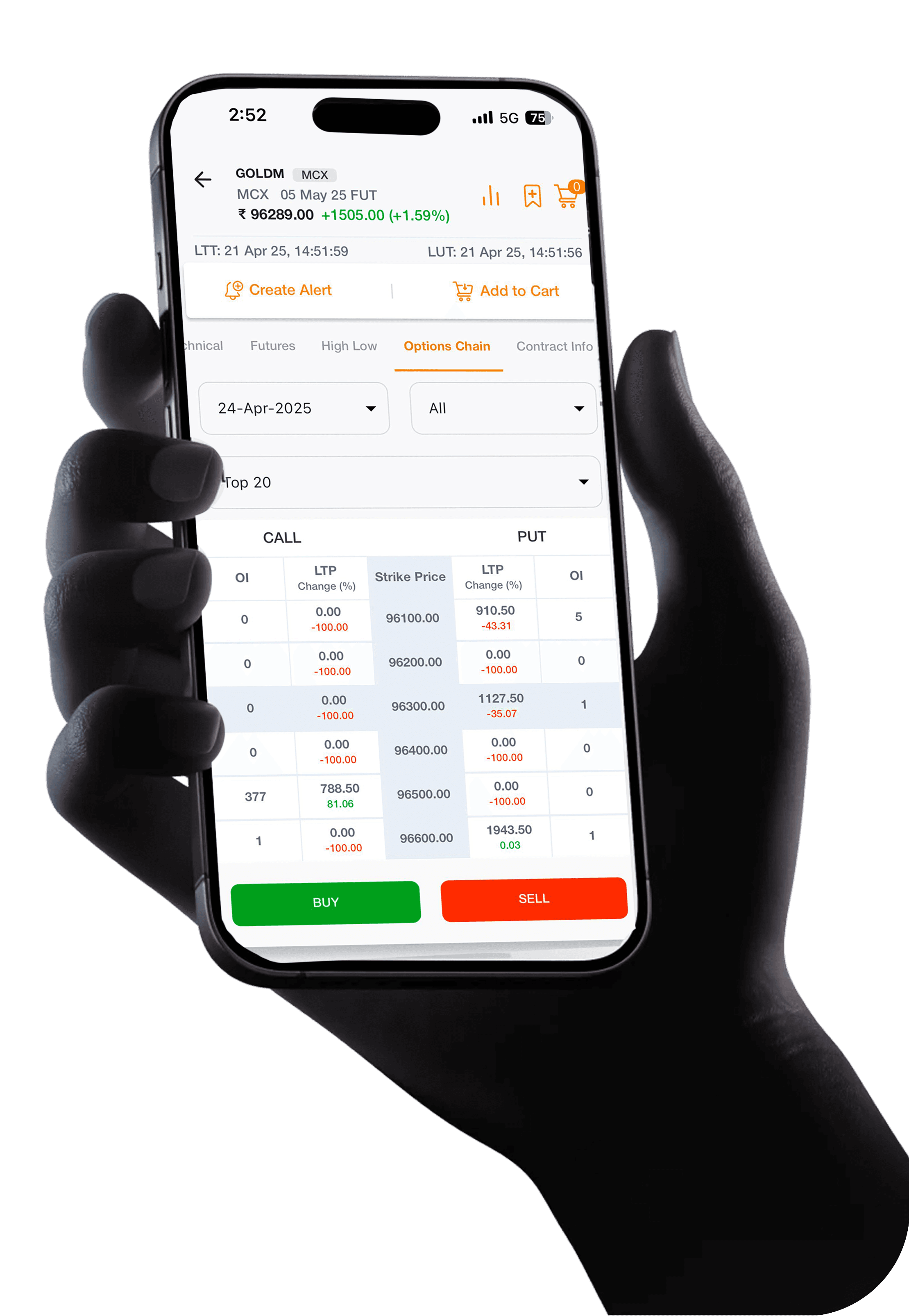

Most investors think about making money when stock prices go up. But experienced traders know that the stock market moves in all directions, and there are strategies designed to profit even when prices fall or stay flat.
The bear call spread is one such strategy. It is a defined-risk options strategy that allows traders to collect a premium upfront while capping both their potential profit and potential loss. Whether you are new to options or have been exploring share market investment for a while, understanding this strategy can meaningfully expand your trading toolkit.
This blog breaks down exactly how the bear call spread works, when to use it, how to calculate your outcomes, and what risks to watch out for.
Key Terms to Know
Before we proceed, certain key terms to understand:
- Call Option: A contract that provides the buyer the right (but not the obligation) to buy a stock at a specific price before a set date.
- Strike Price: Refers to the price or cost at which an options contract can be exercised.
- Premium: The price paid or received for an options contract.
- Expiry Date: The date on which the options contract ceases to exist.
- Implied Volatility (IV): The market's expectation of how much a stock will move. Higher IV generally means higher premiums.
- Theta: The rate at which an option's value decreases as time passes. Also called time decay.
- Credit Spread: An options strategy where the net result is a cash inflow (credit) at the time of entry.
- In the Money (ITM): A call option where the stock price is above the strike price.
- Out of the Money (OTM): A call option where the stock price is below the strike price.
What Is a Bear Call Spread?
A bear call spread, also called a credit call spread, is an options strategy where a trader simultaneously:
- Sells a call option at a lower strike price (closer to the current market price)
- Buys a call option at a higher strike price (further from the current market price)
Both options have the same expiry date and are on the same underlying asset (a stock, index, ETF, etc.).
Because the call you sell is closer to the market price, it carries a higher premium than the one you buy. The difference between the two premiums is the net credit you receive upfront, and that is your maximum profit if things go your way.
The word "bear" reflects the market outlook: this strategy profits when the underlying stock or index stays flat or declines. The word "spread" refers to the fact that you are simultaneously holding two option positions.
How Does a Bear Call Spread Work? A Step-by-Step Example
Let us say you are watching a stock currently trading at ₹500. You believe the stock will not rise above ₹520 over the next month.
Here is how you might set up a bear call spread:
| Action | Strike Price | Premium |
| Sell 1 Call Option | ₹510 | ₹15 (received) |
| Buy 1 Call Option | ₹530 | ₹5 (paid) |
| Net Credit Received | ₹10 |
Each options contract typically represents 100 shares (lot sizes vary in Indian markets; always check the specific contract). For simplicity, let us work with per-unit numbers here.
What happens at expiry?
- If the stock stays below ₹510, both options expire worthless. You keep the full ₹10 premium.
- If the stock rises to ₹520, the sold call is in the money. Your profit starts to shrink.
- If the stock rises above ₹530, you hit your maximum loss of ₹10 (the spread width of ₹20 minus the ₹10 premium received).
Maximum Profit, Maximum Loss, and Breakeven
These three numbers are the most important things to calculate before entering any bear call spread position.
Maximum Profit = Net premium received = Premium collected on sold call − Premium paid on bought call
In our example: ₹15 − ₹5 = ₹10
Maximum Loss = Width of the spread − Net premium received = (Higher strike − Lower strike) − Net premium received
In our example: (₹530 − ₹510) − ₹10 = ₹10
Breakeven Point = Lower strike price + Net premium received
In our example: ₹510 + ₹10 = ₹520
Above ₹520, the position starts losing money. Below ₹520, the position is profitable. At exactly ₹520, you break even.
When Should You Use a Bear Call Spread?
The bear call spread strategy applies best in specific market conditions. Here are the scenarios where traders typically consider it:
1. Mildly Bearish Outlook: You do not need to be aggressively bearish. Even if you expect the stock to move sideways or just slightly lower, this strategy can work in your favour.
2. High Implied Volatility: When implied volatility (IV) is high, option premiums are inflated. Selling options in a high-IV environment means you collect more premium, which improves the risk-reward of the trade.
3. Range-Bound Markets: If you believe a stock is unlikely to break above a certain resistance level, a bear call spread lets you monetize that view.
4. Near Resistance Zones: Many traders set up bear call spreads just above a strong technical resistance zone, the idea being that the stock is unlikely to breach that level before expiry.
Bear Call Spread vs. Other Strategies
As an investor, it helps to understand how a bear call spread compares to related strategies:
| Strategy | Market View | Risk | Reward |
| Bear Call Spread | Mildly bearish/neutral | Capped | Capped (premium) |
| Naked Call Sell | Bearish | Unlimited | Limited (premium) |
| Bear Put Spread | Bearish | Capped | Capped |
| Buying Put Options | Strongly bearish | Limited (premium paid) | High |
The key advantage of the bear call spread over selling a naked (uncovered) call is defined risk. When you sell a naked call, your loss is theoretically unlimited if the stock surges. The bear call spread eliminates that by purchasing the higher-strike call as a hedge; your loss is capped no matter how high the stock goes.
Advantages of the Bear Call Spread
- Defined and limited risk: You always know your worst-case loss before entering the trade. This makes position sizing and risk management far more manageable.
- Upfront premium income: You collect a credit at the start of the trade. If the stock stays below your sold strike, you keep it all without having to wait.
- Lower margin requirement: Compared to a naked short call, a credit call spread typically requires significantly lower margin because the risk is capped.
- Works in flat markets too: You do not need the stock to fall. Simply staying where it is or even moving slightly up but staying below your sold strike is enough to profit.
- Time decay works for you: As days pass and expiry approaches, the time value of options erodes. Since you are a net seller of options in this strategy, time decay (theta) generally benefits you.
- Zero early assignment risk in India: Because all stock and index options traded on the NSE and BSE are European-style, they cannot be exercised before the expiry date. This means you never have to worry about a sudden, unexpected early assignment mid-week.
Risks and Limitations to Keep in Mind
No strategy in the stock market is without risk. Here are the downsides of the bear call spread:
- Capped profit potential: Your maximum gain is always limited to the net premium collected. If the stock falls sharply, you do not benefit beyond the initial credit received.
- Loss if the stock rallies sharply: If the stock breaks above your sold strike and continues rising, your losses grow, up to the maximum loss cap.
- Commission and slippage costs: Since you are dealing with two legs, transaction costs can eat into a small premium collected. This matters more in smaller positions.
- Getting the timing wrong: Even if your longer-term view is correct, a sharp short-term spike in the stock before expiry can cause the trade to move against you.
How to Exit a Bear Call Spread?
You have a few choices when managing an open bear call spread:
- Let it expire worthless: When the stock closes below the sold strike price at expiry, neither option is exercised, allowing the trader to keep the full premium collected. This represents the most favourable outcome for the position.
“Important Note on Physical Settlement: While index options (like Nifty and Bank Nifty) are cash-settled, individual stock options in India are subject to physical delivery if they expire In-The-Money (ITM). If the stock finishes between your two strike prices at expiry, you could be required to physically deliver the underlying shares. To avoid massive margin requirements and delivery hassles, it is best practice to manually close your stock option spreads before the final expiry hour if the stock is trading close to your strikes.”
- Close the position early: If the stock has already fallen and both options have lost significant value, you can buy back the spread for a small debit and lock in most of your profit before expiry. This also eliminates any residual risk.
- Roll the position: If the trade is moving against you but you still hold your view, you might roll the spread, closing the current position and opening a new one with a later expiry and/or different strikes. This is an advanced technique and comes with its own risks.
- Take the loss: If the stock has surged past your sold strike and your view has changed, closing the position and accepting a loss is sometimes the most prudent decision. Since the loss is capped, you always know the worst case.
Tax and Compliance Considerations
Options trading in India falls under the category of speculative or non-speculative business income, depending on whether it is done as a regular business activity. Profits from options are generally taxed as business income and need to be reported accordingly in your Income Tax Return (ITR).
Securities Transaction Tax (STT) applies to options contracts. Additionally, exchange transaction charges, SEBI turnover fees, GST, and stamp duty also apply, which is why net premium calculations must account for these costs.
It is strongly recommended or adviced to consult a qualified tax professional or chartered accountant regarding the tax treatment of your options trades. Tax laws are subject to change, and individual circumstances vary.
Summary
The bear call spread is a well-structured, risk-defined strategy suited for traders who have a mildly bearish or neutral view on a stock or index. It generates upfront income, limits downside risk, and benefits from time decay, making it one of the more practical strategies for active options traders.
That said, it is not a set-and-forget strategy. It requires understanding of options pricing, awareness of key levels, and ongoing position monitoring. Like all forms of share market investment, it comes with risk, and losses are possible if the market moves against you.
If you are new to options, start by paper trading (simulated trading without real money) to understand how the strategy behaves across different market conditions before committing real capital.