If you have spent any time researching how to invest in the share market, you have likely come across the term "averaging." It is one of the most widely discussed strategies among retail investors, yet also one of the most misunderstood. Some treat it as a reliable way to manage volatility; others warn it can deepen losses when used carelessly.
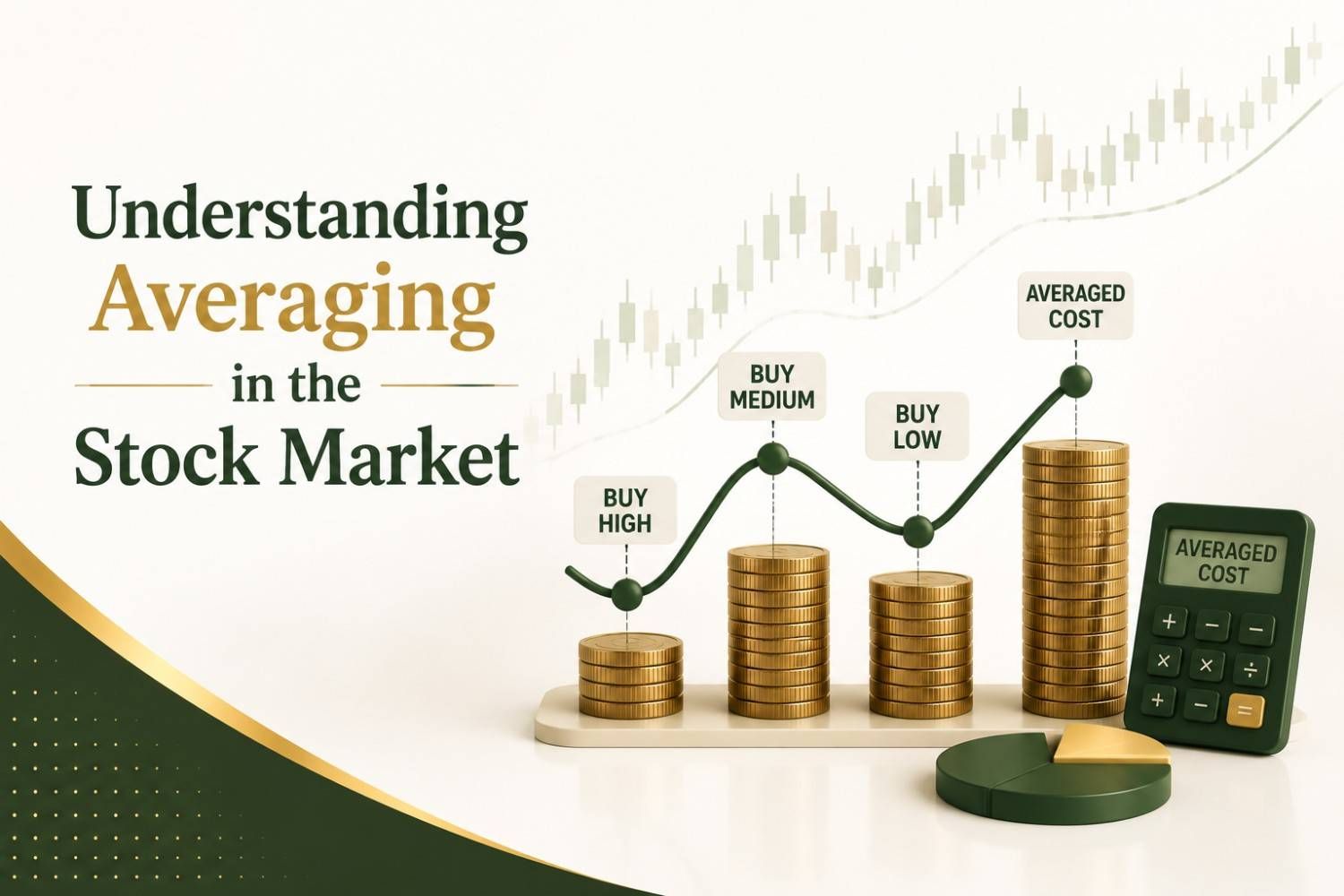
So, what is averaging in the stock market, really? In simple terms, averaging means buying additional shares of a stock you already own, usually at a different price than your original purchase, so that your overall average cost per share changes. The objective is often to reduce the average purchase cost, bringing it closer to the current market price and potentially lowering the point at which the investment becomes profitable.
This blog explains how averaging works, its main types, the advantages and risks involved, how it relates to moving averages, and practical ways to use it more effectively.
What Is Averaging in Stock Market Investing?
Averaging in the stock market is the process of buying more units of a stock you already hold at a price different from your earlier purchase, which changes your average cost. It is calculated as:
Average Cost = Total Amount Invested ÷ Total Number of Shares Held
For instance, if an investor purchases 100 shares at ₹200 each (₹20,000 total), and the price later falls to ₹150, buying another 100 shares costs ₹15,000 more. The total investment becomes ₹35,000 for 200 shares, bringing the average cost down to ₹175 per share, lower than the original ₹200.
Averaging does not change what the stock is actually worth. It only changes the price level at which the investor's existing holdings are valued, on average, and consequently, the price at which they would break even.
Types of Averaging Strategies
1. Averaging Down:
The most commonly discussed form is where an investor buys more shares after the price has fallen, aiming to lower the average purchase price. This is sometimes used when an investor believes a decline is temporary and the company's fundamentals remain sound. However, if the fall reflects genuine business or sector weakness, continuing to buy can increase losses rather than reduce them.
2. Averaging Up:
The opposite approach - buying more shares as the price rises, usually because the stock is performing well or the original investment thesis is playing out. This raises the average cost but is sometimes used by investors adding to positions they have higher conviction in, rather than falling ones.
3. Rupee-Cost Averaging (Systematic Averaging):
A more disciplined, time-based version of averaging. A predetermined amount is invested at fixed intervals, such as weekly, monthly, or quarterly, irrespective of market price fluctuations. This is the principle behind Systematic Investment Plans (SIPs) in mutual funds and is increasingly available for direct stock investing through systematic plans offered by several share market apps. Over time, this can spread the cost of investment across different market cycles without requiring the investor to predict price movements.
How Does Averaging Work in the Stock Market?
A few practical points matter when understanding the mechanics:
- It changes cost basis, not value. A lower average price does not make the company more valuable or guarantee a price recovery; it only changes the breakeven level.
- It requires additional capital. Averaging down means committing more money to a position that has already declined, increasing exposure to that single stock.
- It works differently depending on intent. Averaging based on researched conviction differs significantly, in risk terms, from averaging purely as a reaction to a falling price.
Advantages of Averaging
When used thoughtfully, averaging can offer certain benefits:
- Lower breakeven price: Buying more shares at a reduced price can bring down the average cost, meaning the stock needs to rise less for the position to become profitable.
- Removes the need to time the market perfectly: With rupee-cost averaging in particular, investors don't need to guess the "best" entry point. Spreading purchases across time reduces dependence on any single price decision.
- Encourages disciplined investing: Systematic averaging, such as through SIPs, builds a habit of regular investing rather than reactive, emotion-driven decisions.
- Can smooth out volatility over time: By spreading purchases across various market conditions, investors may lessen the impact of short-term price fluctuations on their overall portfolio performance.
- Allows averaging into conviction-based ideas: For investors who have researched a company thoroughly, averaging can be a way to build a larger position gradually rather than committing a large sum at once.
Risks of Averaging
Averaging is not without significant drawbacks, and these deserve equal attention:
- It can increase losses, not just reduce them: If a stock continues to decline due to weakening fundamentals, averaging down simply means more capital is now tied up in a losing position.
- It can create concentration risk: Repeatedly adding to one stock can make a portfolio less diversified, working against a core risk-management principle of spreading investments across sectors and companies.
- It may encourage poor decision-making: Averaging purely because a price has dropped, without examining why, can become an emotional response rather than a reasoned strategy, sometimes referred to as "catching a falling knife."
- Opportunity cost: Capital used to average into an underperforming stock is capital not available for potentially better-performing investments elsewhere.
- It doesn't fix a flawed investment thesis: If the original reason for buying the stock no longer holds true, averaging down does not resolve that; it only changes the average price, not the underlying problem.
Moving Average in Stock Market Analysis
It's worth distinguishing "averaging" as an investment strategy from a "moving average," which is a technical analysis tool. A moving average in the stock market smooths out price data over a specific period to help study price trends.
The two most common types are:
- Simple Moving Average (SMA): A moving average represents the average closing price of a stock over a specified period, such as 50 or 200 days, and is updated each trading day.
- Exponential Moving Average (EMA): Similar to the SMA, but gives more weight to recent prices, making it more responsive to short-term changes.
Traders often use moving averages to study trend direction or compare short-term and long-term price behaviour, such as a 50-day versus a 200-day moving average. These are based entirely on historical price data and do not predict future performance with certainty.
Final Thoughts
Averaging is a widely used concept in investment in share market discussions, but it is not a guaranteed path to profit, nor a substitute for research. It is fundamentally a method of recalculating the cost of your holdings, useful in some contexts, risky in others, depending on the reasoning behind it, the quality of the underlying investment, and how well it fits your overall financial plan.
Whether you're exploring averaging down, averaging up, or systematic rupee-cost averaging, understanding both the advantages and the risks and applying them with a clear plan rather than as a reaction to price movement makes a meaningful difference in outcomes.