If you've ever watched a business news channel or explored a trading platform, you've almost certainly heard these two words: Sensex and Nifty. They flash across tickers every trading day. People say things like "the market fell 500 points today," but which market? Nifty or Sensex? And does it even matter?
For a casual observer, the two may seem interchangeable. For anyone thinking seriously about investment in the share market, understanding the difference between Sensex and Nifty is one of the most fundamental things you can do. This article breaks it down clearly and tells you what actually matters for your investment decisions.
What Is Sensex?
Sensex stands for the Sensitive Index. It is the benchmark index of the Bombay Stock Exchange (BSE), one of Asia's oldest stock exchanges. The Sensex was launched on January 1, 1986, and tracks the performance of 30 of the largest and most liquid companies listed on the BSE.
Its base year is 1978–79, with a base value of 100. When the index was first published in 1986, it stood at around 549. Today, it trades north of 75,000, a figure that tells you something about how far India's economy has come in four decades.
The 30 companies in the Sensex represent several key sectors: banking, financial services, information technology, energy, FMCG (fast-moving consumer goods), and healthcare.
What Is Nifty?
Nifty, officially called Nifty 50, is the benchmark index of the National Stock Exchange (NSE). It was launched in 1996 and tracks the top 50 companies listed on the NSE, selected based on market capitalization, liquidity, and sector representation.
The Nifty 50 is managed by NSE Indices Limited and covers 13 sectors of the Indian economy, including banking, IT, pharmaceuticals, oil and gas, automobiles, and consumer goods. It represents approximately 62% of the free-float market capitalization of all NSE-listed stocks.
Key Differences Between Sensex and Nifty
Here is a clear comparison of the two indices across the parameters that matter most.
1. Exchange:
Sensex belongs to the BSE (Bombay Stock Exchange), while Nifty belongs to the NSE (National Stock Exchange). These are two separate exchanges, each with its own listed companies, trading systems, and indices.
2. Number of Companies:
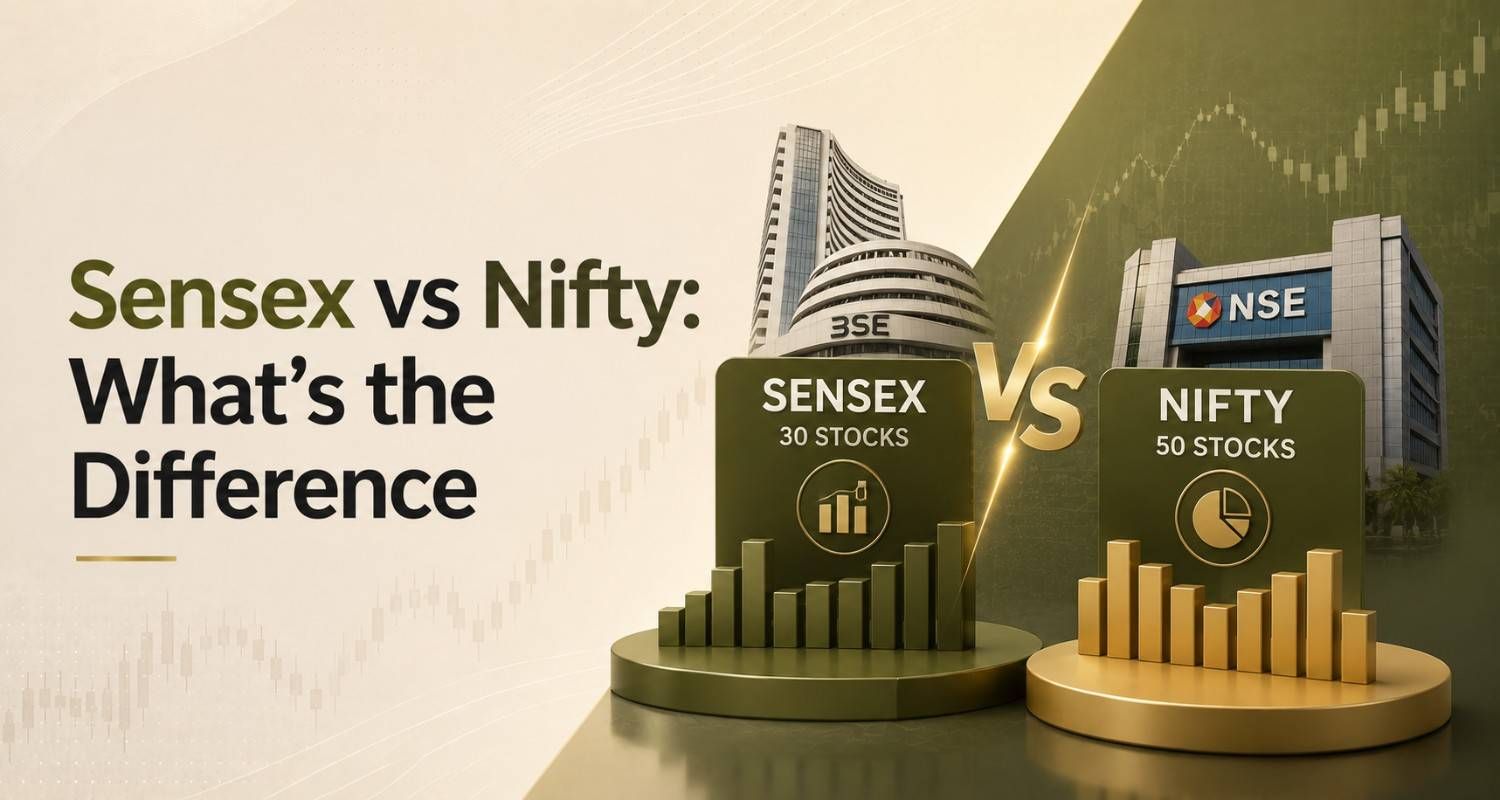
The most straightforward difference: Sensex tracks 30 companies, while Nifty tracks 50 companies. This makes Nifty the broader index by design.
3. Sector Coverage:
Because it includes 50 companies across 13 sectors, Nifty offers more diversified sector exposure. Sensex, with 30 stocks, is more concentrated. Sectors like metals, mid-tier pharma, and select auto companies may have stronger representation in Nifty than in Sensex.
4. Base Year and Base Value:
Sensex has a base year of 1978–79 with a base value of 100. Nifty's base period is November 3, 1995, with a base value of 1,000. This is why the numerical value of Sensex is always much higher than Nifty; it's not that one is "more expensive" than the other; they simply started at different points.
5. Calculation Method:
Both indices use the free-float market capitalization method. This means only the shares available for public trading are factored in, not promoter holdings or government-held shares. This approach gives a more realistic picture of what's actually tradable in the market.
Both indices also follow a semi-annual rebalancing schedule (every six months), in which a committee reviews constituents to add rising-star companies and drop those whose market caps or liquidity have slipped.
6. Derivatives and Trading:
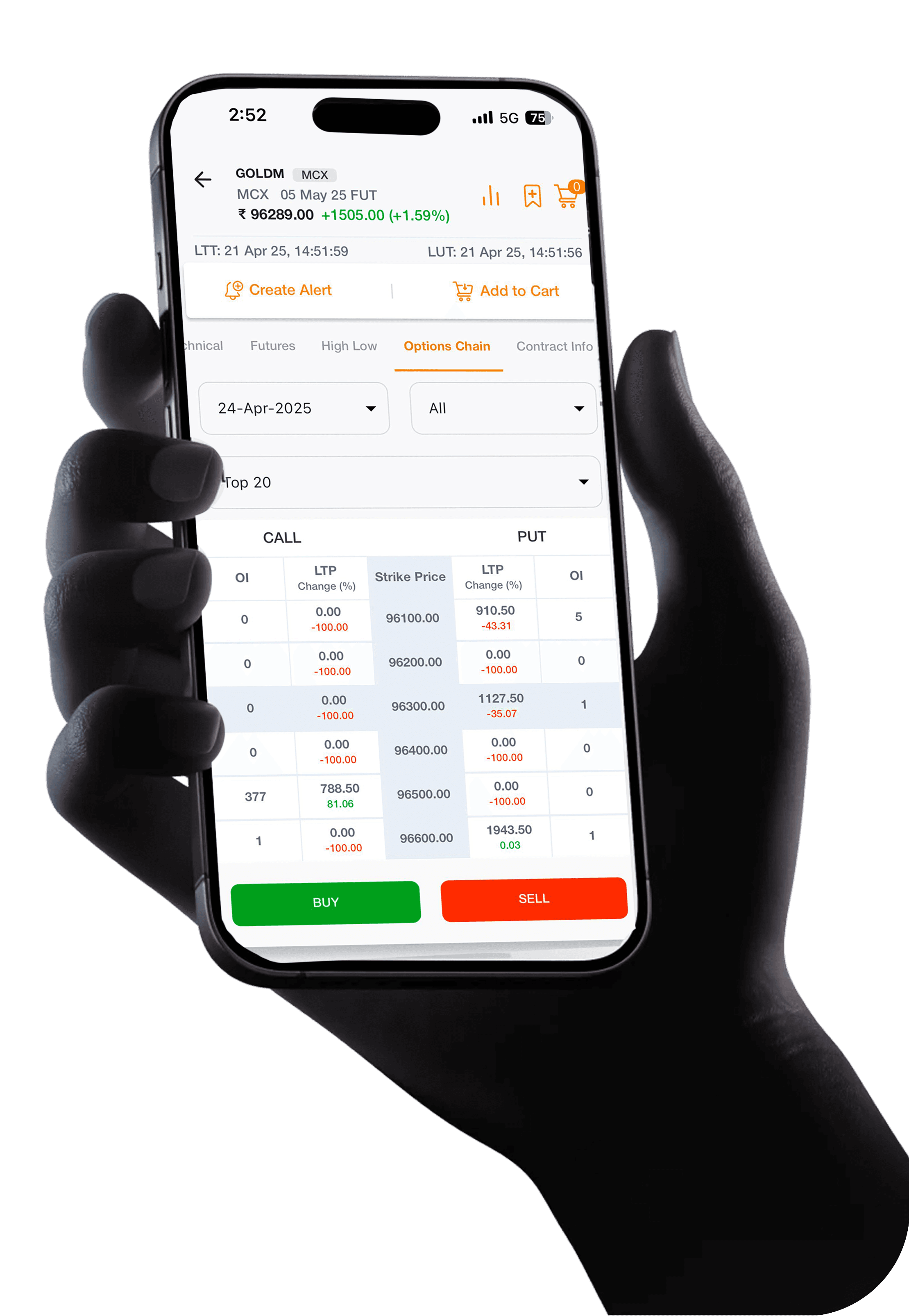
For anyone interested in Futures and Options (F&O), this distinction matters significantly. The Nifty 50 is the backbone of India's derivatives market, commanding significantly higher trading volumes than Sensex derivatives.
Under SEBI's single weekly index framework, the current schedule places Nifty 50 weekly options expiries on Tuesdays (NSE) and Sensex weekly options expiries on Thursdays (BSE), cleanly distributing market liquidity across the trading week.
7. Global Recognition:
Sensex tends to be the index that global financial portals and foreign institutional investors (FIIs) reference when discussing India's macroeconomic health. Nifty, on the other hand, is more commonly referenced in ETF and derivatives analysis internationally.
At a Glance: Sensex vs Nifty
| Feature | Sensex | Nifty 50 |
| Exchange | BSE | NSE |
| No. of Companies | 30 | 50 |
| Launched | 1986 | 1996 |
| Base Year | 1978–79 | November 1995 |
| Base Value | 100 | 1,000 |
| Calculation Method | Free-float market cap | Free-float market cap |
| Rebalancing | Semi-annually | Semi-annually |
| Sector Coverage | Concentrated (fewer sectors) | Broader (13 sectors) |
| F&O Dominance | Lower volume | Higher volume |
| Weekly Expiry | Thursdays (BSE) | Tuesdays (NSE) |
Do They Move Together?
Largely, yes. If you overlay a long-term chart of Sensex and Nifty, the two move almost in tandem, especially during broad market rallies or corrections. That's expected, because many of the largest companies by market cap appear in both indices.
However, they do diverge in certain conditions:
- When financial sector stocks perform strongly, Nifty tends to outperform slightly due to its broader banking and NBFC representation.
- When energy or conglomerate stocks (like Reliance) lead the market, the Sensex can momentarily take the lead.
- During sector-specific rallies, Nifty's wider coverage can make it more responsive.
Which One Should You Track?
There's no universal answer; it depends on your purpose.
- Track Sensex if: You want a quick, high-level pulse of the Indian market, or if you're following global news where India's economy is being discussed. Sensex is the number most commonly cited in headlines and is more familiar to international investors.
- Track Nifty if: You're an active investor or trader, especially if you use index funds, ETFs, or F&O. Nifty's broader coverage gives a more comprehensive view of the economy, and its derivatives market is significantly more liquid.
- For long-term investors: The difference is largely academic. Index funds and ETFs based on both indices are widely available. Both have delivered comparable returns over the long run. What matters more is your investment discipline: starting early, staying consistent, and not reacting to short-term volatility.
Can You Invest in Sensex or Nifty Directly?
No, you cannot invest directly in an index. But you can invest in index mutual funds or Exchange Traded Funds (ETFs) that replicate the performance of either index. These are passively managed and aim to mirror the index's returns, making them a cost-effective option for many investors.
Some examples include Nifty 50 Index Funds, Sensex Index Funds, and Nifty ETFs listed on the NSE.
If you're exploring share market investment through a share market app or brokerage platform, you'll find both Nifty and Sensex-linked products readily available.
A Note on Risk
Investing in the stock market, whether through index funds tied to Nifty or Sensex, or through direct equity, involves market risk. The value of your investment can go up or down based on economic conditions, interest rates, global factors, and corporate performance. Past returns are not a guarantee of future performance. Before making any investment decisions, consider your financial goals, risk tolerance, and investment horizon. When in doubt, consult a SEBI-registered financial advisor.