
Introduction
Every Diwali, the stock market opens for a special one-hour session called Muhurat Trading. While investors consider it an auspicious time to begin the new Samvat year, the market has its own story to tell.
How have the Nifty 50 and Sensex actually performed during Muhurat Trading over the last 10 years?
From sharp gains to occasional losses, the numbers reveal a pattern worth exploring.
Between 2016 and 2025, both indices closed in the green in 8 out of 10 Muhurat Trading sessions. Their strongest performance came in 2022, when both gained 0.87%. But the two negative sessions are a reminder that even an auspicious start does not guarantee market gains.
Let’s look at the Muhurat Trading returns of the last 10 years, compare Nifty and Sensex performance, and understand what these festive market trends tell us.
Muhurat Trading Last 10 Years: Nifty and Sensex Returns
The table below compares each index's percentage change during the Muhurat Trading session, measured against the previous regular trading day's close.
| Year | Nifty 50 close | Nifty return | Sensex close | Sensex return |
|---|---|---|---|---|
| 2016 | 8,625.70 | -0.14% | 27,930.21 | -0.04% |
| 2017 | 10,146.55 | -0.63% | 32,389.96 | -0.59% |
| 2018 | 10,598.40 | +0.65% | 35,237.68 | +0.70% |
| 2019 | 11,627.15 | +0.37% | 39,250.20 | +0.49% |
| 2020 | 12,780.25 | +0.47% | 43,637.98 | +0.45% |
| 2021 | 17,916.80 | +0.49% | 60,067.62 | +0.49% |
| 2022 | 17,730.75 | +0.87% | 59,831.66 | +0.87% |
| 2023 | 19,525.55 | +0.51% | 65,259.45 | +0.54% |
| 2024 | 24,304.35 | +0.40% | 79,724.12 | +0.42% |
| 2025 | 25,868.60 | +0.10% | 84,426.34 | +0.07% |
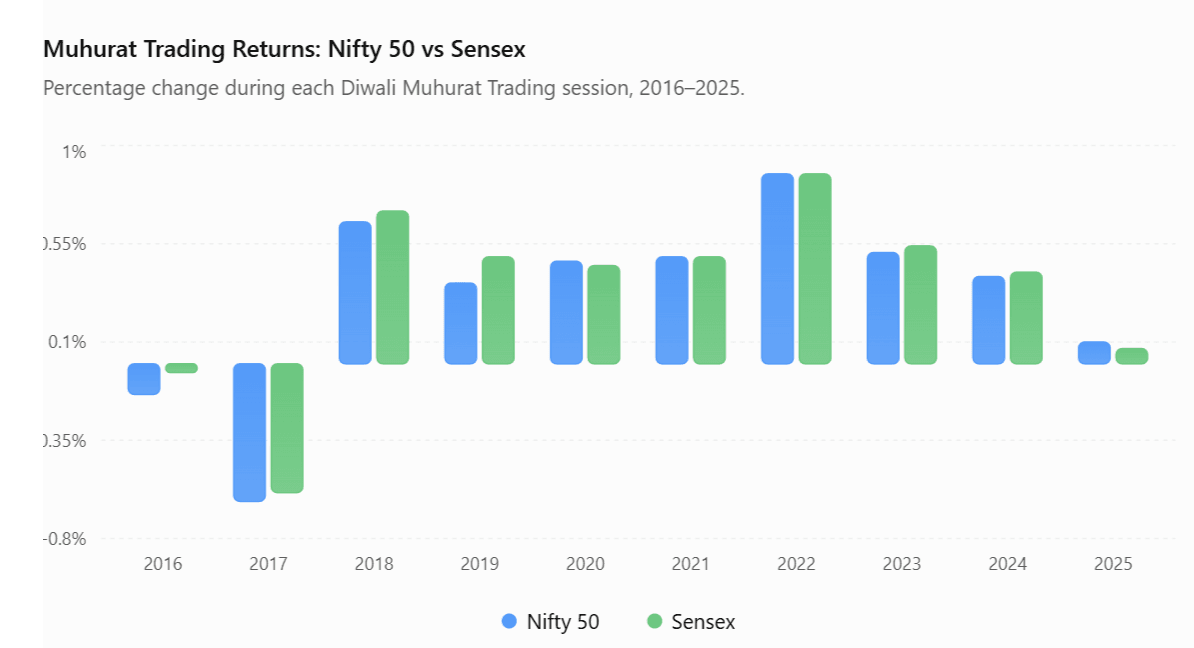
Chart: Nifty 50 vs Sensex Muhurat Trading Returns (2016–2025)
Here are a few things worth noting from the chart below:
- Eight positive sessions: Both indices finished higher in eight of the 10 years.
- Two negative sessions: Both recorded losses in 2016 and 2017.
- Strongest session: In 2022, the Nifty 50 and Sensex each gained 0.87%.
- Modest gains in 2025: The Nifty rose 0.10%, while the Sensex gained 0.07%.
 Source: NSE/BSE data history
Which Was the Best and Worst Muhurat Trading Session?
The last 10 years show that the biggest move did not always come during a strong market year. The session returns reflect what happened during that particular trading window, not the market's performance over the entire year.
Best session: 2022
Both the Nifty 50 and Sensex gained 0.87%, their highest Muhurat Trading returns in the 2016–2025 period.
Weakest session: 2017
The Nifty 50 fell 0.63%, while the Sensex declined 0.59%.
How Often Have Nifty and Sensex Closed Higher During Muhurat Trading?
Across the 10 sessions from 2016 to 2025, both benchmark indices recorded eight positive closes and two negative closes.
| Performance measure | Nifty 50 | Sensex |
|---|---|---|
| Positive sessions | 8 out of 10 | 8 out of 10 |
| Negative sessions | 2 out of 10 | 2 out of 10 |
| Average session return* | +0.31% | +0.34% |
| Best session | +0.87% (2022) | +0.87% (2022) |
| Weakest session | -0.63% (2017) | -0.59% (2017) |
(Note: *Averages calculated from the rounded percentage returns in the table above; they are arithmetic averages, not compounded returns.)
Does Positive Muhurat Trading Performance Mean Markets Will Rise in the Following Year?
Muhurat Trading returns capture a single session, while Diwali-to-Diwali returns measure how an index performs between two Diwali periods. These are different measures and can tell very different stories.
For example, both benchmark indices gained 0.87% during the 2022 Muhurat session. That single-session gain, however, cannot tell investors how the market will perform over the following Samvat year.
And hence does not count for positive Muhurat trading performance in 2026.
Market performance over a longer period depends on factors such as:
- Corporate earnings and business growth
- Interest rates and inflation
- Domestic and global economic conditions
- Investor sentiment and market valuations
- Geopolitical developments and unexpected events
What Does the Historical Trend Mean for Investors?
Muhurat Trading is a longstanding market tradition, but the principles of investing remain the same during the festive season.
Before making an investment in Diwali 2026 Muhurat Trading, consider these points:
- Start with your goals: Decide whether you are investing for the short term or the long term.
- Understand the risk: Stock prices can rise or fall regardless of when you buy them.
- Avoid rushed decisions: A special trading session is not a reason to buy an investment without research.
- Think beyond one session: Focus on your overall investment plan rather than a single day's movement.
If you choose to invest during Muhurat Trading, make the decision based on your financial circumstances and risk tolerance, not solely because the session is considered auspicious.
Conclusion
The last 10 years of Muhurat Trading session have largely ended on a positive note, with the Nifty 50 and Sensex gaining in 8 out of 10 sessions. But the two losing sessions show that even a festive start doesn’t guarantee market gains.
But, remember, that's just the statistics speaking!
So, while Muhurat Trading is a lovely tradition to begin Samvat, let your investment decisions be guided by research, risk appetite and financial goals—not just auspicious timing.
Shubh Deepawali!