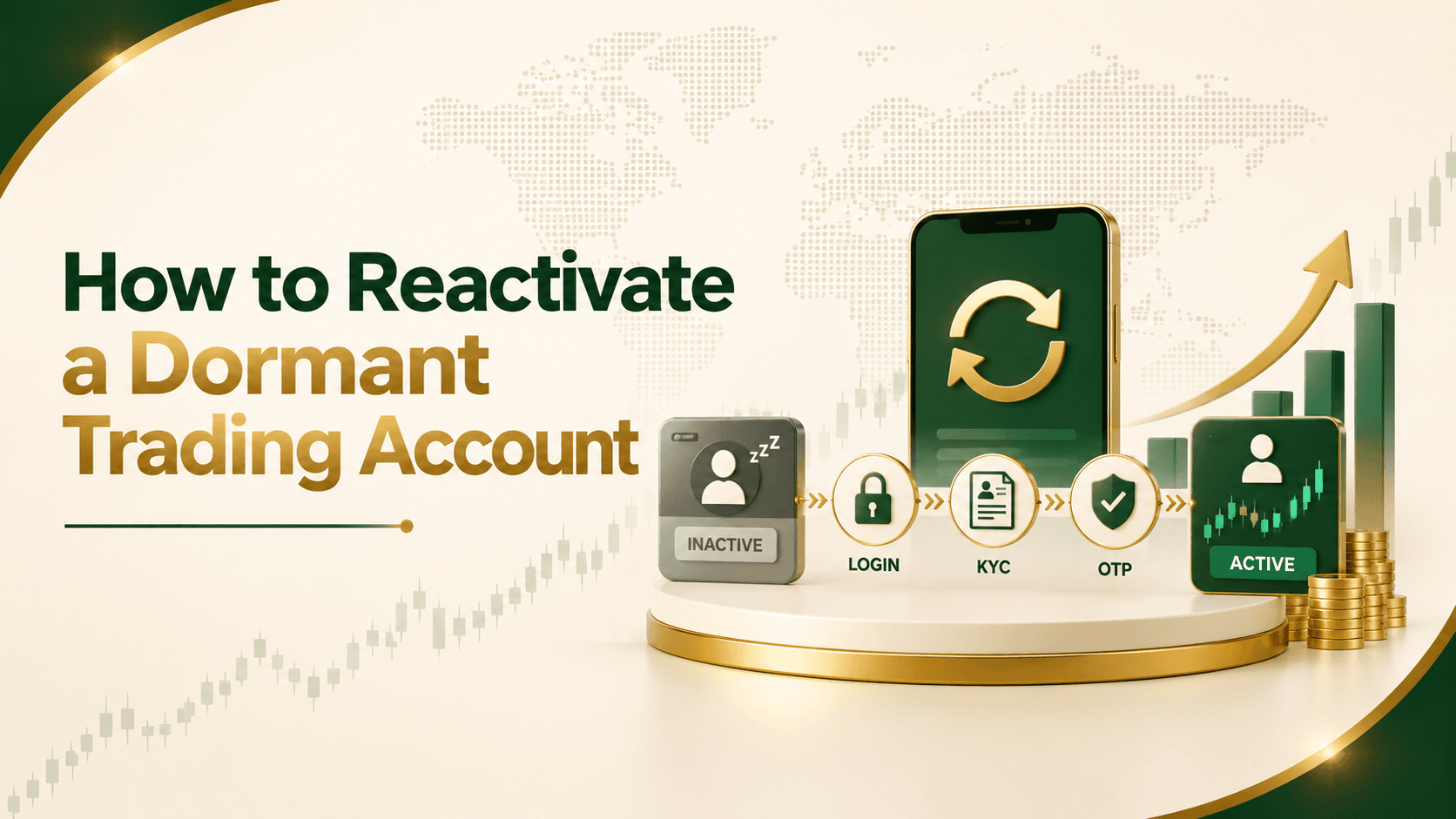
If you haven't traded, invested, or updated your details through a broker in a while, you may find your trading account has been flagged and blocked for further transactions. This isn't an error; it's a regulatory safeguard under SEBI’s KYC framework and stock-exchange circulars designed to protect investors whose accounts have gone unused for an extended period. Reactivating such an account is a well-defined process, and understanding exactly what it involves can help you get back to investing without unnecessary delay.
This guide explains what makes a trading account "inactive" under current exchange norms, how reactivation works, what documents you'll need, and what happens to your existing holdings in the meantime.
What Does an Inactive Trading Account Mean?
As per the latest NSE circular on the treatment of inactive trading accounts (NSE/INS/46471 dated October 25, 2024), a trading account is now classified as inactive if the client has not carried out any of the following through the same trading member for 24 (twenty-four) consecutive months:
- Trading, or participation in an OFS (Offer for Sale), buy-back, or open offer, across any exchange segment (cash, equity derivatives, currency derivatives, commodity derivatives, debt, online bond platform, or any other permitted segment)
- Applying for or subscribing to IPOs (where the bid is successful and not cancelled), Sovereign Gold Bonds (SGBs), or mutual funds, whether as a lump sum or through successful SIP installments, via the exchange's mutual fund platform
- Updating personal KYC details such as email ID, mobile number, or address, with the update reflected as validated or registered with the KYC Registration Agency (KRA)
If none of these have occurred within 24 months, the broker is required to flag the account as "Inactive" in the Unique Client Code (UCC) database maintained with the exchanges. Once flagged, the client’s UCC status at the exchange is marked ‘Inactive’, and the account cannot be used to place fresh trades until it is formally reactivated.
Importantly, the revised guidelines are designed to prevent ‘trade just to stay active’ behaviour. Brokers are expected to focus on genuine investor engagement and KYC upkeep rather than encouraging trades solely to avoid being flagged as inactive; pushing clients to trade purely for this purpose can attract compliance scrutiny.
How to Reactivate Your Trading Account?
When a client whose account is flagged as inactive seeks reactivation, the broker (trading member) is required to follow a defined verification process before restoring trading access:
1. Raise a reactivation request with your broker:
You can raise the request through your broker’s app, website, branch, or customer support.
2. Complete In-Person Verification or Video In-Person Verification (IPV/VIPV):
This is mandatory under SEBI’s KYC framework and related circulars governing reactivation of inactive accounts, and cannot be waived.
3. Confirm or update your basic details:
You’ll need to update the address, mobile number, email ID, bank/DP account, and income details as currently registered with the broker. If anything has changed, you'll need to submit updated documents, which the broker will also reflect in the exchange's UCC records.
4. KRA status check:
The broker will verify your status with the KYC Registration Agency. If your KYC status shows as validated or registered, the broker may simply confirm your existing details with you.
If your status shows as "on hold," "rejected," or registered through a different intermediary, you'll need to submit fresh KYC details and documents so the broker can update your status to validated/registered before you're permitted to trade again.
5. Broker verification and account unblocking:
Once IPV and KYC checks are complete, the broker updates the client’s UCC status to ‘Active’ in the exchange records, and the account is unblocked for trading.
Importantly, once your account is reactivated, the 24-month inactivity clock resets and is counted afresh from the date of reactivation.
Documents Required to Reactivate a Trading Account
The exact documents needed depend on whether your KYC details have changed, but generally include:
- PAN card (mandatory)
- Proof of address (Aadhaar, passport, voter ID, utility bill, or recent bank statement), if your address has changed
- Updated bank account or DP account proof, if applicable
- Income proof, particularly if you wish to continue or begin trading in derivatives
- A short video for In-Person Verification (VIPV), or physical IPV where required
- Any KRA-specific documents needed to move your status from "on hold" or "rejected" to "validated"
If none of your basic details have changed and your KYC status is already validated with the KRA, the process is comparatively lighter, since the broker can rely on existing KRA records after your confirmation.
How Long Does It Take to Reactivate a Trading Account?
There's no single exchange-mandated turnaround time for reactivation; it depends on the broker's internal process and how quickly the required verification is completed. In practice:
- If your KYC is already validated and only IPV/VIPV and a details confirmation are needed, reactivation can often be completed within a few working days.
- If your KYC status is not validated and fresh documents need to be collected and uploaded to the KRA, the process can take longer, since it depends on KRA processing as well.
For an accurate timeline, it's best to check directly with your broker, as this can vary.
Can You Reactivate a Trading Account Online?
Yes, largely. The shift to Video In-Person Verification (VIPV) under SEBI's KYC framework has made much of the reactivation process - confirming details, verifying identity, and completing KYC - possible digitally, without needing to visit a branch. Many brokers now offer this through their apps or web portals.
That said, certain situations may still require offline steps, for instance, if your KYC status needs correction through submission of physical documents, or if you hold a non-individual account (HUF, corporate, partnership, or NRI), which can involve additional signatories and documentation.
What Happens to Your Existing Holdings When Your Trading Account Is Inactive?
Being flagged inactive does not affect the shares or securities already held in your demat account. Your holdings remain safely credited in your name with the depository, and brokers are still required to report your funds and securities balances in their regular compliance filings to the exchanges and clearing corporations, even while your account is flagged inactive; the only exception is that accounts with a nil balance don't need to be included in certain daily reporting submissions.
Separately, under SEBI’s running account settlement framework, brokers are required to settle client funds and securities on a monthly or quarterly basis, as per client preference, regardless of account activity status. If a broker is unable to reach a client to settle their account, they are required to make documented efforts to trace the client rather than simply holding the assets indefinitely.
In short: your investments are not at risk due to inactivity, but you won't be able to place new trades until the account is reactivated.
Common Challenges One Can Face During Trading Account Reactivation
- Outdated contact details: If your registered mobile number or email is no longer accessible, OTP-based verification and VIPV scheduling can be delayed.
- KRA status issues: If your KYC shows as "on hold," "rejected," or registered through a different intermediary, additional documentation is needed before you can resume trading.
- Incomplete or unclear VIPV: Video verification can be rejected if the video quality is poor or details don't clearly match your PAN and other records.
- Non-individual account complexities: HUF, corporate, partnership, or NRI accounts often require sign-off from multiple holders or additional documents, which can extend the timeline.
- Untraceable clients: In some cases, brokers are unable to reach clients at all to complete reactivation or settle their account, which can delay both trading access and the return of funds/securities.
Keeping your contact details current and responding to your broker's KYC communications can help you avoid most of these delays.
What If Your Trading Account Cannot Be Reactivated?
If reactivation isn't possible, for instance, KYC discrepancies cannot be resolved, or you're no longer able to complete verification with your existing broker, you generally have two options:
- Transfer your demat holdings to another broker and open a trading account afresh with them, so you can continue managing your investments.
- Formally close the existing dormant account after transferring out your holdings and settling any dues.
In either case, your existing holdings remain your property and are not forfeited simply because your trading account is inactive.
How to Keep Your Trading Account Active?
Since inactivity is now measured against a specific set of qualifying activities, a few simple habits can help you avoid your trading account being flagged in the first place:
- Place at least one trade, or participate in an OFS/buy-back/open offer, periodically across any segment with your broker.
- Invest in an IPO, SGB, or mutual fund (lump sum or a successful SIP installment) through your broker's platform from time to time.
- Keep your KYC details - mobile number, email, and address - updated and validated with the KRA.
- Respond promptly to any KYC update requests from your broker.
- If you plan a long break from trading, check in with your broker so you understand how it may affect your account status.
Conclusion
An inactive trading account is a routine, regulation-driven safeguard rather than a red flag on your investments. With the 24-month inactivity definition and mandatory IPV/VIPV-based verification now standard across the industry, reactivation is a structured process built around confirming your identity and KYC status. Understanding what counts as "activity," what documents you may need, and how your holdings are protected in the interim can help you navigate reactivation with confidence. For the process specific to your account, it's always best to check directly with your broker's support team.