If you have ever tracked an upcoming IPO, you have probably come across the term "DRHP" in news reports or on the stock exchange website. For many first-time investors, this document can look intimidating simply because of its length and legal language. Yet, this is exactly the document that gives you the earliest and most detailed look at a company before it goes public.
Understanding what a DRHP is in IPO terms, what it contains, and how to read it is one of the most useful skills an investor can build before applying for a mainboard IPO. This blog breaks down the DRHP in simple terms so that you can make an informed decision the next time a company files for a public issue.
What Is DRHP?
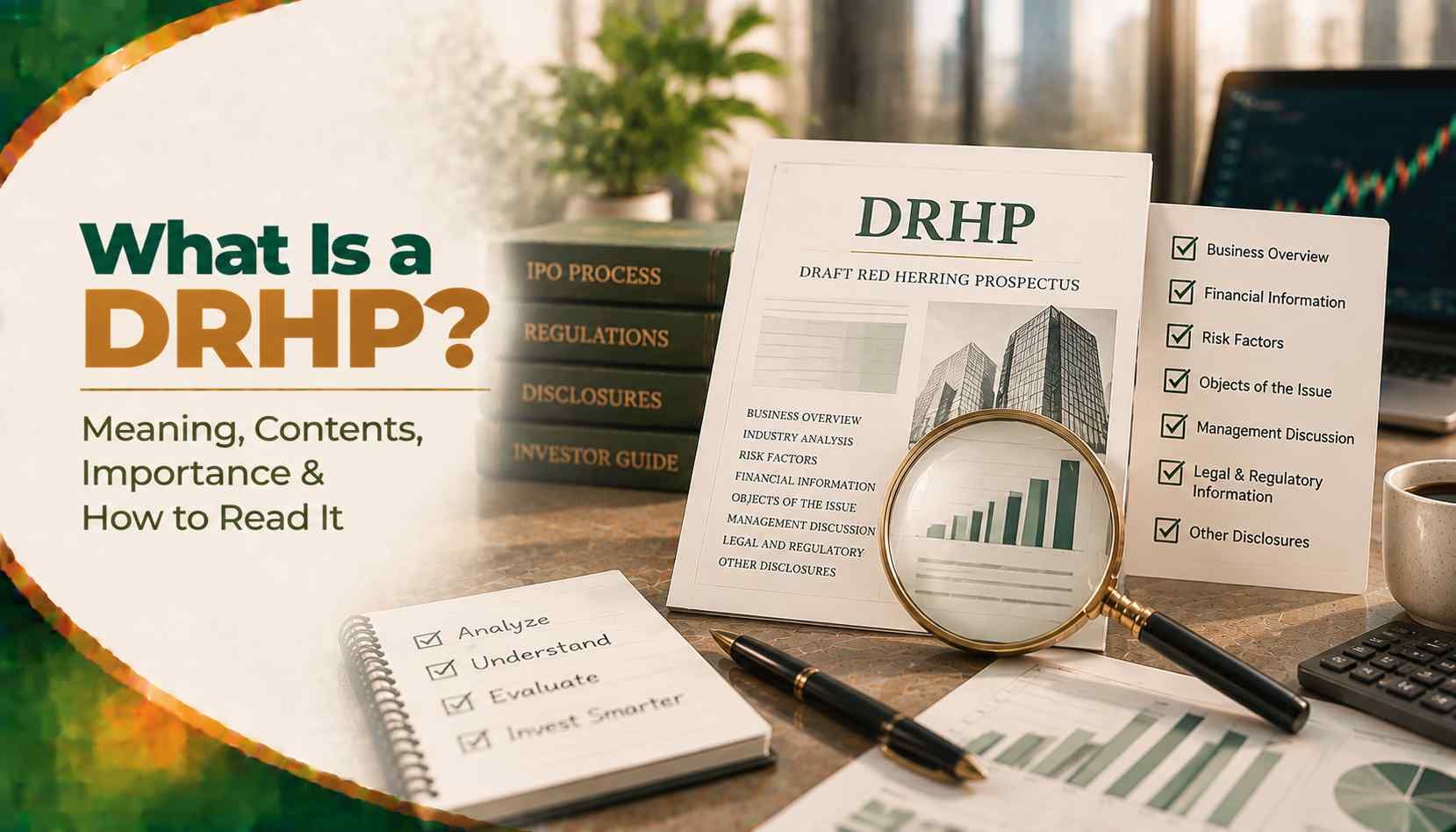
DRHP full form is Draft Red Herring Prospectus. It is a preliminary offer document that a company preparing for an Initial Public Offering (IPO) files with the Securities and Exchange Board of India (SEBI) and the stock exchanges.
To understand the DRHP meaning properly, it helps to break down the two words:
- Draft - This is not the final version of the document. It is prepared for regulatory review and may be revised based on SEBI's observations or feedback from the public.
- Red Herring - This term is used because the document does not disclose certain final details of the issue, most notably the price of the shares and the exact number of shares being offered.
In simple terms, what is DRHP in IPO language: it is the first formal, public document that tells you almost everything about a company planning to list on the stock exchange, except the final price at which its shares will be offered.
Once a company files its DRHP, it becomes a public document. Anyone can access it on the SEBI website or on the websites of the stock exchanges (NSE and BSE) once it has been filed.
What Information Does a DRHP Contain?
A DRHP is usually a lengthy document, often running into several hundred pages, because SEBI requires extensive disclosures under the SEBI (Issue of Capital and Disclosure Requirements) Regulations. While the exact structure can vary slightly by company, most DRHPs include the following sections:
Company and business overview: Nature of business, products or services, business model, and operational history.
Industry overview: The sector the company operates in, market size, competitive landscape, and growth drivers.
Risk factors: A detailed list of internal and external risks that could affect the company's business or financial performance. This is one of the most important sections for investors.
Financial statements: Audited financials for the past few years, including balance sheets, profit and loss statements, and cash flow statements.
Objects of the issue: The specific purpose for which the IPO proceeds will be used, such as funding growth (capital expenditure, acquisitions, working capital), debt repayment, and/or an offer for sale by existing shareholders.
Promoter and management details: Background of promoters, directors, and key managerial personnel, along with their shareholding and any pending litigation involving them
Capital structure: Details of the company's existing share capital and how it will change post-IPO.
Legal and regulatory proceedings: Any ongoing litigation, regulatory action, or disputes involving the company, its promoters, or group entities.
Related party transactions: Dealings between the company and its promoters, subsidiaries, or associate entities.
Reading through these sections gives investors a fairly complete picture of the company's operations and financial health, even though the issue price itself is not yet known at this stage.
Why Is the DRHP Important for an IPO?
The DRHP serves several important purposes in the IPO process:
- Regulatory scrutiny: SEBI examines the DRHP in detail to check whether the disclosures comply with applicable rules and are not misleading.
- Investor awareness: It gives potential investors the information they need to evaluate a company independently, rather than relying only on advertisements or market buzz around an IPO.
‘
- Market feedback: Since the DRHP is made public, market participants, analysts, and even the general public can raise observations, which SEBI may consider before granting its final observations.
- Transparency: Mandatory disclosure of risk factors, litigation, and financials ensures that companies cannot selectively present only favorable information.
For an investor, the DRHP is essentially the first opportunity to assess whether a company's fundamentals, growth plans, and risks align with their own investment goals, well before the excitement of listing day sets in.
How Does the DRHP Fit Into the IPO Process?
The DRHP is one step in a fairly structured sequence that every mainboard IPO in India must follow:
- The company appoints merchant bankers, legal advisors, and auditors to prepare the offer document.
- The DRHP is filed with SEBI and the stock exchanges.
- SEBI reviews the DRHP and may raise queries or observations; the company and its merchant bankers may then revise the draft or provide clarifications before filing the RHP.
- Once the company addresses SEBI’s observations and receives the observation letter, it files the Red Herring Prospectus (RHP) with the Registrar of Companies (RoC) and the stock exchanges.
- The IPO opens for subscription based on the RHP.
- After the issue closes and shares are allotted, the company files the final Prospectus with the Registrar of Companies, which includes the final issue price and size.
Understanding this sequence helps investors know exactly where the DRHP fits in; it is the starting point of public disclosure, not the final word on the IPO's terms.
DRHP vs RHP: What Is the Difference?
Since both documents sound similar, they are often confused. Here is a simple comparison:
| Aspect | DRHP | RHP |
| Stage | Filed first, for SEBI review | Filed with RoC (and exchanges) after addressing SEBI’s observations, at least three working days before the IPO opens |
| Price band | Not disclosed | Disclosed |
| Issue size | May not be finalized | Finalized or near-finalized |
| Can you invest based on it | No | Yes, once the issue opens |
| Nature | Preliminary/draft | Near-final document |
In short, the DRHP is the first detailed disclosure, while the RHP is the refined version that investors actually rely on when the IPO opens for subscription.
DRHP vs RHP vs Prospectus
There is actually a third document in this sequence, the final Prospectus, and it helps to see all three together:
1. DRHP (Draft Red Herring Prospectus):
Filed first, for regulatory review. Price and exact issue size not disclosed.
2. RHP (Red Herring Prospectus):
Filed after SEBI's observations are addressed, just before the IPO opens. Includes the price band and issue structure, but the final price (within the band) and final allotment details are still not fixed at this point.
3. Prospectus:
The final offer document that results when the RHP is filed with the Registrar of Companies after the pricing date and allotment. It includes the final issue price, the final number of shares allotted, and the basis of allotment.
Each of these documents represents a progressively more finalized version of the same core disclosure, moving from "draft and preliminary" to "final and confirmed."
Does a DRHP Mean the IPO Is Confirmed?
No. Filing a DRHP does not guarantee that the IPO will actually take place, or that it will happen on the terms described in the draft. A few points to keep in mind:
- SEBI's review can result in significant changes to the document, or in some cases, the company withdrawing its IPO plans altogether.
- Market conditions between the DRHP filing and the actual IPO can change, sometimes leading companies to postpone or shelve the issue.
- The approval of a DRHP by SEBI is not an endorsement of the company's business or financial soundness; it only confirms that the disclosure requirements have been met. This is explicitly stated in most offer documents and is an important point of compliance for investors to remember.
In other words, a DRHP indicates intent and preparation for an IPO, not a confirmed, unconditional listing.
How to Read a DRHP?
Given the length of a DRHP, most investors do not need to read it cover to cover. A more practical approach is to focus on specific sections in a logical order:
Start with the "Risk Factors" section: This gives you an honest, regulator-mandated list of what could go wrong with the business.
Move to the "Objects of the Issue": Understand exactly why the company is raising money and whether it is being used for growth (like expansion) or merely to repay debt or provide an exit to existing investors.
Review the financial statements: Look at revenue trends, profitability, debt levels, and cash flows over the last three to five years, rather than a single year in isolation.
Check promoter and management background: Look for their experience in the industry and any disclosed litigation or regulatory action.
Look at related party transactions: These can indicate whether the company's dealings with promoter-linked entities are on fair, arm's-length terms.
Read the industry overview: This helps you understand whether the company operates in a growing sector or a highly competitive, low-margin one.
Reading these sections in sequence, rather than jumping around, tends to give a clearer, more connected picture of the business.
What Should You Look for in the DRHP?
While every investor's priorities may differ, a few areas are generally worth close attention:
- Consistency of revenue and profit growth, rather than one-off spikes.
- Debt levels relative to the company's earnings and cash flow.
- Dependence on a small number of customers or suppliers, which can be a concentration risk.
- Pending litigation or regulatory proceedings against the company or its promoters.
- How the IPO proceeds will actually be used; expansion and debt reduction are generally viewed differently from proceeds used purely for an offer for sale by existing shareholders.
- Any qualifications or observations by the statutory auditors in the financial statements.
These pointers are not exhaustive, but they help investors move beyond headlines and evaluate the underlying business.
Where Can You Find a Company's DRHP?
Once filed, a DRHP is a public document and can be accessed through legitimate, regulated sources such as:
1. The SEBI website, under the list of filed offer documents.
2. The websites of the stock exchanges (NSE and BSE), where DRHPs of upcoming SME IPO as well as mainboard IPOs are published.
3. The lead merchant bankers' websites managing the issue.
Investors should rely only on these official sources and check for the latest version, since offer documents (including DRHPs and RHPs) can be revised or supplemented during the SEBI review and pre-issue period.
Does DRHP Mention the IPO Price?
No. By design, a DRHP does not disclose the final issue price or, in most cases, the exact number of shares being offered. This is precisely why the document is called a "red herring"; it deliberately withholds this pricing information because it has not yet been finalized at the draft stage.
The price band is typically disclosed later, in the Red Herring Prospectus (RHP), closer to the recent IPO opening date. The final price within that band is determined only after the book-building process is completed.
Common Misconceptions About DRHP
A few misunderstandings around DRHPs are worth clearing up:
"A filed DRHP means the IPO will definitely happen."
Not necessarily; companies can withdraw or delay their IPO plans even after filing.
"SEBI approves the company's business model when it clears a DRHP."
SEBI's review is focused on disclosure adequacy and regulatory compliance, not on certifying the merits of the business or guaranteeing investment returns.
"The DRHP tells you the exact IPO price."
As explained above, the price band and final price are disclosed later, not in the DRHP.
"Only professional analysts need to read a DRHP."
In reality, the risk factors and financial statements sections are written to be accessible to any investor willing to spend some time reading them carefully.
Conclusion
The Draft Red Herring Prospectus is far more than a regulatory formality; it is one of the most transparent and detailed sources of information available to an investor before a company lists on the stock exchange. Learning to read its key sections, particularly the risk factors, financials, and objects of the issue, can help investors move from simply reacting to IPO buzz to making a more informed assessment of the opportunity.
As with any investment decision, it is advisable to read the complete offer document, along with the RHP once available, and consult a registered investment advisor if needed, rather than relying solely on secondary sources or market sentiment.