In every few weeks, a new company announces its IPO, and the buzz begins. News channels cover it, analysts debate it, and your inbox fills up with "apply now" notifications.
For a first-time investor, it can feel overwhelming and exciting at the same time. But here is the truth that most people learn the hard way: Not every IPO, including a recent SME IPO, deserves your money
Some IPOs deliver significant listing gains and long-term returns. Others list below the issue price and never recover. The difference between a good and a bad IPO investment often comes down to one thing: how well you analyzed it before applying.
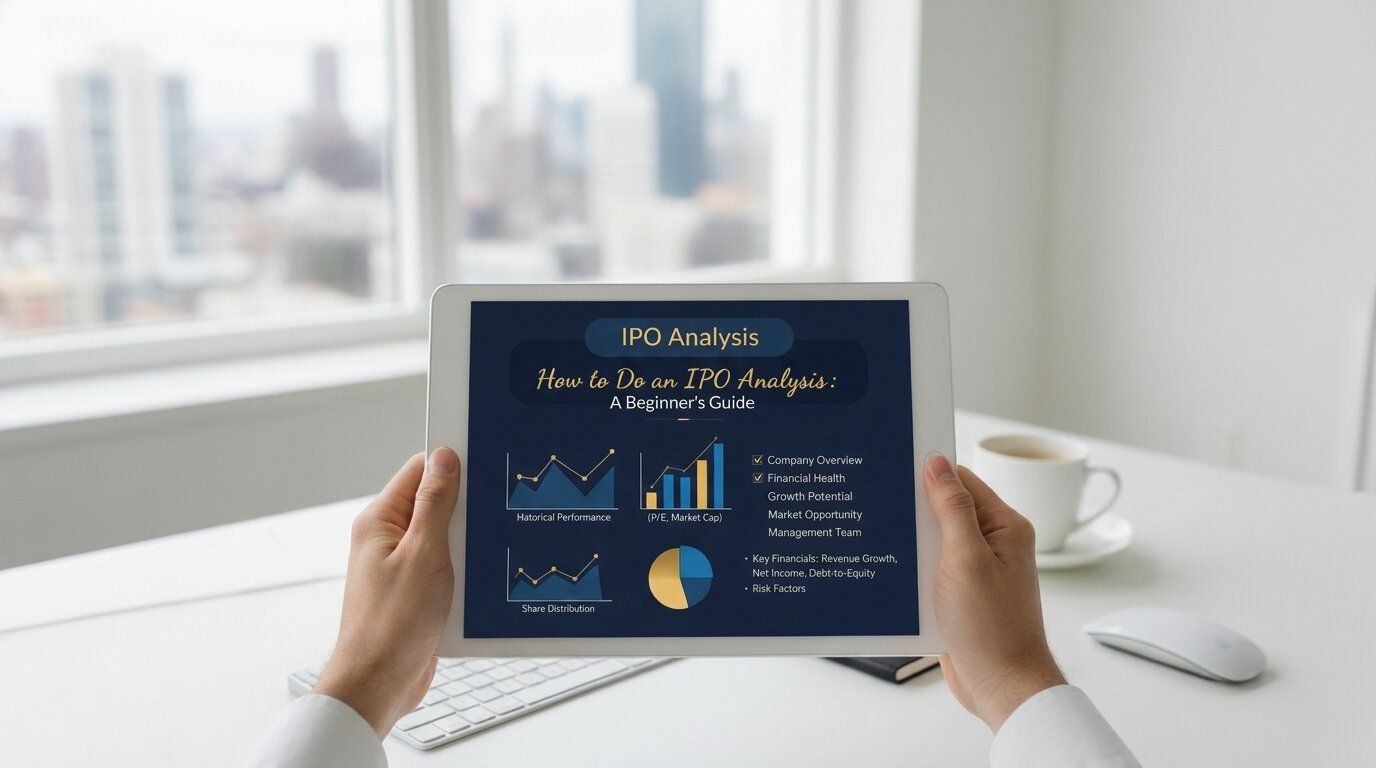
In this guide, we'll help walk you through IPO analysis step by step, in plain language, so you can evaluate any IPO with confidence, whether it is a high-profile mainboard IPO or a smaller SME ipo listing, such as an upcoming SME IPO
What Is an IPO?
An IPO, or Initial Public Offering, is the process through which a privately held company offers its shares to the general public for the first time through a recognized stock exchange.
Before an IPO takes place, the company or business is owned by its founders, early investors, and private equity or venture capital firms. When it decides to "go public," the company or business lists its shares on exchanges like the BSE or NSE, allowing retail investors like you and me to become shareholders.
Why Do Companies Go Public?
Companies pursue an IPO for several reasons:
- To raise fresh capital for business expansion, research, or infrastructure
- To give early investors and promoters an exit opportunity
- To increase brand visibility and credibility
- To use publicly listed shares for future acquisitions or employee stock options
Understanding why a company is going public is actually one of the first and most important steps in IPO analysis, and we will cover that in detail shortly.
How to Do an IPO Analysis?
A proper IPO review involves looking at the company from multiple angles, its business, its financials, its valuation, and the broader market context. Let's take a look at a structured approach you can follow for any IPO.
Step 1: Read the Red Herring Prospectus (RHP):
The Red Herring Prospectus is the official document filed by every company before its IPO. It is submitted to SEBI and made publicly available on the SEBI website, BSE, NSE, and the registrar's portal.
You can think of the RHP as the company's complete self-disclosure document. It contains the business overview, financial statements, risk factors, promoter details, litigation history, and the purpose for which the money is being raised.
Focus on these sections:
Objects of the Issue:
This tells you exactly what the company plans to do with the money it raises. Look for clarity and purpose. Capital expenditure, working capital, and R&D are positive uses. Repayment of loans raised by promoters or heavy OFS components deserves more scrutiny.
Fresh Issue vs. Offer for Sale (OFS):
A fresh issue in this context means the company receives the proceeds. An OFS is where existing shareholders are selling their stake; the company gets nothing from that portion. A large OFS, especially by promoters, often indicates that insiders are using the IPO as an exit, not as a growth milestone, and a closed SME IPO can be a useful case to study.
Risk Factors:
Every RHP lists risks. You'll need to read them seriously. Some risks are standard boilerplate. Others, such as dependence on a single client, ongoing legal disputes, or regulatory uncertainty, can be genuinely material to your investment decision.
Promoter and Management Details:
Who runs this company? What is their background? Have they been involved in any regulatory actions or defaults?
Step 2: Understand the Business Model:
Before diving into numbers, make sure you understand what the company actually does and how it earns money.
Ask yourself these questions:
- What product or service does the company sell?
- Who are its customers - individuals, businesses, or the government?
- Is the revenue model recurring (subscriptions, contracts) or transactional?
- Is the company operating in a growing industry or a mature, saturated one?
- Does the company have any competitive advantage - a strong brand, proprietary technology, regulatory licenses, or cost leadership?
A business that is easy to understand, operates in a growing market, and has a clear competitive edge is far more investable than one that relies entirely on current market momentum.
If you cannot explain the business model in a few simple sentences, it may be worth pausing before you invest.
Step 3: Analyze the Financial Performance:
This is where the numbers speak. You can open the financial statements section in the RHP document and examine at least three years of data.
Revenue Growth:
Is the company growing its top line consistently? Look for steady, year-on-year revenue growth. A company showing a sudden spike in revenue just before the IPO, without a clear explanation, deserves careful scrutiny.
Profitability:
Is the company profitable? If yes, are margins stable or improving? If not, how far is it from breaking even, and what is the timeline?
Key metrics to evaluate:
- EBITDA and EBITDA Margin: Measures operating profitability before interest and tax. Useful for comparing companies within the same sector.
- PAT (Profit After Tax): The actual bottom-line profit. Look for consistency.
- EPS (Earnings Per Share): Used to calculate valuation multiples like P/E.
- Return on Equity (ROE): How efficiently is the company generating profit from shareholders' equity? Higher is generally better.
- Return on Capital Employed (ROCE): Measures how effectively the company uses all its capital, including debt.
Debt Position:
Examine the company's total borrowings and its Debt-to-Equity ratio. High debt is not automatically a problem; it depends on the sector and whether the business generates enough cash flow to service it comfortably.
Cash Flow Analysis:
You should always check the cash flow statement. A company may represent accounting profit while consistently burning cash in operations. Strong, positive operating cash flow is a sign of a fundamentally sound business. Negative operating cash flow over multiple years, particularly in an established business, is a warning sign.
Step 4: Evaluate the Valuation
Even a great company can be a poor investment if you overpay for it. Anaylysing valuations can help you determine whether the IPO price is reasonable relative to the company's earnings, assets, and growth prospects.
Price-to-Earnings (P/E) Ratio:
Divide the IPO price by the EPS (annualized). Compare this P/E to:
- The average P/E of listed peers in the same industry
- The company's own historical earnings trajectory
If the IPO is priced at a significant premium to its peers without a strong justification, such as higher growth rates, better margins, or a dominant market position, it may be overvalued at the issue price.
Price-to-Sales (P/S) Ratio:
More useful for companies that are not yet profitable. Divide the market capitalization at the issue price by the company's annual revenue.
EV/EBITDA:
Enterprise Value to EBITDA is widely used for capital-intensive businesses and gives a clearer picture of operational value compared to P/E.
Price-to-Book (P/B) Ratio:
Particularly relevant for banking and financial sector IPOs. It tells you how much you are paying relative to the company's net assets.
The key principle here is comparison. No single valuation metric means much in isolation. Always benchmark the IPO against listed peers in the same sector before drawing any conclusions.
Step 5: Assess Industry and Competitive Landscape:
A company does not operate alone. The sector it belongs to, and its position within that sector, significantly influence its long-term potential.
Consider the following:
- What is the size of the addressable market, and how fast is it growing?
- Who are the major competitors, both listed and unlisted?
- What is the company's market share, and is it growing or declining?
- Are there any regulatory tailwinds or headwinds that could impact the business?
- Is the industry cyclical or relatively stable?
A company that is a market leader in a growing sector with limited competition is in a fundamentally stronger position than one that is a mid-sized player in a fragmented, price-sensitive industry, even if the financials look similar on the surface.
Step 6: Evaluate Management Quality and Promoter Credibility:
Numbers reflect the past. Management shapes the future. When reviewing the management team and promoters, look at:
Promoter Holding Post-IPO:
A high promoter stake after the IPO signals confidence in the business. If promoters are diluting heavily through OFS, it is a sign worth examining closely.
Track Record:
Have the promoters successfully built and scaled this business over time? Do they have domain expertise and industry experience?
Corporate Governance:
Scan the RHP for any history of auditor resignations, related-party transactions, regulatory penalties, or court cases involving the promoters or the company. These are not minor details; they reflect the integrity with which the business is being run.
Management Compensation:
Excessively high promoter salaries relative to the company's size and profitability can sometimes indicate misaligned incentives.
Step 7: Check Subscription Data and Anchor Investor Interest:
Before the public subscription opens, SEBI-registered institutional investors participate in the anchor investor round. Reviewing who has committed money at this stage gives you a useful signal.
If reputable names, large domestic mutual funds, insurance companies, or well-known FIIs have subscribed to the anchor portion, it means seasoned professionals have reviewed the company and found it worth investing in at the issue price.
Once the IPO opens for public subscription, monitor the daily subscription data, and review the final numbers of an IPO closed today to see how demand played out:
- QIB subscription is the most important signal. Strong QIB interest indicates institutional confidence.
- Retail and HNI subscriptions often reflect market sentiment and expectations for listing gains.
A heavily oversubscribed IPO, particularly in the QIB category, is generally a positive sign, though it does not guarantee listing gains on its own.
Step 8: Define Your Investment Purpose Before Applying:
This is a step most investors skip, and it is a mistake.
Before applying to any IPO in the share market, be clear about your objective:
If you are applying for listing gains, you are essentially making a short-term bet on market sentiment. This can work, but it is unpredictable and should be treated as such.
If you are investing for the long term, then business quality, valuation, and management credibility matter far more than listing day buzz. You should be comfortable holding the stock even if it lists flat or slightly below the issue price, because your thesis is based on where the business will be in three to five years.
Both approaches are valid. But mixing them up, applying with a long-term mindset, and panicking on listing day because of a 5% dip, is where most investors go wrong.
Common Mistakes to Avoid
Even experienced investors make these errors. Being aware of them puts you a step ahead.
Investing based on brand recognition alone:
A well-known consumer brand does not automatically make a well-priced IPO. The valuation has to make sense relative to the company's earnings and growth outlook.
Ignoring the OFS component:
A large Offer for Sale, especially by promoters and private equity investors, means they are exiting at your expense. This is not always a dealbreaker, but it warrants additional scrutiny.
Skipping the financials and relying on analyst notes alone:
Third-party IPO reviews are useful, but they should supplement your own reading, not replace it. Always look at the actual numbers in the RHP.
Comparing companies across different sectors:
A P/E of 60x may be a reasonable indicator for a fast-growing technology company and completely unjustified for a traditional manufacturing business. Always compare within the same industry.
Investing money you may need in the short term:
IPO application funds are blocked for 6 to 7 business days during the allotment process. Make sure the funds you are using can be comfortably locked in for that duration.
Chasing every IPO:
Not every IPO deserves your money. Discipline, including the ability to sit out a listing, is one of the most underrated skills in investing.
Final Thoughts
IPO analysis is not as complicated as it might seem at first. It is, at its core, about asking the right questions: Is this a good business? Are the financials sound? Is the price fair? Is the management trustworthy? Does this IPO fit my investment goals?
The investors who consistently and frequently do well in the IPO market are not the ones who apply to every listing. They are the ones who wait for the right opportunity, do their homework, and invest because the numbers and the business case make sense, not because everyone else is applying.