Stepping into the world of IPO investment, including upcoming IPOs, can feel like a high-stakes game.. Earlier, investing in IPOs meant sending your money away and waiting weeks for a refund if stocks weren't allotted.
Here, ASBA plays a major role - the system that changed the game for Indian investors, making the process safer, faster, and far more efficient.
Whether you are planning to invest in a mainboard IPO or a smaller niche listing, understanding ASBA is your first step toward a seamless investment experience.
Let’s understand the ASBA process together!
What is ASBA in IPO?
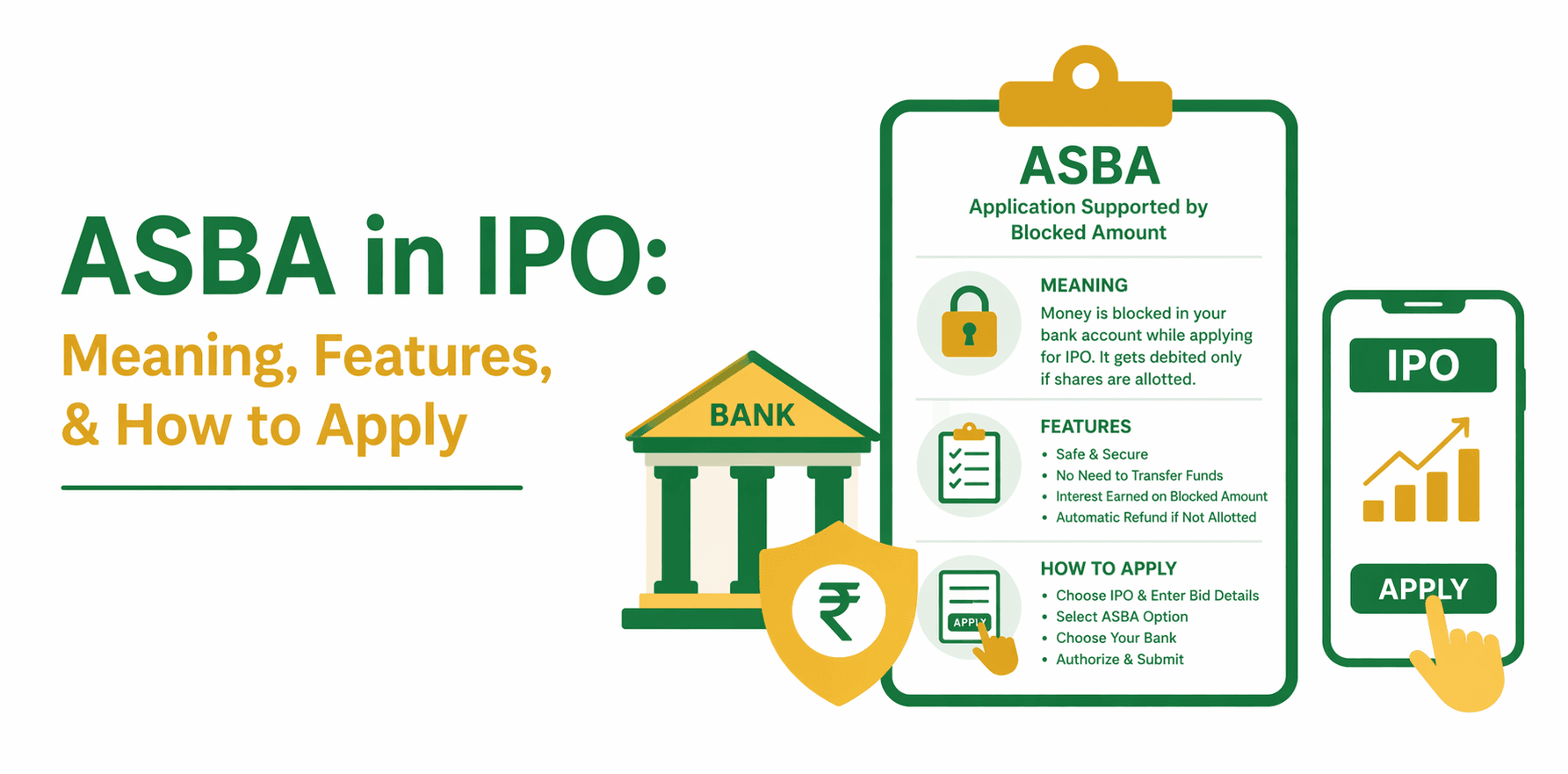
The ASBA IPO full form is Applications Supported by Blocked Amount. First introduced by SEBI (Securities and Exchange Board of India), it is a process developed to ensure that an investor’s money remains in their own bank account until the shares are actually allotted.
In simple terms, when you apply for an IPO, the application money isn't withdrawn immediately. Instead, it is "blocked" or "frozen" in your account. You continue to earn interest on that amount, and the money only leaves your account if you are successful in the allotment process.
How Does ASBA Work in IPO?
The mechanism behind ASBA in IPO is designed to eliminate the liquidity problem often faced by retail investors. Here is the step-by-step flow:
1. Application:
You submit your IPO bid through your bank (SCSB - Self Certified Syndicate Bank) or a UPI-linked brokerage app.
2. Blocking:
The bank marks a "lien" on the required funds. You can see the balance, but you cannot spend it.
3. Data Upload:
The bank sends your application details to the stock exchange.
4. Allotment Phase:
- If Allotted: The exact amount for the shares you received is debited from your account, and the shares are credited to your Demat.
- If Not Allotted: The ‘block’ is removed, and your funds become available for use immediately, including after an IPO closed today.
Features and Benefits of ASBA IPO
ASBA in IPO applications offers several advantages over the old system:
Earn Interest:
Since the money stays in your savings account until allotment, you continue to earn bank interest on that amount.
Zero Refund Hassles:
You never have to worry about refund delays or cheques getting lost in the mail, as with recent IPOs applied for through ASBA
Financial Security:
Your money stays under your control within your own bank.
Simple Modification:
You can easily revise or withdraw your bid while the IPO issue is still open.
Mandatory for All:
As per SEBI mandates, ASBA is now the standard requirement for all investors participating in a mainboard IPO.
How to Apply for an IPO Through ASBA?
Applying via ASBA is straightforward and can be done through two primary channels:
1. Through Net Banking (Direct ASBA):
- Log in to your bank’s net banking portal.
- Navigate to the 'Investments' or 'IPO' section.
- Select the current IPO you wish to apply for.
- Enter your Demat account details (DP ID and Client ID).
- Enter your bid, choose the cut-off price, and submit.
2. Through UPI (UPI-ASBA):
- Open your stockbroker’s app.
- Select the IPO and enter your bid.
- Enter your UPI ID.
- You will receive a mandate request on your UPI app.
- Approve the mandate to "block" the funds.
Note: The UPI ID used must be linked to the same bank account that is registered with the broker, including for a recent SME IPO.
Eligibility Criteria for Using ASBA
To use the ASBA facility, you must meet the following criteria:
Valid Demat Account:
You must have an active Demat account with a SEBI-registered Depository Participant (DP).
SCSB Bank Account:
You must have a savings or current account with a Self-Certified Syndicate Bank.
Sufficient Funds:
The account must have a balance equal to or greater than the total application amount.
PAN Card:
A valid Permanent Account Number linked to your bank and Demat accounts.
Remember: It is also important to remember that the PAN on the Bank Account must match the PAN on the Demat Account.