
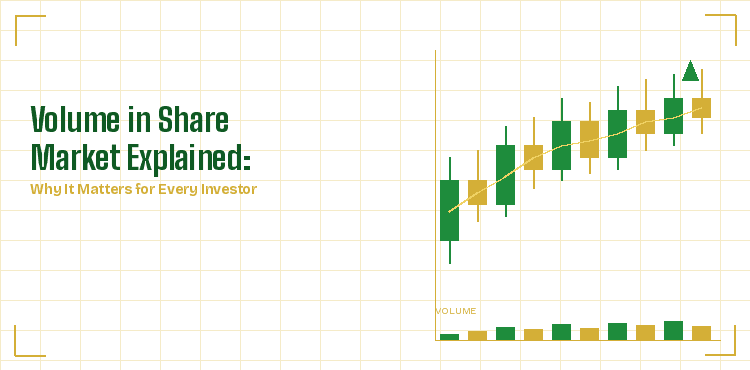
Volume in Share Market Explained: Why It Matters for Every Investor

Volume in Share Market Explained: Why It Matters for Every Investor

When individuals participate in the stock market, they frequently concentrate solely on stock prices. Nevertheless, price by itself does not provide the complete picture. To determine if a price move is robust, weak, authentic, or fleeting, investors should also analyze volume.

Volume is among the key indicators utilized by both traders and long-term investors. It helps gauge market engagement, buying interest, selling pressure, and liquidity. Whether you are a newcomer making your initial investments in the stock market or a seasoned investor overseeing a portfolio, understanding volume can enhance your decision-making.


In this guide, we will explain what is volume in share market, how it works, why it matters, and how you can use it effectively before buying stocks.

What is Volume in Share Market?

Volume in the share market refers to the total number of stocks/equities bought and sold during a specific time period. This could be one trading day, one hour, or even a few minutes.


For example, if 5 lakh shares of a company are traded in a day, the stock’s daily volume is 5 lakh. In simple terms, if you are asking what is volume in share market, it is the measure of how actively a stock is being traded.

Why Volume is Important?

Volume helps investors understand:

  • How popular a stock is at the moment
  • Whether a price move is strong or weak
  • How easily stocks/equities can be bought or sold
  • Whether institutions may be entering or exiting

How Volume Works in the Stock Market?

All trades involve both the buyer and the seller. After completing their trade, the number of shares will be included in the total volume for that stock.


For example, one investor buys 200 shares and another investor sells 200 shares.  This completed transaction adds 200 shares to daily volume.


Volume usually increases during:

  • Market opening hours
  • Quarterly result announcements
  • Budget or policy events
  • Major company news
  • Sharp market rallies or corrections

Large-cap stocks usually see higher trading volume because more people trade them regularly, while small-cap stocks may see lower volume.

Why Volume Matters for Every Investor?

Volume is useful because it gives insights beyond price movement.

1. Confirms Price Trends: If a stock rises with strong volume, the trend is usually considered healthier.

2. Shows Market Interest: High volume often means investors are paying attention to the stock.

3. Improves Liquidity: High-volume stocks are easier to buy and sell quickly.

4. Reduces Trading Risk: Low-volume stocks may have wide bid-ask spreads and sudden price swings.

5. Helps Smarter Share Market Investment Decisions: Studying volume can improve timing, confidence, and risk management in share market investment strategies.

Volume and Price Relationship

Price and volume should always be studied together.

1. Rising Price + High Volume: Usually signals strong buying interest and possible continuation.

2. Rising Price + Low Volume: The rally may be weak and less reliable.

3. Falling Price + High Volume: Often indicates heavy selling pressure or panic.

4. Falling Price + Low Volume: May suggest limited selling and possible stabilization.

5. Sideways Price + Rising Volume: Could signal accumulation before a breakout.

High Volume vs Low Volume Stocks

Understanding the difference between high-volume and low-volume stocks is important for making better investment decisions. Trading volume reflects how actively a stock is being purchased and sold in the stock market. It can also indicate liquidity, investor interest, and price stability.

What Are High Volume Stocks?

High-volume stocks are shares that are traded frequently in large quantities during a trading session. These are usually well-known companies with strong investor participation.


Benefits of High Volume Stocks

  • Easier to buy and sell quickly
  • Better liquidity with lower bid-ask spreads
  • More stable price movement compared to thinly traded stocks
  • Lower risk of price manipulation
  • Suitable for beginners and active traders

Large-cap companies often fall into this category because they attract institutional and retail investors regularly.

What Are Low Volume Stocks?

Low-volume stocks are shares that trade in smaller quantities and may have fewer buyers and sellers. These are often small-cap or lesser-known companies.


Risks of Low Volume Stocks

  • Difficult to purchase or sell at desired prices
  • Higher price volatility
  • Wider bid-ask spreads
  • Greater risk of sudden, sharp movements
  • Technical indicators may be less reliable

How Traders Use Volume Indicators?

Volume indicators help traders confirm momentum and identify setups.

1. Volume Bars: The bars displayed below price charts showcase daily or hourly traded shares.

2. Volume Moving Average: Compares current volume with average volume over the past 10, 20, or 50 sessions.

3. On-Balance Volume (OBV): Tracks whether money flow is entering or leaving a stock.

4. Breakout Volume: When the price crosses resistance with high volume, traders often see it as a stronger breakout.

5. VWAP (Volume Weighted Average Price): Popular for intraday traders to judge average traded price levels.

Most modern share market apps provide these tools, along with charts and alerts.

How Investors Can Use Volume Before Buying Stocks?

Volume can help investors filter stronger opportunities. Here’s how you can use them:

  1. Check Liquidity: Avoid stocks with extremely low daily volume.
  2. Compare Current Volume vs Average Volume: If today’s volume is much higher than the 20-day average, it may signal unusual activity.
  3. Confirm Breakouts: A breakout supported by volume is often stronger than one without participation.
  4. Study Delivery Volume: In Indian markets, delivery volume shows shares actually transferred to Demat accounts, unlike total traded volume, which includes intraday trades.

A high delivery percentage (around 40% to 50% or higher) may suggest genuine accumulation rather than short-term speculation.

  1. Watch Institutional Interest: Sudden high-volume moves may indicate mutual funds, FIIs, or DIIs entering a stock.
  2. Combine with Fundamentals: Use volume with revenue growth, debt levels, valuations, and earnings quality for better investment in share market decisions.

Common Mistakes to Avoid While Using Volume

1. Depending Only on Volume: Volume should be combined with price action and company fundamentals.

2. Ignoring Delivery Data: Total volume alone may hide speculative intraday activity.

3. Chasing One-Day Spikes: Some spikes fade quickly after news events.

4. Buying Illiquid Stocks: Low volume can make exits difficult during volatility.

5. Ignoring Broader Market Trends: Even strong-volume stocks can fall in weak markets.

Ways to Track Volume Easily

Tracking volume has become simple for retail investors. Here’s how you can track volume:

1. Share Market Apps: A reliable share market app can help track:

  • Real-time volume
  • Volume gainers
  • Delivery percentage
  • Interactive charts
  • Average volume comparison
  • Breakout alerts

2. Exchange Websites: NSE and BSE websites publish official market volume data.

3. Brokerage Platforms: Most brokers provide chart tools and screeners.

4. Financial Websites: Useful for scanning unusual volume and top traded stocks.

Volume Strategy for Beginners

If you are new to the stock market, use this simple checklist:

  • Prefer stocks with healthy daily volume
  • Compare current volume with the 20-day average
  • Check if the price rise is backed by volume
  • Avoid random spikes without reason
  • Use the delivery percentage for Indian stocks
  • Combine technicals with fundamentals
Frequently Asked Questions

What is volume in share market in simple words?

It is the number of shares traded in a stock during a specific time period.

Is high volume good for a stock?

Usually, yes, because it indicates better liquidity and stronger participation. However, it should be analyzed with price action.

Why is volume important in the stock market?

Volume helps confirm trends, measure investor interest, and identify strong or weak price moves.

What is delivery volume?

Delivery volume represents shares actually transferred to investors after trading, excluding purely intraday positions.

How can beginners track volume easily?

Beginners can use a reliable share market app to monitor real-time data. Look for apps with Volume Leaders lists, interactive charts, average volume comparison, and unusual volume alerts.

What is a good volume for a stock?

There is no fixed number. Good volume depends on the stock’s usual trading history. Volume significantly above average often attracts attention.

Can volume predict stock price movement?

Volume alone cannot predict price, but it can confirm momentum and indicate possible upcoming moves.

Disclaimer

The information provided in this article is for educational and informational purposes only. Any financial figures, calculations, or projections shared are solely intended to illustrate concepts and should not be construed as investment advice. All scenarios mentioned are hypothetical and are used only for explanatory purposes. The content is based on information from credible, publicly available sources. We do not guarantee the completeness, accuracy, or reliability of the data presented. Any references to the performance of indices, stocks, or financial products are purely illustrative and do not represent actual or future results. Actual investor experience may vary. Investors are advised to carefully read the scheme/product offering information document before making any decisions. Readers are advised to consult with a certified financial advisor before making any investment decisions. Neither the author nor the publishing entity shall be held responsible for any loss or liability arising from the use of this information.

Download TradeMobi App

Real-Time Market Data
Advanced Trading Tools
Expert-Backed Research
Google Play
App Store
TradeMobi

Popular on Anand Rathi

Explore Sitemap

Anand Rathi Share and Stock Brokers Ltd.
SEBI Registration No.: INZ000170832 (BSE-949 | NSE-06769 | MSEI-1014 | MCX-56185 | NCDEX-1252), CDSL & NSDL: IN-DP-437-2019. *Research Analyst - INH000000834. PMS: INP000000282 is Registered under "Anand Rathi Advisors Limited" | MBD-INM000010478 is Registered under "Anand Rathi Advisors Limited"| NBFC is Registered under "Anand Rathi Global Finance Limited" Regn. No.: B-13.01682 | Insurance is Registered under "Anand Rathi Insurance Brokers Ltd." License No. 175. Insurance Corporate Agent: CA1048 (This registration shall be valid from 04-Jun-2025 to 03-Jun-2028).

Anand Rathi International Ventures (IFSC) Private Limited.
SEBI Registration No.: INZ000292939 (INDIA INX Member Code: TM - 5064 | NSE IX Member Code: TM -10048, IIBX Member Code: TM – 2011), IIDI DP ID 350071 AND Registration No.: IFSCA/DP/2022-23/007, IFSCA/CMI/Distributor/2023-24/0002. CIN No.: U65999GJ2016PTC094915. For any complaints email at Ifscgrievance@rathi.com. Regulator: International Financial Services Centres Authority (IFSCA)- https://www.ifsca.gov.in/

Disclaimer:

Equity: Investment in securities market are subject to market risks, read all the related documents carefully before investing.

The securities are quoted as an example and not as a recommendation.

Mutual Funds: Mutual Fund investments are subject to market risks, read all scheme related documents carefully before Investing. AMFI-Registered Mutual Fund Distributor: ARN-4478 (Initial Registration 4th Feb, 2003 & Valid From 2nd April, 2025 - 1st April, 2028) : Anand Rathi Share and Stock Brokers Ltd. | ARN-111569: Anand Rathi Wealth Limited | ARN-100284: AR Digital Wealth Private Limited.

IPO: Opening of account will not guarantee allotment of shares in IPO. Investors are requested to do their own due diligence before investing in any IPO.

*Third Party products: All third-party products like PMS, Mutual Funds, Fixed Income Products, IBS, Bonds, AIFs are not Exchange traded product and "ARSSBL" is just acting as distributor. All disputes with respect to the distribution activity, would not have access to Exchange investor redressal forum or Arbitration mechanism.

MTF: MTF is subject to the provisions of SEBI Cir. CIR/MRD/DP/54/2017 dt June 13, 2017 & terms and conditions mentioned in rights and obligations statement issued by the ARSSBL

Investment Baskets: Baskets are not Exchange traded product, all disputes with respect to this activity, would not have access to Exchange investor redressal forum or Arbitration mechanism.

Research Analyst: The views expressed in this website accurately reflect the personal views of the analyst(s) about the subject securities or issuers and no part of the compensation of the research analyst(s) was, is, or will be directly or indirectly related to the specific recommendations or views expressed by the research analyst(s). The advertisment are bound by stringent internal regulations and also legal and statutory requirements of the Securities and Exchange Board of India (hereinafter "SEBI").

Certification: Registration granted by SEBI and certification from NISM is in no way a guarantee of performance of the intermediary or provides any assurance of returns to investors.

*Award Winning Research: Anand Rathi Share and Stock Brokers Limited (Research Analyst) was awarded as "Best Equity Advisor" at World BFSI Congress & Awards 2022

*Client Data: Client data shown on this website is as on 31st March 2025

Trading View: Anand Rathi has partnered with TradingView for its charting technology. A global platform offering heatmaps, STOCK SCREENERS and market data.

By submitting this form, I hereby provide my explicit consent to be contacted by Anand Rathi Group and its associate companies via phone call, SMS, email, or WhatsApp for information related to products and services, even if I am registered on DND.

Attention Investors:

  • For all communication related to vulnerability reporting, security alerts, or any other suspicious activity related to cyber security, contact priyanksheth@rathi.com/+91-22-62811514"
  • For any complaints email at grievance@rathi.com, For DP related queries/complaints email at dp@rathi.com
  • For any Mutual Fund-related complaints, please email customersupport@rathi.com.
  • For further escalation, you may contact mf@rathi.com.
  • Filing of complaints on SCORES – Easy & quick a. Register on SCORES portal b. Mandatory details for filing complaints on SCORES: I. Name, PAN, Address, Mobile Number, Email ID c. Benefits: I. Effective communication ii. Speedy redressal of the grievances.
  • Stock Brokers can accept securities as margin from clients only by way of pledge in the depository system w.e.f. September 1, 2020.
  • Update your mobile number & email Id with your stock broker/depository participant and receive OTP directly from depository on your email id and/or mobile number to create pledge.
  • Pay 20% upfront margin of the transaction value to trade in cash market segment.
  • Investors may please refer to the Exchange's Frequently Asked Questions (FAQs) issued vide circular reference NSE/INSP/45191 dated July 31, 2020 and NSE/INSP/45534 and BSE vide notice no. 20200731-7 dated July 31, 2020 and 20200831-45 dated August 31, 2020 dated August 31, 2020 and other guidelines issued from time to time in this regard
  • Check your Securities /MF/ Bonds in the consolidated account statement issued by NSDL/CDSL every month.
Prevent Unauthorized Transactions in your demat account → Update your Mobile Number with your Depository Participant. Receive alerts on your Registered Mobile for all debit and other important transactions in your demat account directly from CDSL.No need to issue cheques by investors while subscribing to IPO. Just write the bank account number and sign in the application form to authorise your bank to make payment in case of allotment. No worries for refund as the money remains in investor's account.KYC is one time exercise while dealing in securities markets - once KYC is done through a SEBI registered intermediary (broker, DP, Mutual Fund etc.), you need not undergo the same process again when you approach another intermediary.Prevent Unauthorized Transactions in your demat account → Update your Mobile Number with your Depository Participant. Receive alerts on your Registered Mobile for all debit and other important transactions in your demat account directly from CDSL.No need to issue cheques by investors while subscribing to IPO. Just write the bank account number and sign in the application form to authorise your bank to make payment in case of allotment. No worries for refund as the money remains in investor's account.KYC is one time exercise while dealing in securities markets - once KYC is done through a SEBI registered intermediary (broker, DP, Mutual Fund etc.), you need not undergo the same process again when you approach another intermediary.