AnandRathi

What Are Thematic Funds and How to Invest in Them?

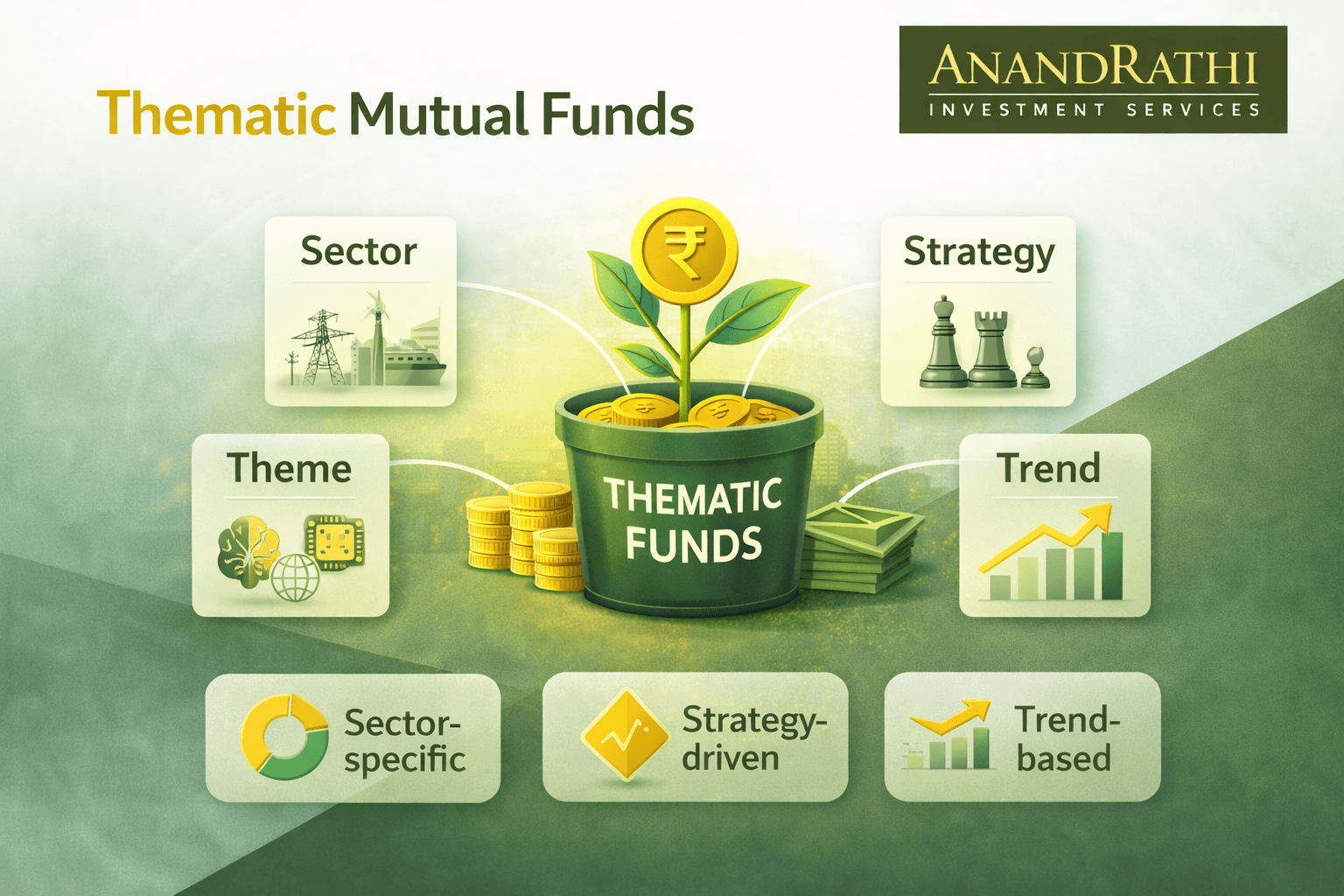
Thematic Mutual Funds

When you hear about stock markets, most people think of broad-based mutual funds or simple index investing. But what if you could put your money in a fund that focuses solely on big, rising trends like electric vehicles, renewable energy, digital India, or healthcare innovation? That's where thematic funds come in.

Over 24.13 crore people are investing in mutual funds, and Thematic funds have emerged as the largest category (15%) within the equity segment. Additionally, among the 70 NFOs (New Fund Offers) launched in FY2025, 52 were purely thematic funds. So, why are investors keen to invest in these funds?

Through this blog, let us explore the meaning of thematic funds, how they work, the key benefits they offer, who should invest in them, and why they are becoming a popular investment option in India.

(**Spoiler alert: Thematic funds are exciting, but they have their own features. Keep reading to see if they're for you or not!)

What Are Thematic Funds?

Thematic funds are a variant of mutual funds that focus on one theme or sector. In short, these funds share a common idea or theme. Based on this, the fund manager identifies companies that align with the basket/theme and subsequently invests in them.

These themes could include;

  • Technology & Digital India
  • Renewable Energy and EVs
  • Healthcare and Pharma
  • Artificial Intelligence
  • Tourism
  • Railways
  • ESG (Environmental, Social, Governance)
  • Lifestyle and Consumption, etc.

This list of themes can include many others. In simple words, think of thematic mutual funds as a painting that focuses on a single theme (like sorrow, happiness, celebration). However, within the same painting, you will see multiple elements (representing companies) related to the theme.

How Do Thematic Mutual Funds Work?

Unlike other funds, the thematic meaning in a mutual fund stems from the theme selected. Instead of spreading money across the market or any index, the fund manager invests only in companies that fit a specific theme.

Once the theme is selected, the fund manager analyzes the market and selects companies that align with the theme. For example, in an EV (Electric Vehicle) theme fund, the portfolio may include battery makers, charging infrastructure companies, and auto manufacturers.

With the basket created, the fund invests in them while seeking diversification and rebalancing whenever required.

Key Features and Benefits of Thematic Funds

If you plan to invest in thematic funds, be sure to consider the features and benefits you will receive in return.

  • Theme-based investing: The entire fund is built around a single idea or trend, such as electric vehicles (EVs), digital India, or renewable energy.
  • Broader than sector funds - Instead of focusing on a single sector, this fund can include multiple sectors as long as they are connected to the theme.
  • Medium- to long-term horizon - These themes unfold over years, so patience is crucial.
  • Higher volatility: With a concentration on a single theme, risk can escalate compared to other funds.
  • Active fund management: Over here, fund managers actively take part in research and pick stocks aligned with the theme.

Benefits of Thematic Funds

With thematic fund investing, you can gain the following benefits for your portfolio, which include;

  • Through the different themes available, you get the opportunity to participate in megatrends.
  • Definitely, thematic funds open doors for multiple ideas. With that said, you don't need to pick individual stocks as the fund manager does it for you.
  • Provides portfolio diversification and adds exposure to sectors or industries that traditional funds might miss.
  • There are chances for high return potential if the chosen theme succeeds.
  • If you believe in a particular theme's future, these funds can fuel your thoughts and investments as well.

Types of Thematic Mutual Funds

Apart from the sector, the asset allocation can also depend on style and factor-based investing. For instance;

Style-based Themes

  • Value Stocks: These are companies that are undervalued, trading below their intrinsic worth. They usually have low P/E or P/B ratios and may be out of favor temporarily.
  • Growth Stocks: It includes companies with high future earnings potential and revenue growth, even if they're currently expensive.
  • Momentum Stocks: These stocks exhibit strong price trends, trying to rise fast and outperform the market.
  • Low-Volatility Stocks: These offer stable returns with lower price swings and tend to perform well during market downturns.
  • Quality Stocks - High-quality companies with strong fundamentals, consistent profitability, low debt, and high ROE.

Other themes include factor-based investing that focuses on low volatility and momentum. With these, one's portfolio can expand by managing the market cycles.

How To Invest In Thematic Funds

Investing in thematic funds is quite straightforward, but it's important to approach them with clarity and discipline.

If you plan to invest, here's how you can get started:

  • Identify a Theme You Believe In: Choose a theme you feel confident about and its future, such as pharma, AI, technology, etc.
  • Research Available Funds: Check which mutual fund houses offer schemes related to that theme and compare their track records, expense ratios, and portfolios. That's where the whole point of investment safety lies.
  • Align with Your Goals: Before getting to invest, ensure that the theme aligns with your overall financial plan and risk appetite. After all, mutual funds are for long-term, not any quick gains.
  • Choose SIP or Lump Sum: If you want to average out market volatility, start with a SIP. If you're confident about the theme and market timing, a lump sum is also an option.
  • Invest Through Platforms: You can invest via mutual fund apps, online brokers, or directly through the AMC (Asset Management Company) website.
  • Monitor and Review: Keep track of the fund's performance and review it at least annually. Also, continue to review the fund and exit if the theme no longer aligns with your expectations.

Examples of Thematic Mutual Funds In India

Some examples of thematic mutual funds in India are:

  • ICICI Prudential Manufacturing Fund
  • Edelweiss Recently Listed IPO Fund Direct-Growth
  • Invesco India Infrastructure Fund
  • DSP Healthcare Fund
  • Quant ESG Equity Fund, etc.

How Are They Different from Sector Funds?

Since both sectoral and thematic funds involve concentrated investing, it's possible to mix them up. However, there's a small yet significant difference. Regardless of whether they fit into a larger story, sector funds only invest in businesses within a certain industry, such as banking or energy. On the other hand, thematic funds have a narrative that may cover several different industries.

For instance, businesses from the utilities, industrial, and technological sectors might be included in a clean energy theme. Therefore, thematic funds are more adaptable in capturing value from several perspectives of a shared trend. In contrast, sector funds are restricted to a specific segment of the economy.

Conclusion

From this blog, you have now understood that not all thematic funds are sector-based. Definitely, they sometimes align towards a sector, but overall, they focus on a particular theme. Thematic mutual funds delve into themes that support causes you care about, such as the digital economy, healthcare, or electric vehicles.

Also, they do pose a unique set of dangers and demand thorough study, just like any other investment. Before any decision, consult a professional or conduct your research. Lastly, consider adding thematic funds to your portfolio if your research and instincts support it.


Frequently Asked Questions

Are Thematic mutual funds risky?

Yes, unlike any mutual fund, even thematic funds carry certain risks. For instance,

  • Since they focus on a single theme or idea, if that theme underperforms, the fund's returns can drop sharply.
  • They are more volatile and sensitive to market cycles.
  • Also, there can be regulatory risk in case the government brings in new policies impacting the existing companies.

What is the taxation of thematic mutual funds?

For any investment done in thematic funds, the respective LTCG and STCG apply.

  • If sold within one year - STCG at 20%
  • If sold after holding for more than 12 months - LTCG at 12-5% (plus exemption of up to ₹1lakh. Above it, is applicable at the mentioned rate.)

Who should invest in thematic mutual funds?

Thematic funds are ideal for investors with a high-risk appetite, strong conviction in specific megatrends, and a long-term horizon (5+ years). Without knowledge or blind investing, it can be a risky move for your portfolio.
 

Disclaimer

The information provided in this article is for educational and informational purposes only. Any financial figures, calculations, or projections shared are solely intended to illustrate concepts and should not be construed as investment advice. All scenarios mentioned are hypothetical and are used only for explanatory purposes. The content is based on information obtained from credible and publicly available sources. We do not guarantee the completeness, accuracy, or reliability of the data presented. Any references to the performance of indices, stocks, or financial products are purely illustrative and do not represent actual or future results. Actual investor experience may vary. Investors are advised to carefully read the scheme/product offering information document before making any decisions. Readers are advised to consult with a certified financial advisor before making any investment decisions. Neither the author nor the publishing entity shall be held responsible for any loss or liability arising from the use of this information.

Download TradeMobi App

Real-Time Market Data
Advanced Trading Tools
Expert-Backed Research
Google Play
App Store
TradeMobi

Popular on Anand Rathi

Explore Sitemap

Anand Rathi Share and Stock Brokers Ltd.
SEBI Registration No.: INZ000170832 (BSE-949 | NSE-06769 | MSEI-1014 | MCX-56185 | NCDEX-1252), CDSL & NSDL: IN-DP-437-2019. *Research Analyst - INH000000834. PMS: INP000000282 is Registered under "Anand Rathi Advisors Limited" | MBD-INM000010478 is Registered under "Anand Rathi Advisors Limited"| NBFC is Registered under "Anand Rathi Global Finance Limited" Regn. No.: B-13.01682 | Insurance is Registered under "Anand Rathi Insurance Brokers Ltd." License No. 175. Insurance Corporate Agent: CA1048 (This registration shall be valid from 04-Jun-2025 to 03-Jun-2028).

Anand Rathi International Ventures (IFSC) Private Limited.
SEBI Registration No.: INZ000292939 (INDIA INX Member Code: TM - 5064 | NSE IX Member Code: TM -10048, IIBX Member Code: TM – 2011), IIDI DP ID 350071 AND Registration No.: IFSCA/DP/2022-23/007, IFSCA/CMI/Distributor/2023-24/0002. CIN No.: U65999GJ2016PTC094915. For any complaints email at Ifscgrievance@rathi.com. Regulator: International Financial Services Centres Authority (IFSCA)- https://www.ifsca.gov.in/

Disclaimer:

Equity: Investment in securities market are subject to market risks, read all the related documents carefully before investing.

The securities are quoted as an example and not as a recommendation.

Mutual Funds: Mutual Fund investments are subject to market risks, read all scheme related documents carefully before Investing. AMFI-Registered Mutual Fund Distributor: ARN-4478 (Initial Registration 4th Feb, 2003 & Valid From 2nd April, 2025 - 1st April, 2028) : Anand Rathi Share and Stock Brokers Ltd. | ARN-111569: Anand Rathi Wealth Limited | ARN-100284: AR Digital Wealth Private Limited.

IPO: Opening of account will not guarantee allotment of shares in IPO. Investors are requested to do their own due diligence before investing in any IPO.

*Third Party products: All third-party products like PMS, Mutual Funds, Fixed Income Products, IBS, Bonds, AIFs are not Exchange traded product and "ARSSBL" is just acting as distributor. All disputes with respect to the distribution activity, would not have access to Exchange investor redressal forum or Arbitration mechanism.

MTF: MTF is subject to the provisions of SEBI Cir. CIR/MRD/DP/54/2017 dt June 13, 2017 & terms and conditions mentioned in rights and obligations statement issued by the ARSSBL

Investment Baskets: Baskets are not Exchange traded product, all disputes with respect to this activity, would not have access to Exchange investor redressal forum or Arbitration mechanism.

Research Analyst: The views expressed in this website accurately reflect the personal views of the analyst(s) about the subject securities or issuers and no part of the compensation of the research analyst(s) was, is, or will be directly or indirectly related to the specific recommendations or views expressed by the research analyst(s). The advertisment are bound by stringent internal regulations and also legal and statutory requirements of the Securities and Exchange Board of India (hereinafter "SEBI").

Certification: Registration granted by SEBI and certification from NISM is in no way a guarantee of performance of the intermediary or provides any assurance of returns to investors.

*Award Winning Research: Anand Rathi Share and Stock Brokers Limited (Research Analyst) was awarded as "Best Equity Advisor" at World BFSI Congress & Awards 2022

*Client Data: Client data shown on this website is as on 31st March 2025

Trading View: Anand Rathi has partnered with TradingView for its charting technology. A global platform offering heatmaps, STOCK SCREENERS and market data.

By submitting this form, I hereby provide my explicit consent to be contacted by Anand Rathi Group and its associate companies via phone call, SMS, email, or WhatsApp for information related to products and services, even if I am registered on DND.

Attention Investors:

  • For all communication related to vulnerability reporting, security alerts, or any other suspicious activity related to cyber security, contact priyanksheth@rathi.com/+91-22-62811514"
  • For any complaints email at grievance@rathi.com, For DP related queries/complaints email at dp@rathi.com
  • For any Mutual Fund-related complaints, please email customersupport@rathi.com.
  • For further escalation, you may contact mf@rathi.com.
  • Filing of complaints on SCORES – Easy & quick a. Register on SCORES portal b. Mandatory details for filing complaints on SCORES: I. Name, PAN, Address, Mobile Number, Email ID c. Benefits: I. Effective communication ii. Speedy redressal of the grievances.
  • Stock Brokers can accept securities as margin from clients only by way of pledge in the depository system w.e.f. September 1, 2020.
  • Update your mobile number & email Id with your stock broker/depository participant and receive OTP directly from depository on your email id and/or mobile number to create pledge.
  • Pay 20% upfront margin of the transaction value to trade in cash market segment.
  • Investors may please refer to the Exchange's Frequently Asked Questions (FAQs) issued vide circular reference NSE/INSP/45191 dated July 31, 2020 and NSE/INSP/45534 and BSE vide notice no. 20200731-7 dated July 31, 2020 and 20200831-45 dated August 31, 2020 dated August 31, 2020 and other guidelines issued from time to time in this regard
  • Check your Securities /MF/ Bonds in the consolidated account statement issued by NSDL/CDSL every month.
Prevent Unauthorized Transactions in your demat account → Update your Mobile Number with your Depository Participant. Receive alerts on your Registered Mobile for all debit and other important transactions in your demat account directly from CDSL.No need to issue cheques by investors while subscribing to IPO. Just write the bank account number and sign in the application form to authorise your bank to make payment in case of allotment. No worries for refund as the money remains in investor's account.KYC is one time exercise while dealing in securities markets - once KYC is done through a SEBI registered intermediary (broker, DP, Mutual Fund etc.), you need not undergo the same process again when you approach another intermediary.Prevent Unauthorized Transactions in your demat account → Update your Mobile Number with your Depository Participant. Receive alerts on your Registered Mobile for all debit and other important transactions in your demat account directly from CDSL.No need to issue cheques by investors while subscribing to IPO. Just write the bank account number and sign in the application form to authorise your bank to make payment in case of allotment. No worries for refund as the money remains in investor's account.KYC is one time exercise while dealing in securities markets - once KYC is done through a SEBI registered intermediary (broker, DP, Mutual Fund etc.), you need not undergo the same process again when you approach another intermediary.
Thematic Funds: Meaning & How to Invest | Anand Rathi