AnandRathi

What is Nifty BeES? Meaning, Features, How It Works & Taxation

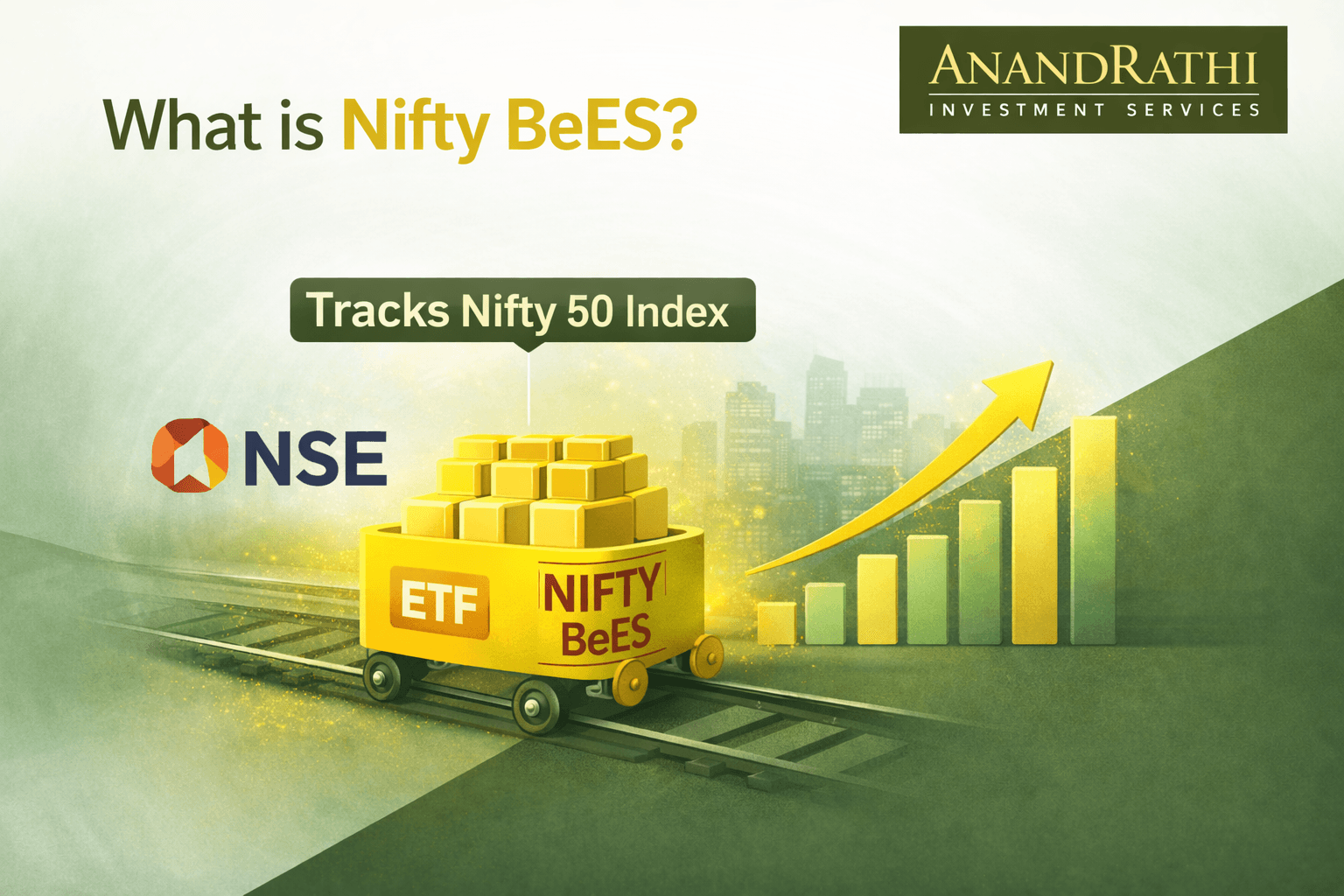
What is Nifty BeES?

Many investors want exposure to the stock market without selecting individual stocks or tracking dozens of companies. Index-based investment instruments were designed to solve this problem by allowing investors to participate in the broader market through a single security.

One such instrument available in India is Nifty BeES. It tracks Nifty 50's performance, which represents 50 large companies that are listed on the exchange - National Stock Exchange of India. Because it trades on the exchange like a stock while also belonging to the mutual fund ecosystem, Nifty BeES sits at the intersection of stock market trading and mutual fund investment.

For investors exploring mutual funds online, understanding how this ETF works can provide useful insight into index-based investing. In this guide, we’ll explore what is Nifty BeES ETF, its features, how it works, its benefits, and its taxation. So keep scrolling ahead!

What is Nifty BeES ETF?

Nifty BeES (Nifty Benchmark Exchange Traded Scheme) is an Exchange Traded Fund (ETF) that aims to replicate the performance of the Nifty 50. It was introduced by Nippon India Mutual Fund and is among the earliest ETFs launched in India.

In simple terms:

Nifty BeES is a fund that invests in the same companies that form the Nifty 50 index, in similar proportions. Each unit of the ETF represents a small portion of the index. As the index moves up or down, the price of Nifty BeES generally moves in the same direction.

Key Features of Nifty BeES

Understanding the core features helps explain why Nifty BeES functions differently from traditional mutual funds.

  1. Index-Based Investment: Nifty BeES follows a passive investment strategy, meaning it aims to replicate the performance of the index rather than outperform it.
  2. Exchange-Traded Structure: Unlike conventional funds, Nifty BeES is traded directly on the National Stock Exchange of India during market hours.
  3. Diversified Exposure: By tracking the Nifty 50, the ETF provides exposure to 50 large-cap companies across different sectors.
  4. Transparent Portfolio: The holdings are aligned closely with the composition of the Nifty 50 index, making the portfolio structure relatively transparent.
  5. Market Liquidity: Since it trades on the exchange, units can be bought or sold throughout the trading day.

How Does Nifty BeES Work?

To understand what is Nifty BeES, it helps to look at its structure step by step.

Step 1: Fund Creation - An asset management company collects money from investors and creates the ETF.

Step 2: Portfolio Replication - The fund invests in the companies that make up the Nifty 50, maintaining similar weightage.

Step 3: Exchange Listing - Units of the ETF are listed on the National Stock Exchange of India.

Step 4: Market Trading - Investors can buy or sell Nifty BeES units during trading hours, similar to buying or selling shares.

Step 5: Price Movement - The price of the ETF generally moves in line with the Nifty 50 index because the underlying portfolio mirrors the index composition.

Example: How Nifty BeES Tracks the Market

Imagine the Nifty 50 rises by 1%. Because Nifty BeES replicates the index portfolio:

  • The ETF’s value typically rises by a similar percentage.
  • If the index falls, the ETF generally moves downward as well.

This direct relationship between the ETF and the index is why Nifty BeES is classified as a passive investment instrument.

Nifty BeES vs Traditional Mutual Funds

Although Nifty BeES belongs to the mutual fund ecosystem, its structure differs significantly from traditional funds.

AspectsNifty BeESTraditional Mutual Funds
StructureExchange Traded FundOpen-ended or closed-ended fund
TradingBought and sold on the stock exchangePurchased through fund houses or mutual funds online platforms
Price DiscoveryMarket price changes during trading hoursNAV is calculated once at the end of the day
Investment StylePassive index trackingTypically actively managed
LiquidityTraded anytime during market hoursRedemption processed based on end-of-day NAV

Both fall under the broader category of mutual fund investment, but the investment experience differs.

Role of Nifty BeES in a Portfolio

Nifty BeES can play several roles depending on how investors structure their portfolios.

  1. Broad Market Exposure: Because it tracks the Nifty 50, it reflects the performance of major companies across sectors.
  2. Core Portfolio Allocation: Some investors allocate index-based instruments as a foundational component of their equity exposure.
  3. Diversification: Through a single investment instrument, Nifty BeES provides exposure to multiple sectors and companies.
  4. Passive Investment Strategy: Investors who prefer index-linked returns instead of active fund management may consider ETFs as part of their investment approach.

Advantages & Disadvantages of Nifty BeES

Advantages:

  • Diversified Market Exposure: Tracking the Nifty 50 provides exposure to multiple sectors through one instrument.
  • Transparent Investment Structure: The ETF’s holdings mirror the index, making the portfolio composition easy to understand.
  • Exchange-Based Trading: Units are traded on the National Stock Exchange of India, enabling intraday buying and selling.
  • Passive Investment Approach: The fund follows an index-replication strategy rather than active stock selection.

Disadvantages:

  • No Outperformance Objective: Since it tracks an index, the goal is to replicate market performance rather than exceed it.
  • Market Risk: Returns are directly linked to the movement of the underlying index.
  • Trading Infrastructure Required: Buying or selling units requires access to the stock exchange.

Taxation on Nifty BeES

For taxation purposes, Nifty BeES is treated similarly to equity-oriented investments in India.

  1. Short-Term Capital Gains (STCG):

    If units are sold within or less than one year of purchase, gains may be taxed at 20% under short-term capital gains rules applicable to equity investments.

  2. Long-Term Capital Gains (LTCG):

    If units are held for more than one year, gains above the applicable exemption limit of ₹1.25 Lakh are taxed at 12.5% under the long-term capital gains rules.

Tax regulations may change over time, and guidelines issued by the Securities and Exchange Board of India help regulate such investment instruments.

Understanding what is Nifty BeES ETF helps clarify how index-based exchange-traded funds function within the broader investment landscape. Because it combines features of exchange trading and mutual fund investment, it represents one of the structures through which investors participate in index-linked market movements while exploring mutual funds online and other investment platforms.


Frequently Asked Questions

1. What is Nifty BeES ETF?

Nifty BeES ETF is a fund listed on the National Stock Exchange of India that aims to replicate the returns of the Nifty 50 index.

2. Is Nifty BeES the same as a mutual fund?

Nifty BeES is part of the mutual fund ecosystem but structured as an exchange-traded fund, meaning it is traded on the stock exchange rather than purchased directly from the fund house.

3. What is the difference between Nifty BeES and Nifty 50?

The Nifty 50 is a market index that tracks the performance of 50 major companies, while Nifty BeES is an ETF designed to replicate that index by investing in the same companies.

4. Where is Nifty BeES traded?

Nifty BeES is listed and traded on the National Stock Exchange of India, where investors can buy or sell units during market hours.

Disclaimer

Mutual fund investments are subject to market risks. Please read all scheme-related documents carefully before investing. The information provided is for educational purposes only. Tax rules may change and can differ based on individual investor profiles and the type of mutual fund selected. Any illustrations or examples used are solely for explanation and do not guarantee returns. Please consult your financial advisor before making any investment decisions. Anand Rathi Share and Stock Brokers Ltd. is an AMFI-registered mutual Fund Distributor | ARN-4478| 10th Floor, A Wing, Express Zone, Western Express Highway, Goregaon (East), Mumbai, Maharashtra - 400063, India. Mutual Fund investments are subject to market risks. Read all scheme-related documents carefully before investing. For more details, please visit www.anandrathi.com.

Download TradeMobi App

Real-Time Market Data
Advanced Trading Tools
Expert-Backed Research
Google Play
App Store
TradeMobi

Popular on Anand Rathi

Explore Sitemap

Anand Rathi Share and Stock Brokers Ltd.
SEBI Registration No.: INZ000170832 (BSE-949 | NSE-06769 | MSEI-1014 | MCX-56185 | NCDEX-1252), CDSL & NSDL: IN-DP-437-2019. *Research Analyst - INH000000834. PMS: INP000000282 is Registered under "Anand Rathi Advisors Limited" | MBD-INM000010478 is Registered under "Anand Rathi Advisors Limited"| NBFC is Registered under "Anand Rathi Global Finance Limited" Regn. No.: B-13.01682 | Insurance is Registered under "Anand Rathi Insurance Brokers Ltd." License No. 175. Insurance Corporate Agent: CA1048 (This registration shall be valid from 04-Jun-2025 to 03-Jun-2028).

Anand Rathi International Ventures (IFSC) Private Limited.
SEBI Registration No.: INZ000292939 (INDIA INX Member Code: TM - 5064 | NSE IX Member Code: TM -10048, IIBX Member Code: TM – 2011), IIDI DP ID 350071 AND Registration No.: IFSCA/DP/2022-23/007, IFSCA/CMI/Distributor/2023-24/0002. CIN No.: U65999GJ2016PTC094915. For any complaints email at Ifscgrievance@rathi.com. Regulator: International Financial Services Centres Authority (IFSCA)- https://www.ifsca.gov.in/

Disclaimer:

Equity: Investment in securities market are subject to market risks, read all the related documents carefully before investing.

The securities are quoted as an example and not as a recommendation.

Mutual Funds: Mutual Fund investments are subject to market risks, read all scheme related documents carefully before Investing. AMFI-Registered Mutual Fund Distributor: ARN-4478 (Initial Registration 4th Feb, 2003 & Valid From 2nd April, 2025 - 1st April, 2028) : Anand Rathi Share and Stock Brokers Ltd. | ARN-111569: Anand Rathi Wealth Limited | ARN-100284: AR Digital Wealth Private Limited.

IPO: Opening of account will not guarantee allotment of shares in IPO. Investors are requested to do their own due diligence before investing in any IPO.

*Third Party products: All third-party products like PMS, Mutual Funds, Fixed Income Products, IBS, Bonds, AIFs are not Exchange traded product and "ARSSBL" is just acting as distributor. All disputes with respect to the distribution activity, would not have access to Exchange investor redressal forum or Arbitration mechanism.

MTF: MTF is subject to the provisions of SEBI Cir. CIR/MRD/DP/54/2017 dt June 13, 2017 & terms and conditions mentioned in rights and obligations statement issued by the ARSSBL

Investment Baskets: Baskets are not Exchange traded product, all disputes with respect to this activity, would not have access to Exchange investor redressal forum or Arbitration mechanism.

Research Analyst: The views expressed in this website accurately reflect the personal views of the analyst(s) about the subject securities or issuers and no part of the compensation of the research analyst(s) was, is, or will be directly or indirectly related to the specific recommendations or views expressed by the research analyst(s). The advertisment are bound by stringent internal regulations and also legal and statutory requirements of the Securities and Exchange Board of India (hereinafter "SEBI").

Certification: Registration granted by SEBI and certification from NISM is in no way a guarantee of performance of the intermediary or provides any assurance of returns to investors.

*Award Winning Research: Anand Rathi Share and Stock Brokers Limited (Research Analyst) was awarded as "Best Equity Advisor" at World BFSI Congress & Awards 2022

*Client Data: Client data shown on this website is as on 31st March 2025

Trading View: Anand Rathi has partnered with TradingView for its charting technology. A global platform offering heatmaps, STOCK SCREENERS and market data.

By submitting this form, I hereby provide my explicit consent to be contacted by Anand Rathi Group and its associate companies via phone call, SMS, email, or WhatsApp for information related to products and services, even if I am registered on DND.

Attention Investors:

  • For all communication related to vulnerability reporting, security alerts, or any other suspicious activity related to cyber security, contact priyanksheth@rathi.com/+91-22-62811514"
  • For any complaints email at grievance@rathi.com, For DP related queries/complaints email at dp@rathi.com
  • For any Mutual Fund-related complaints, please email customersupport@rathi.com.
  • For further escalation, you may contact mf@rathi.com.
  • Filing of complaints on SCORES – Easy & quick a. Register on SCORES portal b. Mandatory details for filing complaints on SCORES: I. Name, PAN, Address, Mobile Number, Email ID c. Benefits: I. Effective communication ii. Speedy redressal of the grievances.
  • Stock Brokers can accept securities as margin from clients only by way of pledge in the depository system w.e.f. September 1, 2020.
  • Update your mobile number & email Id with your stock broker/depository participant and receive OTP directly from depository on your email id and/or mobile number to create pledge.
  • Pay 20% upfront margin of the transaction value to trade in cash market segment.
  • Investors may please refer to the Exchange's Frequently Asked Questions (FAQs) issued vide circular reference NSE/INSP/45191 dated July 31, 2020 and NSE/INSP/45534 and BSE vide notice no. 20200731-7 dated July 31, 2020 and 20200831-45 dated August 31, 2020 dated August 31, 2020 and other guidelines issued from time to time in this regard
  • Check your Securities /MF/ Bonds in the consolidated account statement issued by NSDL/CDSL every month.
Prevent Unauthorized Transactions in your demat account → Update your Mobile Number with your Depository Participant. Receive alerts on your Registered Mobile for all debit and other important transactions in your demat account directly from CDSL.No need to issue cheques by investors while subscribing to IPO. Just write the bank account number and sign in the application form to authorise your bank to make payment in case of allotment. No worries for refund as the money remains in investor's account.KYC is one time exercise while dealing in securities markets - once KYC is done through a SEBI registered intermediary (broker, DP, Mutual Fund etc.), you need not undergo the same process again when you approach another intermediary.Prevent Unauthorized Transactions in your demat account → Update your Mobile Number with your Depository Participant. Receive alerts on your Registered Mobile for all debit and other important transactions in your demat account directly from CDSL.No need to issue cheques by investors while subscribing to IPO. Just write the bank account number and sign in the application form to authorise your bank to make payment in case of allotment. No worries for refund as the money remains in investor's account.KYC is one time exercise while dealing in securities markets - once KYC is done through a SEBI registered intermediary (broker, DP, Mutual Fund etc.), you need not undergo the same process again when you approach another intermediary.