
Mutual funds are considered one of the most popular investment options today. It is largely because of the ease with which one can invest in mutual funds online.
However, the industry wasn’t always this accessible or diversified. Some schemes have been around for decades and have played a major role in the development of the Mutual Fund industry.
These are known as the oldest mutual funds, funds that have consistently operated across multiple market cycles and economic environments.
Understanding these old mutual funds can help investors make better decisions when they invest in mutual funds.
What Are Oldest Mutual Funds?
The term "oldest mutual funds" refers to mutual funds that have been in existence for a long period of time, i.e., 20 years, 30 years, and even 40 years or more. These funds have been able to prove their strength and ability to survive:
- Economic slowdowns
- Market crashes
- Regulatory changes
- Shifts in investment trends
Unlike other newly launched schemes, these funds have an established record, and hence investors can assess their performance more effectively.
History of Mutual Funds: Global and Indian Perspective
Global Origin
The concept of mutual funds was first introduced in the 18th century in Europe. The idea was simple: collect money from multiple investors and invest it collectively.
Evolution in India
The journey of mutual funds in India can be broadly classified into various phases:
1. Formation Phase (1963–1987):
- The industry was initiated by the Unit Trust of India (UTI)
- Emphasis on conservative investment options
- Few options available for investors
2. Expansion Phase (1987–1993):
- Entry of public sector mutual funds (banks and institutions)
- Increased competition and product variety
3. Liberalisation Phase (Post-1993-2003):
- Private sector players entered the market
- The SEBI (Mutual Fund) Regulations, 1993, were formulated, which introduced standardized transparency and protection for the small investor
- Introduction of diversified equity funds, debt funds, and hybrid funds
- Rise of mutual fund investment as a mainstream option
4. Digital & Growth Phase (2003–Present):
- UTI was bifurcated, bringing the industry under a uniform SEBI regulatory umbrella
- A massive push toward investor education and the "Mutual Funds Sahi Hai" campaign
- Rise of online mutual fund platforms
- Easy access to mutual funds online
- Increased retail investor participation
Examples of Oldest Mutual Funds in India
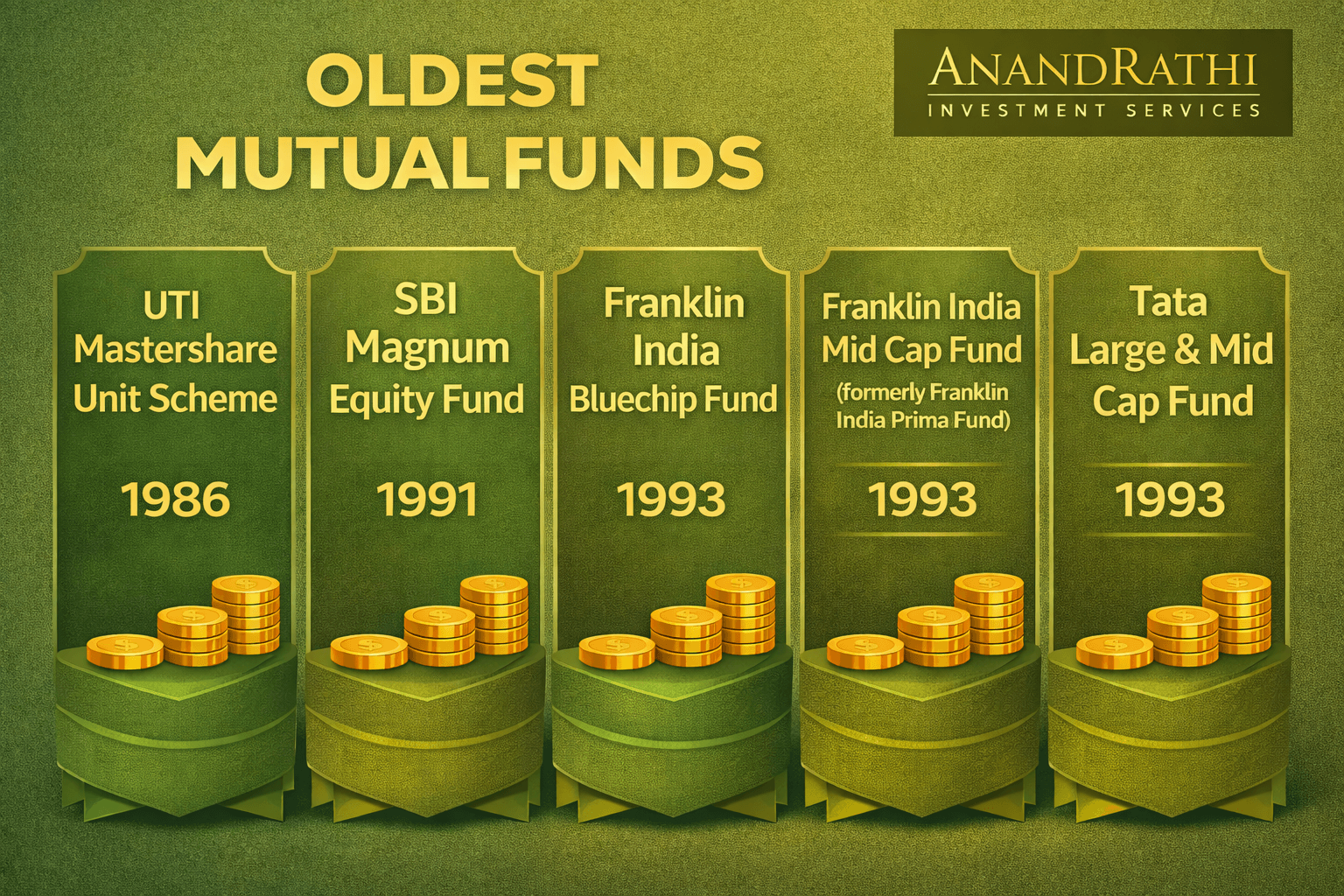
Some of the most notable old mutual funds that continue to exist today include:
- UTI Mastershare Unit Scheme (1986)
One of the oldest equity-based schemes - SBI Magnum Equity Fund (1991)
Popular for its long-term growth prospects - Franklin India Bluechip Fund (1993)
Invests in large-cap companies - Franklin India Mid Cap Fund (formerly Franklin India Prima Fund)
A well-known mid-cap fund - Tata Large & Mid Cap Fund (1993)
Balanced exposure to large and mid-sized companies
These funds have built credibility due to their longevity and consistent management.
What Makes Old Mutual Funds Unique?
1. Long-Term Performance Data: One of the biggest advantages of the oldest mutual funds is the availability of long-term historical data. Investors can evaluate:
- Performance across decades
- Behaviour during market downturns
- Consistency in returns
2. Ability to Withstand Market Cycles: Old mutual funds have managed to handle situations like stock market crashes, inflation, and changes in interest rates. Because of this, they are more dependable than newer funds that have short track records.
3. Experienced Fund Management: The longevity of these funds often shows strong fund management practices and solid investment processes.
4. Established Investment Strategy: These funds normally follow a strategy, and the strategy has been refined over time. These funds are different from newer funds, which may seek to use aggressive investment strategies.
Benefits of Investing in Old Mutual Funds
1. Credibility and Trust: The long existence of these funds builds investor confidence.
2. Consistency in Returns: While returns may not always be the highest, they tend to be more stable over time.
3. Demonstration of Compounding: Old funds clearly show how long-term mutual fund investment can benefit from compounding.
4. Lower Risk of Strategy Failure: New funds may change strategies frequently, but older funds usually have proven models.
Limitations of Old Mutual Funds
Even though the oldest mutual funds have many advantages, they also have some limitations:
1. Slower Growth Potential: Old mutual funds may not always offer the same high returns as the newer mutual funds.
2. Large Fund Size (AUM): Old mutual funds with large assets may not always be able to make flexible investment decisions.
3. Outdated Strategies: Some older funds may not be able to adjust quickly to new trends in the market.
How to Invest in Mutual Funds Online?
With the help of digital platforms, investing in mutual funds online is extremely simple:
Step-by-Step Process:
- Register on a trusted investment platform
- Complete KYC verification
- Explore available mutual fund schemes
- Select funds based on goals and risk appetite
- Start SIP (Systematic Investment Plan) or invest a lump sum
- Monitor your portfolio regularly
Online investing has made mutual fund investment more convenient, transparent, and accessible.
Key Factors to Consider Before Investing
Before selecting from the oldest mutual funds, consider:
- Investment objective
- Risk tolerance
- Fund performance (long-term and recent)
- Expense ratio
- Fund manager’s track record
- Portfolio composition
Always ensure that the fund aligns with your financial goals rather than choosing it solely based on age.