AnandRathi

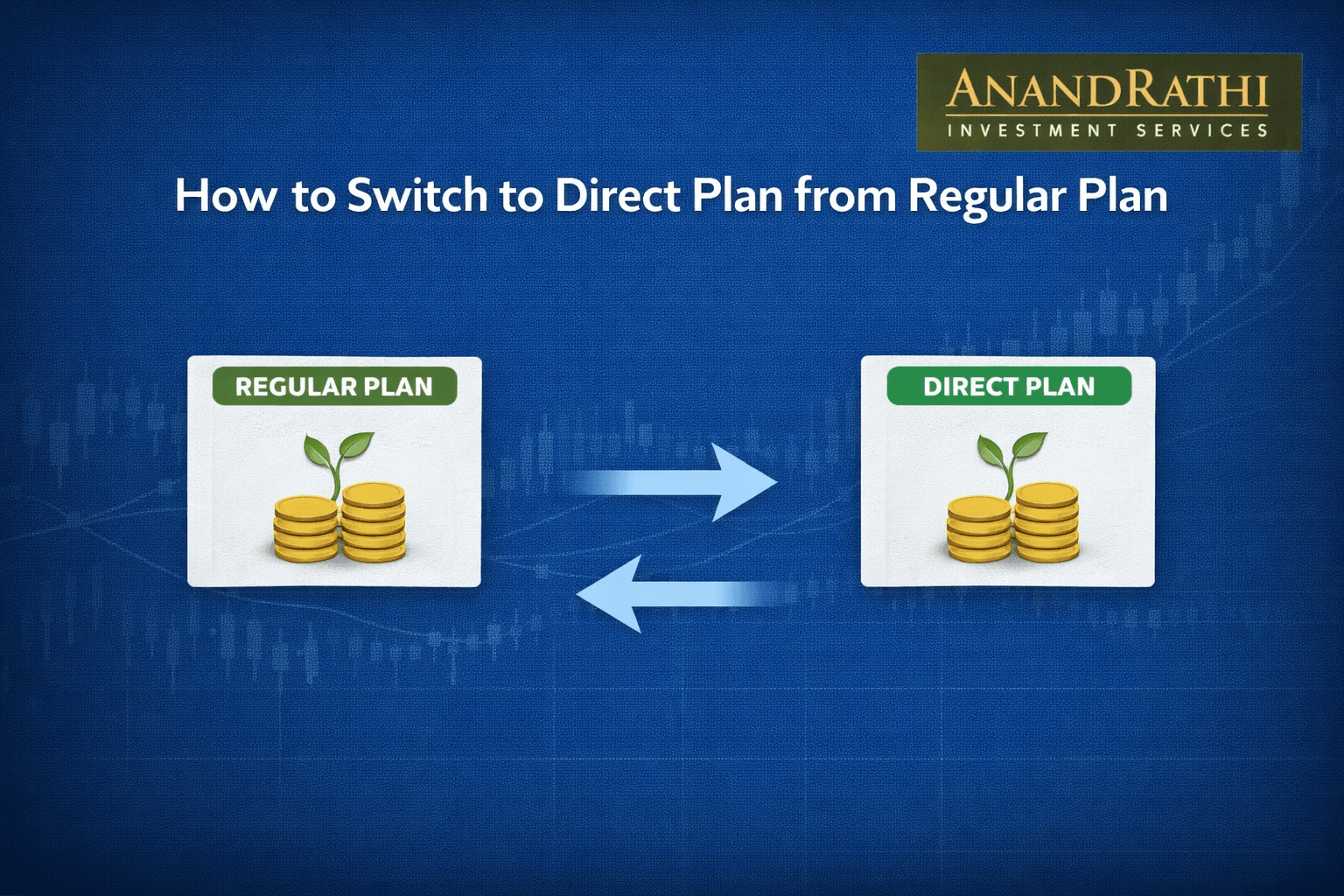
How To Switch To Direct Plan From Regular Plan?

How To Switch To Direct Plan From Regular Plan?

Investors today are increasingly looking for ways to maximise returns from their mutual fund investment.

One of the most effective ways to do this is by switching from a regular plan to a direct plan. With the growth of mutual funds online, this process has become easier, faster, and more transparent.

If you already invest in mutual funds, understanding how to switch from a regular plan to a direct plan can significantly improve your long-term wealth creation.

This guide will walk you through everything you need to know about switching from regular to direct mutual fund plans.

Regular and Direct Plan in Mutual Funds

Before learning how to switch from regular to direct plan, it’s important to understand the difference between the two:

Regular Plan

A regular plan is a mutual fund scheme that can be bought through intermediaries such as brokers, agents, or distributors. These intermediaries earn a commission (expense ratio component), which is paid by the investor indirectly.

Direct Plan

A direct plan is purchased directly from the Asset Management Company (AMC) without any intermediary. Since there is no commission involved, the expense ratio is lower, which can result in significant capital appreciation over time.

How To Switch From a Regular Plan to a Direct Plan?

If you’re wondering how to switch from regular plan to direct plan, here’s a step-by-step guide:

1. Log in to Your Account:

You can access your mutual fund account by logging in through the AMC website, the registrar websites such as CAMS or KFintech, and your existing investment portal.

2. Select the Scheme You Want to Switch:

Choose the mutual fund scheme where you currently hold units under the regular plan.

3. Choose the “Switch” Option:

Most platforms provide a “Switch” option. Select the option for Switch. Change from Regular Plan to Direct Plan (same scheme).

4. Enter the Number of Units or Amount:

You can switch your entire investment or switch a part of your investment.

5. Confirm and Submit:

Confirm your investment and submit your switch request.

6. Tax Implications:

Since you are making a switch, it is treated as a redemption of units from the regular plan and a fresh investment in the direct plan. Capital gains tax is levied on the investment.

7. Track Your New Investment:

Once processed, your investment will reflect under the direct plan of the same scheme.

Why Switch From a Regular Plan to a Direct Plan?

Many investors are shifting to direct plans due to cost efficiency and better transparency.

1. Lower expense ratio: The biggest reason to switch is cost savings. Regular plans include distributor commissions. In a direct plan, there is no middleman involved, making the investment more cost-efficient and transparent.

2. Long-Term Capital Appreciation: Due to this, direct plans result in substantial capital appreciation. It is not because the fund is performing better. It is because less money is deducted as fees.

3. Compounding: In the case of investment in mutual funds, compounding is important. When costs are low, the investment pool grows, and hence the power of compounding can be utilized efficiently, resulting in better wealth creation.

4. Transparency: In direct plans, you get better transparency. You know exactly where you are investing your money. There are no hidden costs involved.

Things to Consider Before Switching

Before you decide how to switch from a regular to a direct plan, keep these factors in mind:

Before you decide how to switch from a regular to a direct plan, keep these factors in mind:

1. Exit Load: In a major investor-friendly move, SEBI has clarified that no exit load is charged when switching between Regular and Direct plans within the same scheme.

However, ELSS (Tax Saver)schemes have a 3-year lock-in period. You cannot switch ELSS units until this lock-in period is over.

2. Capital Gains Tax: Switching is considered the redemption of units from the regular plan and fresh investment in the direct plan. Hence, capital gains tax is levied.

Fund CategoryShort-Term Capital Gains (STCG)Long-Term Capital Gains (LTCG)
Equity Funds20% (if held < 1 year)12.5% (if held > 1 year; exempt up to ₹1.25 lakh)
Debt FundsSlab rate (always)No LTCG benefit for investments after April 1, 2023.

Debt funds bought before April 1, 2023, still qualify for:

  • 12.5% LTCG (after 24 months)
  • However, indexation benefits are removed

3. Market Timing & Holding Period Reset: A switch can take 1–2 business days. During this time, your money is briefly out of the market. Avoid switching during periods of extreme market volatility.

Also, you should remember that your holding period starts from zero in the direct plan, and tax is calculated based on the new investment date.

4. SIP Transition: A switch only moves your existing units, not your SIPs. You are required to cancel your regular SIP and start a new SIP in the direct plan.

5. Advisory & Service Support: When you move to a direct plan, you do not pay any distributor commission. However, you do not get any advisory support as you are required to manage the entire portfolio yourself.

Common Mistakes to Avoid

While learning how to switch from a regular plan to a direct plan, avoid the following common pitfalls:

  • Don’t switch without taxability in mind; it might impact gains.
  • Always ensure exit charges are not applicable before switching.
  • Excessive switching can result in avoidable costs and tax events.
  • Switching to a direct plan doesn’t fix poor fund selection; review the scheme first.
  • Many investors forget to initiate SIPs in the direct plan after switching.

Frequently Asked Questions

1. Is there any exit load when switching to a direct plan?

As per the latest regulations, no exit load is charged when switching between regular and direct plans within the same scheme.

Exception: ELSS funds still have a 3-year lock-in, so switching is not allowed before that.
 

2. Is switching from a regular to a direct plan taxable?

Yes. Switching is considered redemption and fresh investment. So, capital gains tax is levied on the basis of fund type and holding period. 
 

3. Does switching affect my SIP?

Yes. A switch only transfers your existing units. It does not transfer your SIP. You must cancel the existing SIP and start a new SIP in the direct plan.
 

4. Can I switch partially from a regular to a direct plan?

Yes, you can switch the full investment or switch only a portion of your units. 
 

5. Do I need a new folio to switch?

No, you do not need a new folio.
 

Disclaimer

Mutual fund investments are subject to market risks. Please read all scheme-related documents carefully before investing. The information provided is for educational purposes only. Tax rules may change and vary by individual investor profile and the type of mutual fund selected. Any illustrations or examples used are solely for explanation and do not guarantee returns. Please consult your financial advisor before making any investment decisions. Anand Rathi Share and Stock Brokers Ltd. is an AMFI-registered mutual Fund Distributor | ARN-4478| 10th Floor, A Wing, Express Zone, Western Express Highway, Goregaon (East), Mumbai, Maharashtra - 400063, India. Mutual Fund investments are subject to market risks. Read all scheme-related documents carefully before investing. For more details, please visit www.anandrathi.com

Download TradeMobi App

Real-Time Market Data
Advanced Trading Tools
Expert-Backed Research
Google Play
App Store
TradeMobi

Popular on Anand Rathi

Explore Sitemap

Anand Rathi Share and Stock Brokers Ltd.
SEBI Registration No.: INZ000170832 (BSE-949 | NSE-06769 | MSEI-1014 | MCX-56185 | NCDEX-1252), CDSL & NSDL: IN-DP-437-2019. *Research Analyst - INH000000834. PMS: INP000000282 is Registered under "Anand Rathi Advisors Limited" | MBD-INM000010478 is Registered under "Anand Rathi Advisors Limited"| NBFC is Registered under "Anand Rathi Global Finance Limited" Regn. No.: B-13.01682 | Insurance is Registered under "Anand Rathi Insurance Brokers Ltd." License No. 175. Insurance Corporate Agent: CA1048 (This registration shall be valid from 04-Jun-2025 to 03-Jun-2028).

Anand Rathi International Ventures (IFSC) Private Limited.
SEBI Registration No.: INZ000292939 (INDIA INX Member Code: TM - 5064 | NSE IX Member Code: TM -10048, IIBX Member Code: TM – 2011), IIDI DP ID 350071 AND Registration No.: IFSCA/DP/2022-23/007, IFSCA/CMI/Distributor/2023-24/0002. CIN No.: U65999GJ2016PTC094915. For any complaints email at Ifscgrievance@rathi.com. Regulator: International Financial Services Centres Authority (IFSCA)- https://www.ifsca.gov.in/

Disclaimer:

Equity: Investment in securities market are subject to market risks, read all the related documents carefully before investing.

The securities are quoted as an example and not as a recommendation.

Mutual Funds: Mutual Fund investments are subject to market risks, read all scheme related documents carefully before Investing. AMFI-Registered Mutual Fund Distributor: ARN-4478 (Initial Registration 4th Feb, 2003 & Valid From 2nd April, 2025 - 1st April, 2028) : Anand Rathi Share and Stock Brokers Ltd. | ARN-111569: Anand Rathi Wealth Limited | ARN-100284: AR Digital Wealth Private Limited.

IPO: Opening of account will not guarantee allotment of shares in IPO. Investors are requested to do their own due diligence before investing in any IPO.

*Third Party products: All third-party products like PMS, Mutual Funds, Fixed Income Products, IBS, Bonds, AIFs are not Exchange traded product and "ARSSBL" is just acting as distributor. All disputes with respect to the distribution activity, would not have access to Exchange investor redressal forum or Arbitration mechanism.

MTF: MTF is subject to the provisions of SEBI Cir. CIR/MRD/DP/54/2017 dt June 13, 2017 & terms and conditions mentioned in rights and obligations statement issued by the ARSSBL

Investment Baskets: Baskets are not Exchange traded product, all disputes with respect to this activity, would not have access to Exchange investor redressal forum or Arbitration mechanism.

Research Analyst: The views expressed in this website accurately reflect the personal views of the analyst(s) about the subject securities or issuers and no part of the compensation of the research analyst(s) was, is, or will be directly or indirectly related to the specific recommendations or views expressed by the research analyst(s). The advertisment are bound by stringent internal regulations and also legal and statutory requirements of the Securities and Exchange Board of India (hereinafter "SEBI").

Certification: Registration granted by SEBI and certification from NISM is in no way a guarantee of performance of the intermediary or provides any assurance of returns to investors.

*Award Winning Research: Anand Rathi Share and Stock Brokers Limited (Research Analyst) was awarded as "Best Equity Advisor" at World BFSI Congress & Awards 2022

*Client Data: Client data shown on this website is as on 31st March 2025

Trading View: Anand Rathi has partnered with TradingView for its charting technology. A global platform offering heatmaps, STOCK SCREENERS and market data.

By submitting this form, I hereby provide my explicit consent to be contacted by Anand Rathi Group and its associate companies via phone call, SMS, email, or WhatsApp for information related to products and services, even if I am registered on DND.

Attention Investors:

  • For all communication related to vulnerability reporting, security alerts, or any other suspicious activity related to cyber security, contact priyanksheth@rathi.com/+91-22-62811514"
  • For any complaints email at grievance@rathi.com, For DP related queries/complaints email at dp@rathi.com
  • For any Mutual Fund-related complaints, please email customersupport@rathi.com.
  • For further escalation, you may contact mf@rathi.com.
  • Filing of complaints on SCORES – Easy & quick a. Register on SCORES portal b. Mandatory details for filing complaints on SCORES: I. Name, PAN, Address, Mobile Number, Email ID c. Benefits: I. Effective communication ii. Speedy redressal of the grievances.
  • Stock Brokers can accept securities as margin from clients only by way of pledge in the depository system w.e.f. September 1, 2020.
  • Update your mobile number & email Id with your stock broker/depository participant and receive OTP directly from depository on your email id and/or mobile number to create pledge.
  • Pay 20% upfront margin of the transaction value to trade in cash market segment.
  • Investors may please refer to the Exchange's Frequently Asked Questions (FAQs) issued vide circular reference NSE/INSP/45191 dated July 31, 2020 and NSE/INSP/45534 and BSE vide notice no. 20200731-7 dated July 31, 2020 and 20200831-45 dated August 31, 2020 dated August 31, 2020 and other guidelines issued from time to time in this regard
  • Check your Securities /MF/ Bonds in the consolidated account statement issued by NSDL/CDSL every month.
Prevent Unauthorized Transactions in your demat account → Update your Mobile Number with your Depository Participant. Receive alerts on your Registered Mobile for all debit and other important transactions in your demat account directly from CDSL.No need to issue cheques by investors while subscribing to IPO. Just write the bank account number and sign in the application form to authorise your bank to make payment in case of allotment. No worries for refund as the money remains in investor's account.KYC is one time exercise while dealing in securities markets - once KYC is done through a SEBI registered intermediary (broker, DP, Mutual Fund etc.), you need not undergo the same process again when you approach another intermediary.Prevent Unauthorized Transactions in your demat account → Update your Mobile Number with your Depository Participant. Receive alerts on your Registered Mobile for all debit and other important transactions in your demat account directly from CDSL.No need to issue cheques by investors while subscribing to IPO. Just write the bank account number and sign in the application form to authorise your bank to make payment in case of allotment. No worries for refund as the money remains in investor's account.KYC is one time exercise while dealing in securities markets - once KYC is done through a SEBI registered intermediary (broker, DP, Mutual Fund etc.), you need not undergo the same process again when you approach another intermediary.