AnandRathi

What Are the Differences Between Active and Passive Funds?

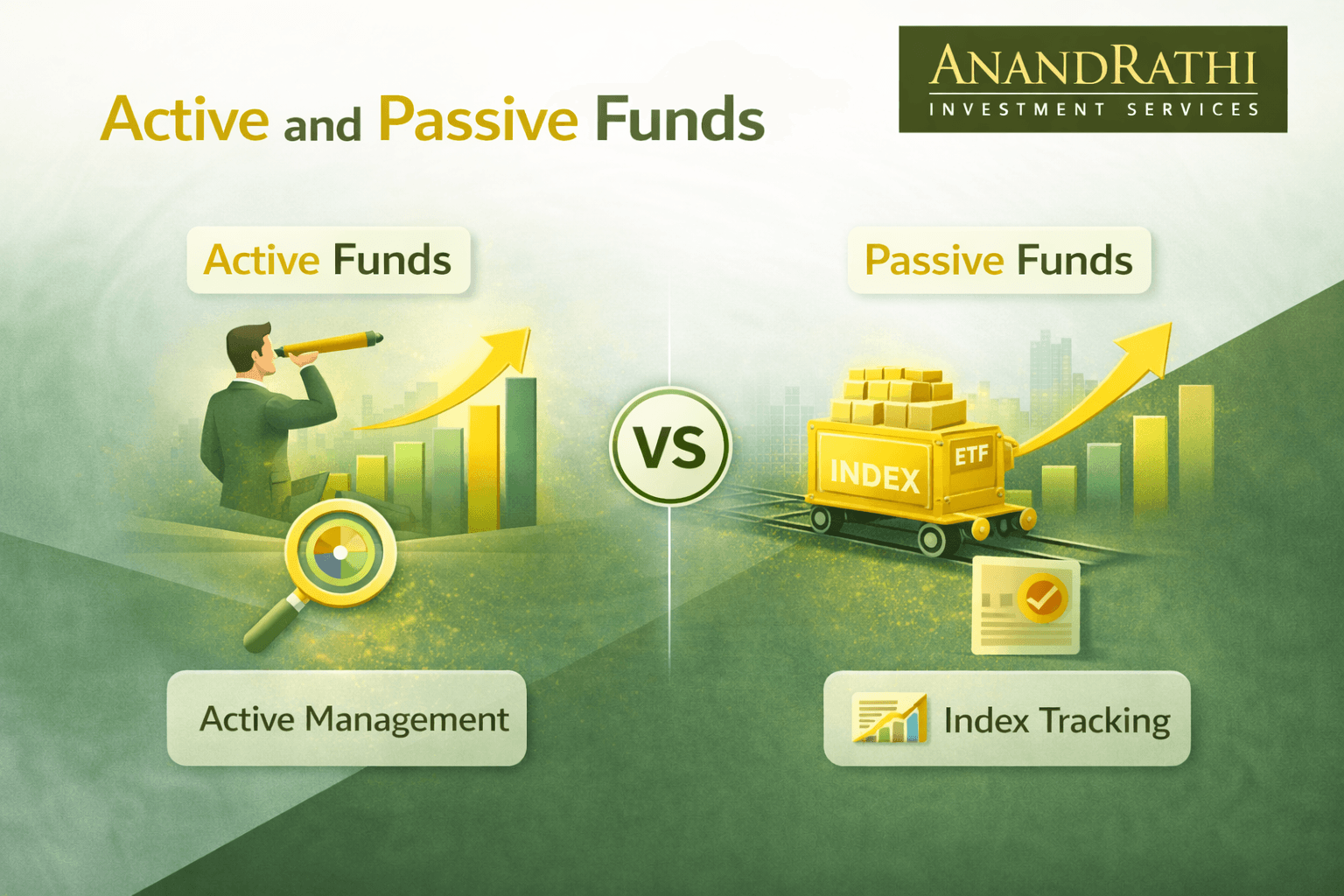
Active and Passive Funds

When it comes to mutual fund investing, Active and passive funds are the two main options available to investors. At the same time, both investment strategies cater to different investor types and offer distinctive characteristics, risks, and returns. But, as an investor, what should you choose?

Keep reading, as this blog helps you understand the plus points of active and passive mutual funds and why either may not fit your investing objectives and risk tolerance level.

Understanding Active Mutual Funds

Active mutual funds involve fund managers actively making investment decisions to outperform a market benchmark or index. Here, fund managers conduct in-depth research and examine market movements, and then make any investments.

These mutual funds often focus on taking advantage of market imperfections (or gaps). For instance, a fund manager may favour investments in businesses within a certain industry if they believe that sector will perform better than others.

What are Passive Mutual Funds?

Passive mutual funds are among those categories that replicate the performance (or path) of a specific market index, like the Nifty 50 or Sensex. Here, the fund invests the pooled money in the same stocks in precisely the same proportion as their underlying index, as opposed to choosing individual securities based on in-depth analysis.

Additionally, the returns you earn in passive funds are much aligned with the overall market performance. Hence, even the fund manager's role in this type of mutual fund is limited.

Active vs. Passive Mutual Funds

While both follow distinct investment strategies, they do have differences. Let us understand them:

Investment Approach

By default, passive funds replicate a market index without human intervention. In comparison, active funds do rely on qualified managers to make informed investment decisions.

Objective

Active mutual funds employ timing and strategic asset allocation to outperform their benchmarks. The goal of passive funds is to match the returns of their benchmark.

Cost Structure

Due to management fees, research expenditures, and frequent trading, active funds generally have a higher expense ratio. Passive funds have fewer expenses because they involve less management.

Risk and Return

Active funds may yield higher returns than passive funds if the manager's investing techniques are successful. However, because active management entails informed assumptions on particular market outcomes, this carries a larger risk.

Because passive funds are well-diversified across various market indices, they involve a relatively low level of risk. In other words, they may not outperform the market significantly, but they do offer steady and consistent returns.

Transparency

Since these holdings and allocations closely resemble the underlying index, which investors can readily track, passive mutual funds provide greater transparency. In contrast, the managers regularly modify portfolios in response to market events, which leads to less transparency in active mutual funds.

Active Funds vs. Passive Funds: Key Differences In Table

If the above data seems overwhelming, refer to the table below for a brief overview of active and passive funds.

FactorActive FundsPassive Funds
Management StyleActively managed by fund managers who pick stocks/bonds to beat the market.Simply track a market index (like Nifty 50, Sensex) without active decision-making.
ObjectiveAim to outperform the benchmark index.Aim to mirror the benchmark index.
Cost (Expense Ratio)Higher, due to research and active managementLower, since it just tracks an index
ReturnsIt can be higher than index, but not guaranteed.
Mostly, it depends on manager’s skill and knowledge.
Generally it matches index returns, which often excludes small expenses.
RiskHigher risk if bets go wrong. Also, the performance varies with manager’s calls.Lower risk of underperformance as it only tracks index movements.
TransparencyLess transparent (portfolio changes depend on manager’s strategy).Highly transparent (always mirrors index composition).
ExamplesActively managed equity funds, sectoral funds, and thematic funds.Index funds and Exchange Traded Funds (ETFs).

When to Choose Active or Passive Mutual Funds?

Investors who are comfortable taking on more risk and seeking potential for greater rewards frequently choose active funds.

Active funds can suit if you;

  • Aim for returns above market averages.
  • Prefer a strategic approach and professional oversight.
  • You're willing to accept potentially higher volatility for the potential to outperform.

Likewise, the best use of Passive Funds is viable for those;

  • Preferring lower-cost investments.
  • Seeking a transparent, simple investment strategy.
  • Desiring predictable returns closely aligned with overall market performance.

More often, long-term investors who want to gradually increase their wealth without engaging in excessive market timing or close portfolio monitoring choose passive funds.

Active vs Passive: Why Not Both?

Today, many investors opt for a balanced approach by including both active and passive funds in their portfolios. By combining them, one can benefit from the stability and reduced expenses of passive investing while still beating the market through active management.

Conclusion

Choosing between active and passive mutual funds isn’t about finding the “best” one—it’s about what fits you. Your goals, comfort with risk, costs, and how long you’re willing to stay invested all matter. Active funds can chase higher growth but bring higher costs and more ups and downs. Passive funds, on the flip side, keep it simple with low fees and returns that move in line with the market.

In the end, it’s about building a mix that matches your own comfort and objectives. And getting the right advice comes with consulting a professional if you need more clarity on it.


Disclaimer

The information provided in this article is for educational and informational purposes only. Any financial figures, calculations, or projections shared are solely intended to illustrate concepts and should not be construed as investment advice. All scenarios mentioned are hypothetical and are used only for explanatory purposes. The content is based on information obtained from credible and publicly available sources. We do not guarantee the completeness, accuracy, or reliability of the data presented. Any references to the performance of indices, stocks, or financial products are purely illustrative and do not represent actual or future results. Actual investor experience may vary. Investors are advised to carefully read the scheme/product offering information document before making any decisions. Readers are advised to consult with a certified financial advisor before making any investment decisions. Neither the author nor the publishing entity shall be held responsible for any loss or liability arising from the use of this information.

Download TradeMobi App

Real-Time Market Data
Advanced Trading Tools
Expert-Backed Research
Google Play
App Store
TradeMobi

Popular on Anand Rathi

Explore Sitemap

Anand Rathi Share and Stock Brokers Ltd.
SEBI Registration No.: INZ000170832 (BSE-949 | NSE-06769 | MSEI-1014 | MCX-56185 | NCDEX-1252), CDSL & NSDL: IN-DP-437-2019. *Research Analyst - INH000000834. PMS: INP000000282 is Registered under "Anand Rathi Advisors Limited" | MBD-INM000010478 is Registered under "Anand Rathi Advisors Limited"| NBFC is Registered under "Anand Rathi Global Finance Limited" Regn. No.: B-13.01682 | Insurance is Registered under "Anand Rathi Insurance Brokers Ltd." License No. 175. Insurance Corporate Agent: CA1048 (This registration shall be valid from 04-Jun-2025 to 03-Jun-2028).

Anand Rathi International Ventures (IFSC) Private Limited.
SEBI Registration No.: INZ000292939 (INDIA INX Member Code: TM - 5064 | NSE IX Member Code: TM -10048, IIBX Member Code: TM – 2011), IIDI DP ID 350071 AND Registration No.: IFSCA/DP/2022-23/007, IFSCA/CMI/Distributor/2023-24/0002. CIN No.: U65999GJ2016PTC094915. For any complaints email at Ifscgrievance@rathi.com. Regulator: International Financial Services Centres Authority (IFSCA)- https://www.ifsca.gov.in/

Disclaimer:

Equity: Investment in securities market are subject to market risks, read all the related documents carefully before investing.

The securities are quoted as an example and not as a recommendation.

Mutual Funds: Mutual Fund investments are subject to market risks, read all scheme related documents carefully before Investing. AMFI-Registered Mutual Fund Distributor: ARN-4478 (Initial Registration 4th Feb, 2003 & Valid From 2nd April, 2025 - 1st April, 2028) : Anand Rathi Share and Stock Brokers Ltd. | ARN-111569: Anand Rathi Wealth Limited | ARN-100284: AR Digital Wealth Private Limited.

IPO: Opening of account will not guarantee allotment of shares in IPO. Investors are requested to do their own due diligence before investing in any IPO.

*Third Party products: All third-party products like PMS, Mutual Funds, Fixed Income Products, IBS, Bonds, AIFs are not Exchange traded product and "ARSSBL" is just acting as distributor. All disputes with respect to the distribution activity, would not have access to Exchange investor redressal forum or Arbitration mechanism.

MTF: MTF is subject to the provisions of SEBI Cir. CIR/MRD/DP/54/2017 dt June 13, 2017 & terms and conditions mentioned in rights and obligations statement issued by the ARSSBL

Investment Baskets: Baskets are not Exchange traded product, all disputes with respect to this activity, would not have access to Exchange investor redressal forum or Arbitration mechanism.

Research Analyst: The views expressed in this website accurately reflect the personal views of the analyst(s) about the subject securities or issuers and no part of the compensation of the research analyst(s) was, is, or will be directly or indirectly related to the specific recommendations or views expressed by the research analyst(s). The advertisment are bound by stringent internal regulations and also legal and statutory requirements of the Securities and Exchange Board of India (hereinafter "SEBI").

Certification: Registration granted by SEBI and certification from NISM is in no way a guarantee of performance of the intermediary or provides any assurance of returns to investors.

*Award Winning Research: Anand Rathi Share and Stock Brokers Limited (Research Analyst) was awarded as "Best Equity Advisor" at World BFSI Congress & Awards 2022

*Client Data: Client data shown on this website is as on 31st March 2025

Trading View: Anand Rathi has partnered with TradingView for its charting technology. A global platform offering heatmaps, STOCK SCREENERS and market data.

By submitting this form, I hereby provide my explicit consent to be contacted by Anand Rathi Group and its associate companies via phone call, SMS, email, or WhatsApp for information related to products and services, even if I am registered on DND.

Attention Investors:

  • For all communication related to vulnerability reporting, security alerts, or any other suspicious activity related to cyber security, contact priyanksheth@rathi.com/+91-22-62811514"
  • For any complaints email at grievance@rathi.com, For DP related queries/complaints email at dp@rathi.com
  • For any Mutual Fund-related complaints, please email customersupport@rathi.com.
  • For further escalation, you may contact mf@rathi.com.
  • Filing of complaints on SCORES – Easy & quick a. Register on SCORES portal b. Mandatory details for filing complaints on SCORES: I. Name, PAN, Address, Mobile Number, Email ID c. Benefits: I. Effective communication ii. Speedy redressal of the grievances.
  • Stock Brokers can accept securities as margin from clients only by way of pledge in the depository system w.e.f. September 1, 2020.
  • Update your mobile number & email Id with your stock broker/depository participant and receive OTP directly from depository on your email id and/or mobile number to create pledge.
  • Pay 20% upfront margin of the transaction value to trade in cash market segment.
  • Investors may please refer to the Exchange's Frequently Asked Questions (FAQs) issued vide circular reference NSE/INSP/45191 dated July 31, 2020 and NSE/INSP/45534 and BSE vide notice no. 20200731-7 dated July 31, 2020 and 20200831-45 dated August 31, 2020 dated August 31, 2020 and other guidelines issued from time to time in this regard
  • Check your Securities /MF/ Bonds in the consolidated account statement issued by NSDL/CDSL every month.
Prevent Unauthorized Transactions in your demat account → Update your Mobile Number with your Depository Participant. Receive alerts on your Registered Mobile for all debit and other important transactions in your demat account directly from CDSL.No need to issue cheques by investors while subscribing to IPO. Just write the bank account number and sign in the application form to authorise your bank to make payment in case of allotment. No worries for refund as the money remains in investor's account.KYC is one time exercise while dealing in securities markets - once KYC is done through a SEBI registered intermediary (broker, DP, Mutual Fund etc.), you need not undergo the same process again when you approach another intermediary.Prevent Unauthorized Transactions in your demat account → Update your Mobile Number with your Depository Participant. Receive alerts on your Registered Mobile for all debit and other important transactions in your demat account directly from CDSL.No need to issue cheques by investors while subscribing to IPO. Just write the bank account number and sign in the application form to authorise your bank to make payment in case of allotment. No worries for refund as the money remains in investor's account.KYC is one time exercise while dealing in securities markets - once KYC is done through a SEBI registered intermediary (broker, DP, Mutual Fund etc.), you need not undergo the same process again when you approach another intermediary.