AnandRathi

How To Open A Demat Account: A Step-by-Step Guide

Introduction

Investing in the stock market demands a Demat account as a mandatory requirement. You cannot even buy a stock, bond, or any digital security without this account. But what is it, and why is it important to open a Demat A/c?

A Demat Account (or Dematerialisation Account) is a digital folder for holding investments such as shares, bonds, mutual funds, government securities, and similar. Opening this account is essential to buy and sell securities in the market. With multiple sources online, we have created an easy guide on how to open a Demat A/c for you. 

Keep reading to learn how to create a Demat account online and start investing!

How To Open A Demat Account Online: Step-by-Step Guide

Opening a Demat account online is simplified with 7 easy steps.
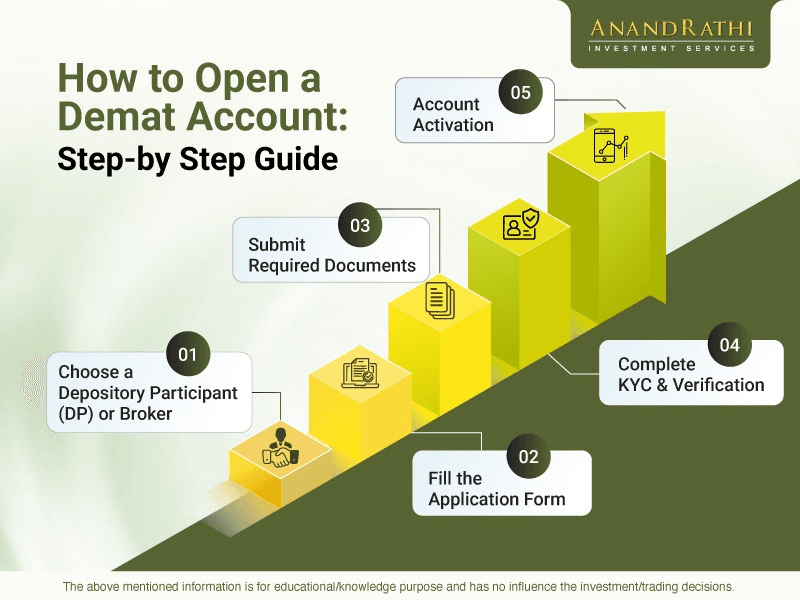
image.png

Step 1 - Select the DP or Broking Platform 

The first step is to compare the existing depository participants (DPs), Brokers, or financial institutions that allow you to invest in the market. Scan their features, offerings, and charges before opening a Demat account with them. 

Step 2 - Fill In The Basic Details 

As you visit their website or download the app, they will ask you to fill out an application form. This is necessary to create a Demat account. Fill in basic details, including address proof, income proof, PAN card, Bank details, personal details, and nomination details. 

At this point, you may also have to add the nominee's details (whom you want to add as a nominee, in your absence).    

At the same stage, the broking platform may ask you to link your bank account for seamless transfers. Enter your bank details, IFSC code, account number, account type, branch name, and similar others. 

Some brokers may also ask whether your Aadhar or PAN Card is linked to your Bank account. 

Step 4 - Upload Your Documents 

Next, upload the requested documents (detailed list below) on the portal, such as Aadhar card, PAN Card, passport-size photo, PoI, PoA, etc. 

Step 5 - Online Verification 

To prove your identity as a human, the assigned agent may ask you to record a video. Don't worry, all this happens online (digitally). Just read out (your name, PAN Card, Aadhar card, and similar details) in front of the online agent.

Step 6 - Complete e-KYC 

By this time, you may have filled out the application form. However, it is still incomplete without e-KYC verification. With the digital signing option using an Aadhar-linked number, you can complete the Demat A/c opening process. 

This quick, paperless, and digital way makes it easy to submit the application form. 

Step 7 - Submit The Application Form

The last step to open your Demat account is to read the Terms & Conditions and submit the form. Once verified and approved, the applicant will receive their account details (account number and Login details) to start investing in the market. 

By following these simple steps, you can open a Demat account without any confusion. 

Documents Required To Open a Demat Account

Most DPs and brokers will ask for the following list of documents required to open a Demat account. It includes;

  1. PAN Card
  2. Aadhar Card
  3. Proof of Identity (PAN Card or Aadhar Card works)
  • For NRIs, a Portfolio Investment Scheme (PIS) letter from the RBI.
  • For Companies, a Certificate of Incorporation, Articles of Association (AoA), and Memorandum of Association (MoA) are a must.


  • Proof of Address (PoA) - Any of the following will work.
    • Utility bills (like electricity or water bills)
    • Ration card
    • Pan card
    • Voter ID
    • Driver's license
    • Aadhar card
    • National Population Register (NPR) letter, etc. 


  • Income proof
    • Last 6 months' bank account statement
    • Current Salary Slips/ Form 16
    • Cancelled cheque or Passbook for bank account proof.
    • ITR Acknowledgement Copy
    • Demat holdings statement (if you have any existing Demat AC)
    • Net-worth Certificate copy.


(Note: These are basic documents common among all DPs as per SEBI guidelines. There can be additions or exclusions as well, depending on the broker.)

What Are The Charges To Create A Demat Account?

Often, creating a Demat account comes with certain charges. Even though the AMC (Account Maintenance Charges) comes with zero cost for the first year, expenses do occur later. For instance;


Charge TypeWhat It MeansTypical Cost
Account Opening FeeOne-time charge when you open the account₹0 to ₹500 (Many brokers offer ₹0)
Annual Maintenance Charges (AMC)Yearly fee to maintain your Demat A/c.₹0 to ₹850/year (some brokers waive this for 1st year)
Transaction ChargesFee for buying/selling shares during trade execution, clearance, and settlement. ₹10 to ₹25 per transaction (only when selling/delivery)

Dematerialisation charges 


For converting physical share certificates into digital form.₹150 to ₹400 per share certificate

(NoteWhen opening a Demat A/c, do compare the fees/charges applicable before going with any broker.)

Conclusion

Opening a Demat account is necessary to participate in the market. Regardless of the broking platform, a Dematerialisation account is the first thing required to be filled out.  With these 7 simple steps, you can open your account hassle-free and start investing in the market. Fill in the basic details, upload the documents required to open a demat account, complete the online verification, e-KYC, and there you have your account ready. 

Before choosing any broker, conduct research on fees, charges, and the interface offered. With the right decision and selection, take your first step towards investing!


Frequently Asked Questions

What is the difference between a Trading account and a Demat account?

The basic difference between a Demat account and a trading account lies in the utility of each. While a former is used for storing the securities digitally, the trading account enables you to buy and sell equity shares in the market. 
 

How long does it take to open a Demat account?

According to the SEBI guidelines, the DP must process the Demat A/C opening request within 7 days. But nowadays, with many brokers, you can expect to get your Demat A/c ready within 24 hours.  

Can I open a Demat Account online?

Yes, you can open your Demat account online by following the mentioned steps. You only need to fill out the application form (on the portal), submit the requested documents, complete e-verification, and you're good to go. 

Are there any hidden fees on opening a Demat Account?

It varies for multiple brokers. For instance, in the initial year, there could be no AMC charges, but the following year, they might be included. Likewise, for orders executed, there can be transaction fees like ₹10 to ₹25 per transaction (only when selling/delivering). 
 

What if I open a Demat account and then stop using it?

Opening a Demat A/c and not using it (or placing any trade) for 12 months can make it "Dormant." In short, they get frozen for a certain period unless voluntarily closed. 
 

How can minors create a Demat account in India?

A minor can open a Demat account by having a guardian appointed. It must be operated by the latter unless the minor turns major. This guardian can be the father, in the absence of the mother. In case both are absent, the court will appoint one. 
 

How can Non-Resident Indians (NRIs) open a Demat account in India?

If you are an NRI (Non-Resident Indian), you can easily create a Demat account by following these steps:

  • Open a bank account - 
      NRE for fully repatriable investments 
      NRO for income earned in India, with limited repatriability.
  • Obtain RBI Approval under the PIS (Portfolio Investment Scheme) if you are buying shares.
  • Open a Demat & Trading Account with a SEBI-registered broker.
  • Route All Transactions via PIS Account.

If the NRI becomes a resident of India, the Demat account must be converted to its resident status. Also, there is no need for PIS for applying to IPOs. 
 

Can I open more than one Demat account?

Yes. You can create more than one Demat account with the same DP (with the same name) or with another DP. However, the investor must comply with the KYC norms when opening a Demat A/c (more than one). 
 

Which Demat account should I create?

Depending on an individual's status, there are different types of Demat accounts available. For instance,

  • Regular Demat account - For Resident Indians
  • Repatriable Demat A/c (NRE) and Non-Repatriable Account (NRO) - For NRIs
  • Basic Services Demat Account (BSDA) - For small investors with a portfolio value of up to ₹2 lakhs.
  • Corporate Demat A/c - For institutions and corporates. 
     

How can I check the status of my Demat account application?

You can view the status of your Demat A/C form on the broker's portal/application. Alternatively, the applicant can track the status via the NSDL or CDSL website. Enter your PAN card or application ID and view the status. 
 

Do I have to keep a minimum balance of securities in a Demat account?

No, there is no need to keep any minimum balance in the Demat A/c. 
 

Disclaimer

This is for educational/information purposes only. The general topic and information do not aim to influence the investment/trading decisions of any investors.

Download TradeMobi App

Real-Time Market Data
Advanced Trading Tools
Expert-Backed Research
Google Play
App Store
TradeMobi

Popular on Anand Rathi

Explore Sitemap

Anand Rathi Share and Stock Brokers Ltd.
SEBI Registration No.: INZ000170832 (BSE-949 | NSE-06769 | MSEI-1014 | MCX-56185 | NCDEX-1252), CDSL & NSDL: IN-DP-437-2019. *Research Analyst - INH000000834. PMS: INP000000282 is Registered under "Anand Rathi Advisors Limited" | MBD-INM000010478 is Registered under "Anand Rathi Advisors Limited"| NBFC is Registered under "Anand Rathi Global Finance Limited" Regn. No.: B-13.01682 | Insurance is Registered under "Anand Rathi Insurance Brokers Ltd." License No. 175. Insurance Corporate Agent: CA1048 (This registration shall be valid from 04-Jun-2025 to 03-Jun-2028).

Anand Rathi International Ventures (IFSC) Private Limited.
SEBI Registration No.: INZ000292939 (INDIA INX Member Code: TM - 5064 | NSE IX Member Code: TM -10048, IIBX Member Code: TM – 2011), IIDI DP ID 350071 AND Registration No.: IFSCA/DP/2022-23/007, IFSCA/CMI/Distributor/2023-24/0002. CIN No.: U65999GJ2016PTC094915. For any complaints email at Ifscgrievance@rathi.com. Regulator: International Financial Services Centres Authority (IFSCA)- https://www.ifsca.gov.in/

Disclaimer:

Equity: Investment in securities market are subject to market risks, read all the related documents carefully before investing.

The securities are quoted as an example and not as a recommendation.

Mutual Funds: Mutual Fund investments are subject to market risks, read all scheme related documents carefully before Investing. AMFI-Registered Mutual Fund Distributor: ARN-4478 (Initial Registration 4th Feb, 2003 & Valid From 2nd April, 2025 - 1st April, 2028) : Anand Rathi Share and Stock Brokers Ltd. | ARN-111569: Anand Rathi Wealth Limited | ARN-100284: AR Digital Wealth Private Limited.

IPO: Opening of account will not guarantee allotment of shares in IPO. Investors are requested to do their own due diligence before investing in any IPO.

*Third Party products: All third-party products like PMS, Mutual Funds, Fixed Income Products, IBS, Bonds, AIFs are not Exchange traded product and "ARSSBL" is just acting as distributor. All disputes with respect to the distribution activity, would not have access to Exchange investor redressal forum or Arbitration mechanism.

MTF: MTF is subject to the provisions of SEBI Cir. CIR/MRD/DP/54/2017 dt June 13, 2017 & terms and conditions mentioned in rights and obligations statement issued by the ARSSBL

Investment Baskets: Baskets are not Exchange traded product, all disputes with respect to this activity, would not have access to Exchange investor redressal forum or Arbitration mechanism.

Research Analyst: The views expressed in this website accurately reflect the personal views of the analyst(s) about the subject securities or issuers and no part of the compensation of the research analyst(s) was, is, or will be directly or indirectly related to the specific recommendations or views expressed by the research analyst(s). The advertisment are bound by stringent internal regulations and also legal and statutory requirements of the Securities and Exchange Board of India (hereinafter "SEBI").

Certification: Registration granted by SEBI and certification from NISM is in no way a guarantee of performance of the intermediary or provides any assurance of returns to investors.

*Award Winning Research: Anand Rathi Share and Stock Brokers Limited (Research Analyst) was awarded as "Best Equity Advisor" at World BFSI Congress & Awards 2022

*Client Data: Client data shown on this website is as on 31st March 2025

Trading View: Anand Rathi has partnered with TradingView for its charting technology. A global platform offering heatmaps, STOCK SCREENERS and market data.

By submitting this form, I hereby provide my explicit consent to be contacted by Anand Rathi Group and its associate companies via phone call, SMS, email, or WhatsApp for information related to products and services, even if I am registered on DND.

Attention Investors:

  • For all communication related to vulnerability reporting, security alerts, or any other suspicious activity related to cyber security, contact priyanksheth@rathi.com/+91-22-62811514"
  • For any complaints email at grievance@rathi.com, For DP related queries/complaints email at dp@rathi.com
  • For any Mutual Fund-related complaints, please email customersupport@rathi.com.
  • For further escalation, you may contact mf@rathi.com.
  • Filing of complaints on SCORES – Easy & quick a. Register on SCORES portal b. Mandatory details for filing complaints on SCORES: I. Name, PAN, Address, Mobile Number, Email ID c. Benefits: I. Effective communication ii. Speedy redressal of the grievances.
  • Stock Brokers can accept securities as margin from clients only by way of pledge in the depository system w.e.f. September 1, 2020.
  • Update your mobile number & email Id with your stock broker/depository participant and receive OTP directly from depository on your email id and/or mobile number to create pledge.
  • Pay 20% upfront margin of the transaction value to trade in cash market segment.
  • Investors may please refer to the Exchange's Frequently Asked Questions (FAQs) issued vide circular reference NSE/INSP/45191 dated July 31, 2020 and NSE/INSP/45534 and BSE vide notice no. 20200731-7 dated July 31, 2020 and 20200831-45 dated August 31, 2020 dated August 31, 2020 and other guidelines issued from time to time in this regard
  • Check your Securities /MF/ Bonds in the consolidated account statement issued by NSDL/CDSL every month.
Prevent Unauthorized Transactions in your demat account → Update your Mobile Number with your Depository Participant. Receive alerts on your Registered Mobile for all debit and other important transactions in your demat account directly from CDSL.No need to issue cheques by investors while subscribing to IPO. Just write the bank account number and sign in the application form to authorise your bank to make payment in case of allotment. No worries for refund as the money remains in investor's account.KYC is one time exercise while dealing in securities markets - once KYC is done through a SEBI registered intermediary (broker, DP, Mutual Fund etc.), you need not undergo the same process again when you approach another intermediary.Prevent Unauthorized Transactions in your demat account → Update your Mobile Number with your Depository Participant. Receive alerts on your Registered Mobile for all debit and other important transactions in your demat account directly from CDSL.No need to issue cheques by investors while subscribing to IPO. Just write the bank account number and sign in the application form to authorise your bank to make payment in case of allotment. No worries for refund as the money remains in investor's account.KYC is one time exercise while dealing in securities markets - once KYC is done through a SEBI registered intermediary (broker, DP, Mutual Fund etc.), you need not undergo the same process again when you approach another intermediary.