
Introduction
If you are planning to invest in the stock market, one of the first things you will hear is, "Open a Demat account." And honestly, without it, investing in the stock market in India is almost impossible today.
In today's time, you cannot buy or sell shares in physical paper form like in earlier days. Everything is digital. So to hold those shares in electronic format, you need a Demat account.
In this blog, we will understand the concept of a Demat account, how the process of demat account works after you open it, and also the complete Demat account opening process step by step.
So, if you are a beginner, don't worry. We'll keep it simple and clear.
Keep Scrolling!
What Is Demat Account & Why Was Introduced?
First, let's understand the concept of Demat Account.
Demat means "Dematerialization." It simply means converting physical shares into electronic form. Earlier, when buying shares, investors/traders used to get physical share certificates.
Now, imagine handling papers worth lakhs. The risk is high that they could be lost, stolen, damaged, or even forged.
To solve these problems, the Demat system was introduced in India in 1996 under the Depositories Act of 1996. As a result of this, instead of papers, your shares are held (or stored) electronically in a Demat account. Just like your money is stored in a bank account, your investments are stored in this account.
Since 1996, an average of 5928 Demat accounts have been opened every day.
Key Participants in the Demat Account Process
Let's now learn who is involved in the Demat Account opening process.
| Stakeholder | Role in the Demat Account Process |
| Investor (You) | Opens the demat account, buys and sells securities, and holds investments in electronic form. |
| Depository (NSDL/CDSL) | Stores securities in electronic format and maintains ownership records securely. |
| Depository Participant (DP) |
|
| Stock Exchange (NSE/BSE) | Provides the platform where securities are bought and sold. |
| Clearing Corporation | Ensures smooth settlement of trades by transferring securities and funds between parties. |
| Bank | Handles fund transfers for buying and selling transactions linked to the demat account. |
| SEBI | Regulates and monitors the entire system to protect investors and ensure fair practices. |
How Does the Process of Demat Account Work?
Before understanding the process of demat account, learn who is involved in this process.
Technically, there are mainly three parties involved:
- Depository (like NSDL or CDSL)
- Depository Participant (DP – your broker or bank)
- You (the investor)
In simple terms, think of it as;
- Depository (like NSDL / CSDL), like a Bank who holds your shares
- DP = Your broker
- You = Account holder
When you buy shares:
- You place a buy order through your trading account.
- The order is routed to the stock exchange and matched with a seller.
- Once the trade is confirmed, the Clearing Corporation processes the settlement.
- Your Depository Participant (DP) receives confirmation of the transaction.
- The Depository (NSDL/CDSL) then credits the shares to your demat account electronically.
- You can now see those shares in your holdings.
When you sell shares from Demat Ac:
- You place a sell order through your trading account.
- After the trade is executed, your DP instructs the Depository to debit the shares from your demat account.
- The shares are transferred to the buyer through the settlement process.
- Once the settlement is complete, money is credited to your linked bank account.
Also, if a company announces:
- Dividend → It directly comes to your bank account.
- Bonus shares → Automatically credited to demat.
- Stock split → Updated automatically in your holdings.
Demat Account Opening Process: Step-by-Step Guide
Now, coming to the most practical part — the demat account opening process.
And it's honestly much simpler than people think – now that it's done online.
Here's how it works:
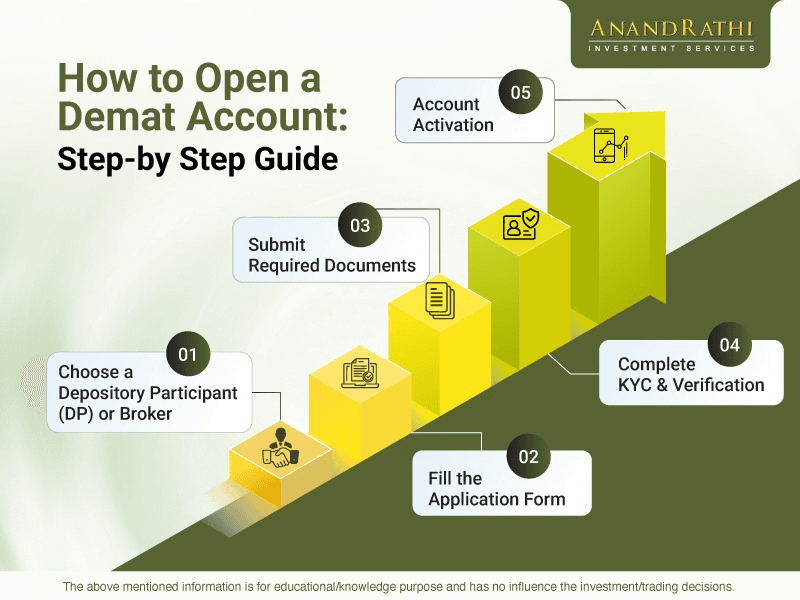
Step 1: Choose a Depository Participant (DP)
You need to open your demat account with a broker or bank. These are called Depository Participants. Choose based on brokerage charges, platform ease, and service.
Today, the demat account opening process is fully digital.
Step 2: Fill the Application Form
You will enter:
- Name
- PAN number
- Mobile number
- Email ID
- Bank details
Nowadays, everything is online. No need to physically visit the branch in most cases.
Step 3: Submit Required Documents
Generally required documents:
- PAN Card (mandatory)
- Aadhaar Card (for address & KYC)
- Bank proof (cancelled cheque or bank statement)
- Address Proof
- Income proof (if you want to trade in derivatives)
Step 4: Complete KYC & Verification
During the same time, you may need to do:
- Video KYC
- OTP verification
- E-sign using Aadhaar
This is part of the compliance process.
Step 5: Account Activation
Once verified, you receive:
- Client ID
- Demat number (BO ID)
The demat account opening process usually takes 24–48 hours, depending on the broker. And that's it. Your demat account is now ready to buy and sell securities.
Charges Involved in Opening a Demat Account
Many beginners think opening a demat account is free. Sometimes yes, sometimes no. Let's understand this properly.
Here are common charges:
1. Account Opening Charges - Some brokers charge zero. Some may charge a small fee (after freebie period ends).
2. Annual Maintenance Charges (AMC) - This is a yearly fee to maintain your demat account. It can vary from ₹300 to ₹800, or more, depending on the broker.
3. Transaction Charges / DP Charges - Whenever you sell shares, a small fee is charged for debiting securities from your demat account.
4. Brokerage Charges - Also known as STT - Securities Transaction Tax, is charged when you buy or sell shares. It is related to a trading account, but connected with overall investing.
Always check the full charge structure before choosing a broker. Small differences can matter in the long run.
(Bonus Fact - In the recent 2026 Budget, the STT on futures trades was raised from 0.02 % to 0.05 %, and the STT on options premium and exercise was increased to 0.15 %, making derivatives trading a bit more expensive for active traders.)
Why Opening a Demat Account is Important for Investors?
Now the question is, why is it so important?
1st → If you want to invest in the stock market in India, you will need a demat account. There is no alternative.
2nd → It is safe in this digital world, as there is nil risk of losing physical certificates.
3rd → It is convenient. You can check your holdings anytime through the app or online trading platform.
4th → Faster settlement. Currently settlement cycle is T+1, which means shares get credited on the next working day or less.
5th → Investments can be Easily Tracked, along with profit, loss, and corporate actions, all in one place.
Conclusion
The demat account opening process is simple, online, and takes very little time if the documents are ready.
If you are serious about starting your investment journey, opening a demat account is the first practical step. But this initiative must start with understanding the basics, comparing brokers, and reviewing charges.
And lastly, before opening the demat account, do research properly or consult a financial advisor (or demat account provider) to get more clarity on the process.