
Introduction: Why Does the Middle East News Matter to India?
It's not even been a week, and the geopolitical tensions arising from the Iran war news are intense. Since the news broke on television, the first reaction was from those concentrated in the Middle East and those partnering with these nations.
And what really matters is the "Duration of Conflict more than the Intensity of Headlines."
But here's the real question: Does it actually put the Indian stock market at risk?
For India, the answer, for now, largely comes down to one word -”Oil.”
The real market impact is often very different from what television headlines suggest.
Stay tuned, as we understand how this crisis is actually affecting Indian equities and what investors should watch in the stock market as a result of the Middle East news.
Why Does The Middle East Matter To India?
For India, the Middle East isn't just a geopolitical region: "It's an Economic Lifeline."
Indian markets don't fall simply because of war headlines. They react to what those headlines mean for oil supply, inflation, liquidity, and foreign investor behaviour. And for India, the Middle East crisis signals potential risks for imports routed through the region.
Over 80% of India's crude oil needs are imported, and a large portion comes from or passes through this region.
At the start of this week, the Saudi Aramco refinery was attacked and later brought a halt to production, further impacting the supply zones. So when tensions rose, oil prices rose as well.
And when oil prices move, everything else starts shifting – be it inflation expectations, the rupee, government finances, fiscal deficit, corporate margins, and eventually, stock market valuations.
That's the real transmission channel where a single shock can ripple through the entire economy and financial markets.
Historical Evidence: How Indian Markets Reacted to Past Conflicts
History is a great teacher, especially when it comes to markets and geopolitics.
It's not dormant as Indian equities have faced multiple Middle East and global conflicts over the last two decades.
And the patterns are surprisingly consistent. For example;
Pattern #1 - Equity Corrections Were Contained: From the 2003 Iraq War to the 2011 Arab Spring and even the 2022 Russia-Ukraine conflict, median drawdowns were modest. Markets fell, yes, but they bounced back relatively in a steady manner.
Pattern #2 - Volatility Spikes, Then Stabilises: At such times, realised volatility typically jumps at the onset of conflict but tends to mean-revert once uncertainty is priced in.
Pattern #3 - Front-Loaded Market Stress: The worst of the sell-offs usually happens in the first few days or weeks. If the conflict is short, the market often recovers before long-term macro effects set in.
Pattern #4 - Macro Context Matters More Than War Alone: The 2011 market correction is a perfect example of how the economy was driven more by inflation and fiscal issues than by Middle East tensions.
But this time, the impact of the Middle East war is different from past patterns!
How are US-Iran-Israel Tensions Are Affecting Indian Markets Now?
The recent escalation involving the US, Israel, and Iran has already left its footprints on Indian markets.
And here's how Middle East tensions have affected the Indian stock markets until now:
Impact #1: Oil - Still the Main Transmission Channel
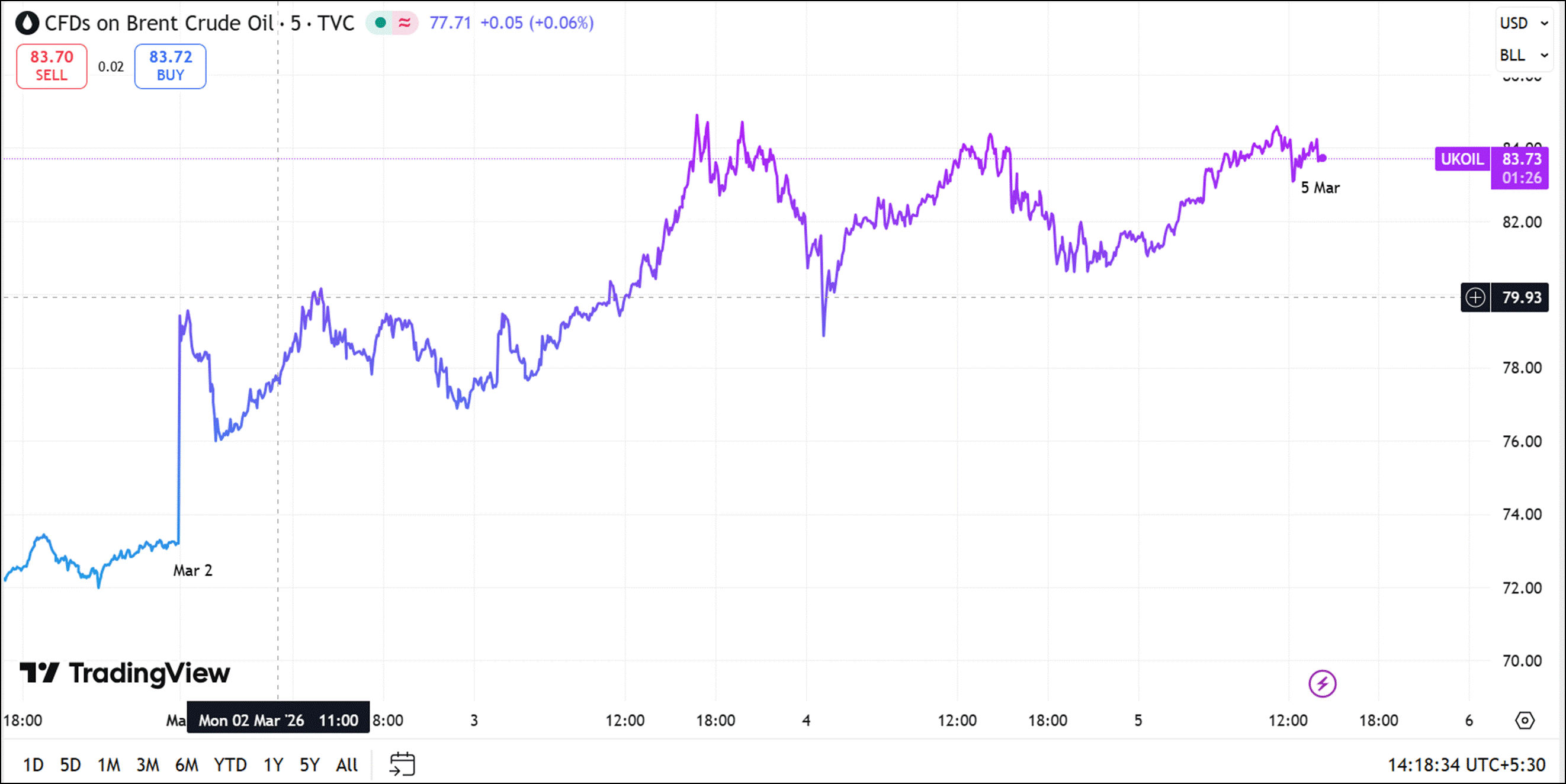
Between 2nd and 4th March 2026, Crude oil prices jumped by ~12%, climbing above $80 per barrel as the conflict intensified, with fears of supply disruption through critical sea routes.
India imports over 85% of its oil, and with the restrictions imposed on the Strait of Hormuz, almost 38% of our oil imports are affected as well. In other words, India’s GDP will also suffer by 0.5 per cent if this continues.
These higher crude prices have a greater impact on the import bill, which can widen the current account deficit and put inflationary pressure on fuel and transportation costs.
Source: TradingView
Not to miss: Estimates suggest that "Every $10↑ in crude could widen the current account deficit by ~0.35–0.40% of GDP and raise inflation by ~20–30 basis points."
Impact #2: Equity Corrections – Immediate Losses, But Usually Contained
This same week, Indian stock markets witnessed a significant sell‑off, with the Sensex sliding over 1,000 -1,800+ points and the Nifty falling 400+ points in a single session.
While this erased large amounts of market value, the market feels such corrections are often short‑lived, especially when the conflict is brief. But how long will macro conditions remain stable is also a question.
Impact #3: For Foreign Portfolio Investors, Liquidity Still Matters the Most
Foreign investors have turned cautious again amid the Iran-Israel war, and Indian stock markets have soon felt its effects.
Alone, FIIs sold about ₹11,000 crore of Indian stocks over two sessions, reflecting a shift to risk‑off sentiment. This selling pressure indicates their concern over global liquidity and rising risk aversion rather than the conflict alone.
With crude oil imports and barrel price rise, FIIs may see it as a short-term risk management and liquidity cycles rather than a fundamental loss of confidence in the Indian economy.
Afterall, protecting and preserving capital flows matter more in such market conditions.
Impact #4: Volatility Spikes, Then Calms
With any geopolitical news, volatility is meant to spike, but with settling chaos, it calms as well.
As of now, the market's fear has caused the India VIX to surge sharply to more than 20% to around ~21, a level not seen since mid‑2025.
A high VIX suggests investors expect larger price swings ahead, typically triggered by fear of rising oil, currency weakness, and capital outflows.
Likewise, year‑to‑date volatility also rose over 119%, indicating growing uncertainty.
If the Iran-Israel war continues for a long time, the volatility may stay in; however, the recovery could be significantly steady.
Impact #5: Rupee Weakens → More Costly Imports
The Indian rupee hit record lows near ₹92+ to the US dollar amid rising oil and risk‑off flows.
A weaker rupee makes imports, especially crude oil, making it more expensive, worsening the trade deficit and pressuring inflation. Also, investors can see a rise in domestic fuel prices and a similar effect in production costs for energy‑intensive industries.
And not just crude oil imports, but rupee inflation can feed higher import costs for other commodities as well – A Macro-Level Effect On All Industries.
Impact #6: Instability in Gold Prices, But Oil Spikes Continue
Gold has historically benefited during geopolitical tensions or wars, as investors move toward safe-haven assets to protect their capital.
However, during the recent Iran–Israel tensions, the pattern looked slightly different. At the start of the week, some investors began booking profits in gold commodity, especially as the US dollar strengthened, which typically puts pressure on gold prices.
At the same time, crude oil prices reacted more sharply due to fears of supply disruption in the Middle East. While these oil spikes can be sudden, they are often temporary unless the conflict begins to disrupt global energy supply chains.
Impact #7 - Possible Interest Rate Halts
The weightage of Fuel in CPI (Consumer Price Index) is 4.4% and around 7.95% in WPI (Wholesale Price Index). Considering the oil prices have increased by 12% in the last three days, the CPI/WPI would increase of 50-95 bps.
If this happens, the inflation rate will also see a surge and likewise the possible rate cuts assumed by the central bank may not occur soon.
Sectors Likely to Benefit or Suffer from Middle East Geopolitical Risk
The current Middle East tensions are a macro-level shock – meaning the stock market impact is not limited to one industry. Rising crude oil prices, currency volatility, and global risk sentiment have affected multiple sectors at the same time.
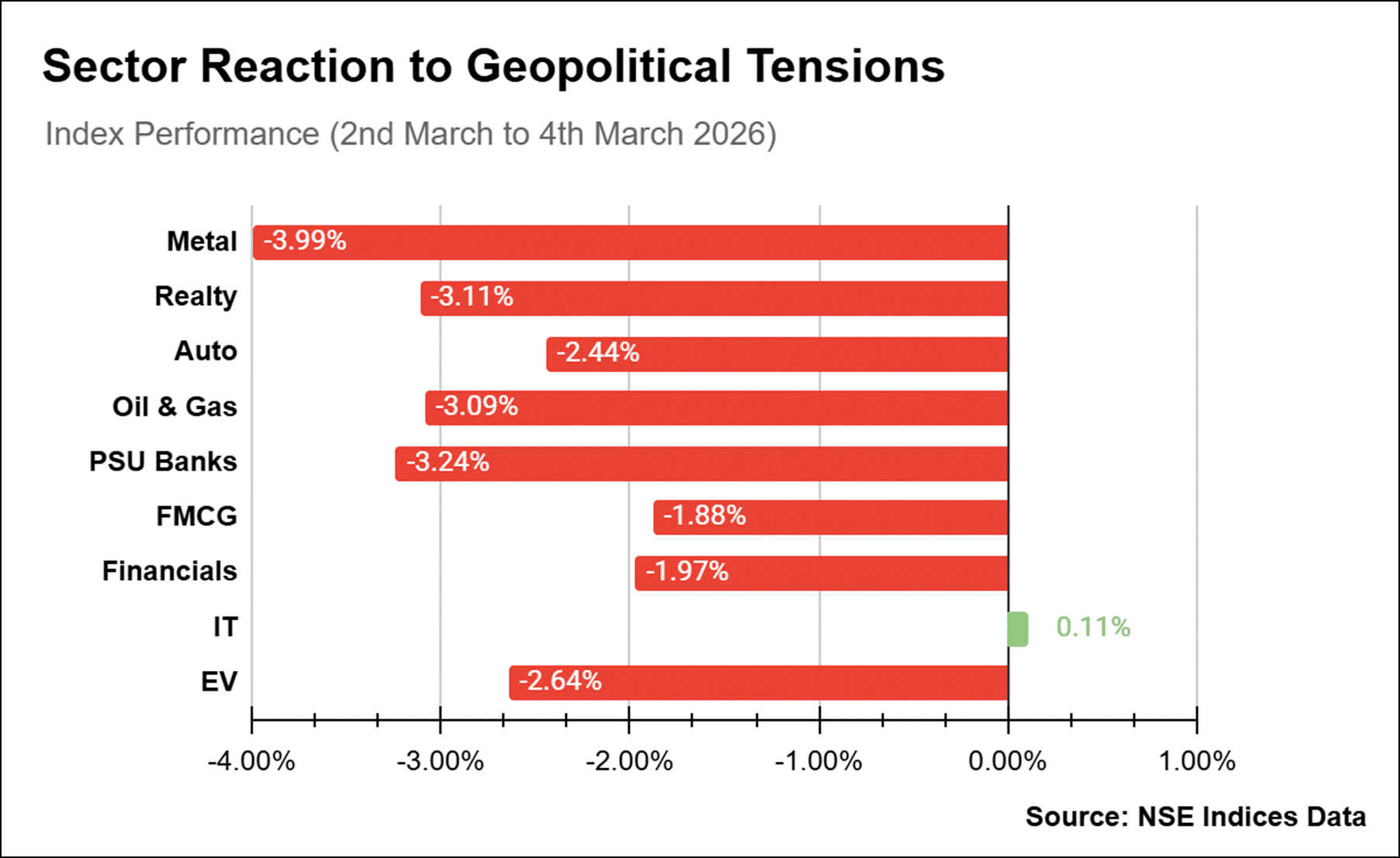
But the IT sector was muted by the impact of the Iran-Israel war. Likewise, despite EV being a potential prospect in crude oil prices, in the last few days, this industry is driven majorly by sentiments.
Mostly, IT services remain relatively insulated from Middle East tensions, but the sector has its own struggles in currently navigating AI-driven shifts and evolving global tech spending.
The Next Step: What Indian Investors Should Track During a Global Conflict?
When global conflicts dominate the headlines, markets often react instantly.
But history suggests something important: "Wars Rarely Change The Long-Term Direction Of Markets On Their Own. What Matters Far More Is The Health Of The Domestic Economy."
Take 2011 as an example. The market correction did trigger, but the real reason was macro weakness, not the conflict itself.
For investors today, one key factor to track is the "Duration of the Middle East conflict."
If Iran-Israel tensions remain short-lived, markets could absorb the shock quickly, and volatility could fade. But if the conflict begins to disrupt global energy supply or trade routes for a prolonged period, the ripple effects can spread widely through oil prices, inflation, fiscal deficit, currency stability, and corporate earnings as well.