Introduction: Why Gold Prices Are Rising Again in 2026?
Gold is once again dominating headlines, touching new highs, attracting investor attention, and becoming a key discussion point across global markets. But this rise didn't happen suddenly.
Since 2022, after the Russia–Ukraine conflict, gold has seen a strong comeback, encouraging countries to rethink their financial strategies amid geopolitical tensions, inflation concerns, and market uncertainty.
In fact, for the first time since 1996, foreign central banks now hold more gold than US Treasuries as a share of their international reserves — highlighting a major shift toward hard assets in global reserve management.
But gold doesn't rise randomly. Unlike equities, which react to earnings or growth expectations, gold moves mainly because of macro forces, global uncertainty, and monetary policy changes.
So the real question isn't “Is gold rising in 2026?"
If it is, then: Why is Gold Rising and Should Investors ?
Let's break down the key drivers behind gold's rally and the structural trends shaping its rise — along with the insights investors should take away today.
What Determines Gold Prices? Understanding the Basics
Before exploring the reasons behind the rally, it's important to understand how gold prices move and what determines the price of gold.
Gold typically gains strength when:
- Economic uncertainty increases
- Inflation expectations rise
- Interest rates stabilize or fall
- Investors seek safer assets
Because gold does not generate income like stocks or bonds, its value comes from being a store of wealth and financial stability.
But not always, there are other reasons as well.
Reason #5: Central Banks Are Buying Gold Aggressively
One of the talked drivers highlighted in recent market coverage is "Record Central Bank Accumulation."
Also, they have increasingly reduced reliance on the US dollar and turned toward gold as a non-sovereign reserve asset that helps protect against currency devaluation and strengthens monetary stability.
Since 2022, Central banks, particularly in BRICS nations, have bought record amounts of gold (average 1000 tonnes from 2022-2025). And to diversify away from the US dollar, 2025 also witnessed sustained high-volume purchases & increased holdings by countries like China, Russia, and India.
Community market discussions also point to sustained official buying as a key reason gold has maintained upward momentum despite volatility.
Reason #4: Currency Weakness and Dollar Diversification
Another important reason why gold is rising in 2026 is the gradual shift away from heavy dependence on the US dollar in global reserves, often referred to as "De-Dollarisation."
Many nations are now diversifying their reserve assets to reduce exposure to a single currency–based monetary system. In this transit, gold plays a crucial role since this non-sovereign asset that does not depend on the economic stability or policies of any one country.
The growing shift toward gold reflects a broader move from a unipolar, dollar-dominated financial system toward a more multipolar global order, where multiple currencies and hard assets share importance.
And that's where Gold allows countries to strengthen financial independence while protecting reserves from currency volatility and geopolitical risks.
As demand from central banks and global institutions increases under this diversification trend, gold prices receive sustained long-term support.
Reason #3: Hedge against Geopolitical Uncertainty
Amid rising geopolitical tensions, gold remains a safe-haven asset.
Unlike currencies or government bonds, its value does not depend on political decisions, sanctions, or monetary policies. But there is counterparty risk at times.
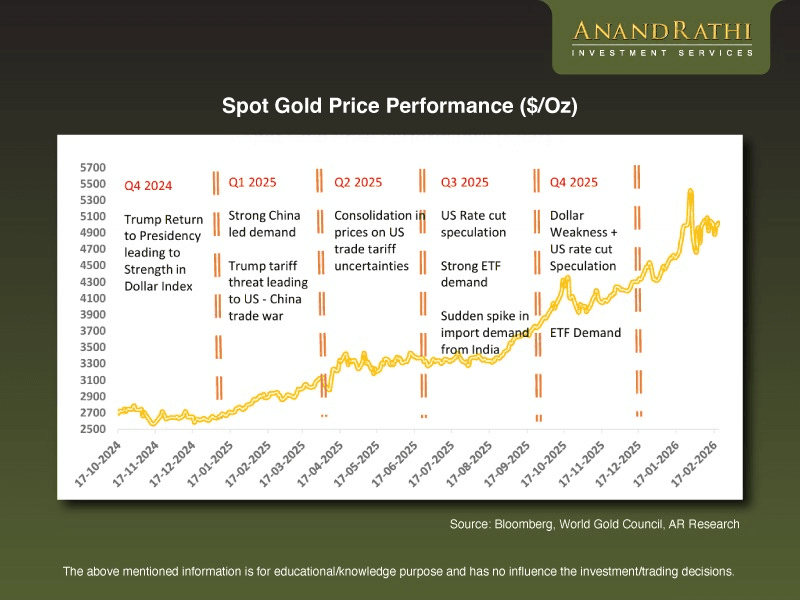
So whenever global stability is questioned, investors and central banks tend to move toward assets that are not controlled by any single country — and gold historically benefits from this shift.
Global central banks purchased over 1,000 tonnes of gold annually in recent years, one of the highest buying phases in decades, signalling growing demand for politically neutral reserve assets.
Reason #2: The Rise of Gold as a Strategic Global Reserve Asset
Under Basel III regulations, gold is classified as a Tier-1 asset, meaning it is recognised as a high-quality, liquid reserve comparable to cash and sovereign bonds.
Today, global central banks (along with the IMF) collectively hold about 17–20% of all the gold ever mined, with total reserves reaching approximately 36,520.7 metric tons as of November 2025. Most of these purchases have occurred after 2010, when central banks shifted from net sellers to consistent net buyers of gold.
This trend reflects what many analysts call a "New Gold Order — a quiet but meaningful move away from excessive dependence on the US dollar.”
Rather than a temporary market trend, it represents a strategic shift toward diversification. During which, gold increasingly acts as a stabilising anchor in a more fragmented and multipolar global financial system.
Reason #1: Investment Demand Is Expanding Beyond Jewellery
Gold demand today is no longer driven only by tradition or weddings. It is increasingly powered by investment intent. A major behavioural shift is taking place, especially in India.
According to a Deloitte India report, 86% of Indian consumers now view gold and jewellery as a preferred instrument for portfolio creation, placing it almost on par with financial assets like mutual funds and equities (87%).
At the same time, rising prices are changing how investors buy gold. Instead of heavy jewellery, investors are increasingly choosing coins, bars, ETFs, and other forms, focusing on liquidity and value rather than ornamentation.
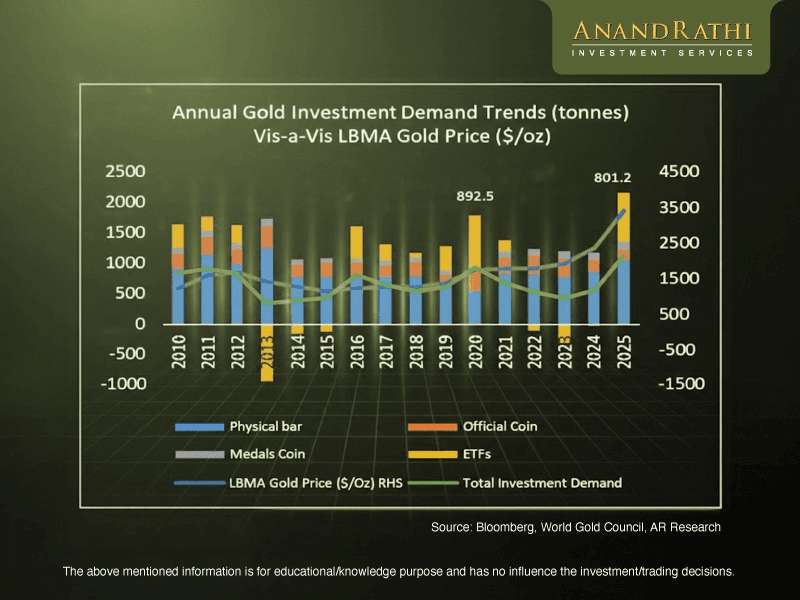
This highlights a key transformation: gold is evolving from a consumption asset to a financial asset.
Final Thoughts: What Should Investors Understand From This?
Prices naturally rise and fall, but what truly matters is understanding the reasons behind why gold (or any commodity) moves in a particular direction.
Gold's current rise reflects broader economic signals such as inflation concerns, geopolitical uncertainty, currency shifts, and changing global reserve strategies. Rather than focusing only on price movements, investors should focus on the underlying trends driving demand.