
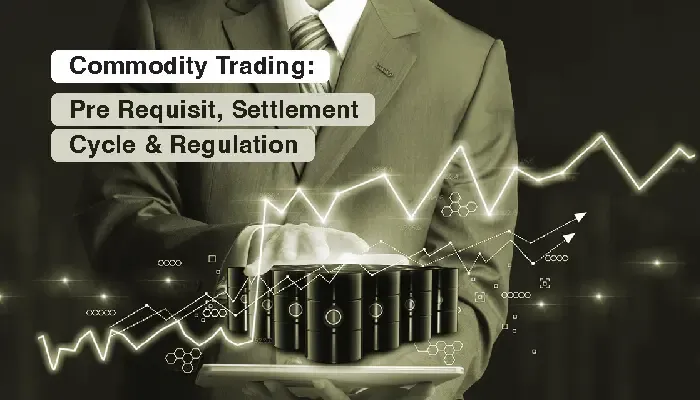
What are the prerequisites of commodity trading?
One needs to open a commodity trading account which will enable the user to trade across the registered exchanges. If a person intends to participate in deliveries, the local sales tax requirements have to be fulfilled, or they can use the C&F (Cost and Freight) agent services.
Do I need to take delivery of the commodity compulsorily every time I put a trade for it?
No, taking delivery of commodities is not compulsory, but a majority of the commodities are settled by compulsory delivery. The investor who does not wish to get into deliveries can hold his position from the first day of the contract till the specified last trade day. One has to proactively square off his positions well before the expiry of the contract. But if there is any open position at the expiry then it will be settled by delivery. (Delivery logic may differ from commodity to commodity, please check the exchange product note for the delivery logic of specific commodities).
Is there any no delivery period for commodities also as applicable in Equity trading?
Unlike equities, commodities are not dividend-yielding assets, and there is no concept of book closures, so there is no concept of a 'No Delivery' period applicable to commodities. Instead, they follow a “staggered delivery period,” which usually follows the last few working days (at least five working days required) near contract expiry.
How is commodity trading regulated in India and who regulates it?
Commodity trading in India is regulated by the Securities and Exchange Commission Board of India (SEBI). It came into effect following the merger of FMC (Forwards Market Commission) with SEBI on September 28, 2015. Later, the SEBI established the Commodity Derivatives Market Regulation Department (CDMRD) to oversee the commodity derivatives segment. Previously, commodity trading was handled by FMC set up in 1953.
Is commodity trading also available online as is for Equity & FNO trades? How safe is Online Commodity Trading?
Yes, commodity trading is also available online through the Internet akin to Equity and FNO trades. With the SEBI regulations and guidelines, investors can trade in commodities such as gold, silver, crude oil, metals, and several agricultural products.
What is the normal settlement cycle for commodity trades?
Unlike equity markets which have a common settlement day for all the scrips traded on a particular day, the commodity markets do not have a common cycle. As per the customs and traditions in the market from where the base price of the commodity is derived; the settlement dates defer for each commodity. For example, the Gold contract on MCX trades along with the COMEX Gold, so it has a contract that expires every alternate month, at the same time the Agro commodities have different settlement dates. (Please refer to the exchange websites for settlement dates of a specific commodity).
How are margin requirements, risk management, and settlements treated in commodity trading?
There are various kinds of margins in commodity markets, the total margin is the sum of the following:
- Initial Margin : The margin required to initiate the position. It is a percentage of the commodity contract lot value.
- Mark-to-Market (MTM) : The margin payable at the end of the trading day based on closing prices. If the price falls, the buyer pays, or else the seller will pay for any price rise.
- Exposure Margin : The margin required to carry the position
- Special Margin : Any special or additional margin imposed from time to time.
- Lean Period Margin : On the arrival of new crops, higher volatility may occur in commodity prices. This margin provides a shield against the uncertainty of crop arrivals.
Delivery Period Margin : Also known as Tender Period Margin, it is an additional margin collected for a short time before the delivery to reduce any settlement risks.
Typically the broker may charge the same amount of margin as specified by the exchange or more, and all clients have to maintain all the above-mentioned margins.
If there is any dispute in commodity trading, who would settle the same and how would it be settled?
All the disputes arising out of commodity trading will be settled as per the bylaws of the respective exchange where the trade was done.
Are there any taxes levied on commodity trading also?
Similar to the equity exchanges, the commodity market trading also attracts taxes. The taxes applicable on commodity trading consist of the following:
- An exchange fee is charged on every transaction
- Commodity Transaction Tax (CTT) applies to non-agricultural products (0.01% from seller’s side).
- Service tax (GST) applicable on the brokerage amount payable
- Educational cess on the service tax
- Stamp Duty on every contract note
As of now the Commodities Transaction Tax (CTT) which was proposed in the budget speech of 2008, has not been implemented, hence CTT is not applicable so far.
Which are the registered commodity exchanges in India?
There are 4 commodity exchanges that deal in commodity derivatives. A few of them include the Multi Commodity Exchange of India (MCX) and the National Commodity and Derivatives Exchange of India (NCDEX).